HexClad Has 300 Active Meta Ads. Most of Them Are Younger Than Your Last Grocery Run.
Contents

I scraped all 300 of HexClad's active Meta ads.
Across all 300 ads, the cooking video is everything you'd picture from a premium pan brand - slow searing, melting butter, the glistening steak. The more telling detail sat in the dates. The account is almost entirely new.
291 of the 300 ads - 97 percent of the account - started running in the last 90 days. Only nine ads have been alive longer than six months. A brand this size could be sitting on years of proven creative, and instead nearly the entire library was built since February.
Then I looked at how the ads themselves were made, and majority of them are running on DCO.
The entire account was built in the last three months
Here's the launch timeline, counted by the date each ad first went live:
- February 2026: 63 new ads
- March 2026: 81 new ads
- April 2026: 147 new ads
So, before February - the active library is almost empty. You could count a couple of ads from April, June and September 2025.
But the account roughly doubled its monthly output in 2026. Twice in a row, considering March and April, accounts for nearly half of everything currently running.
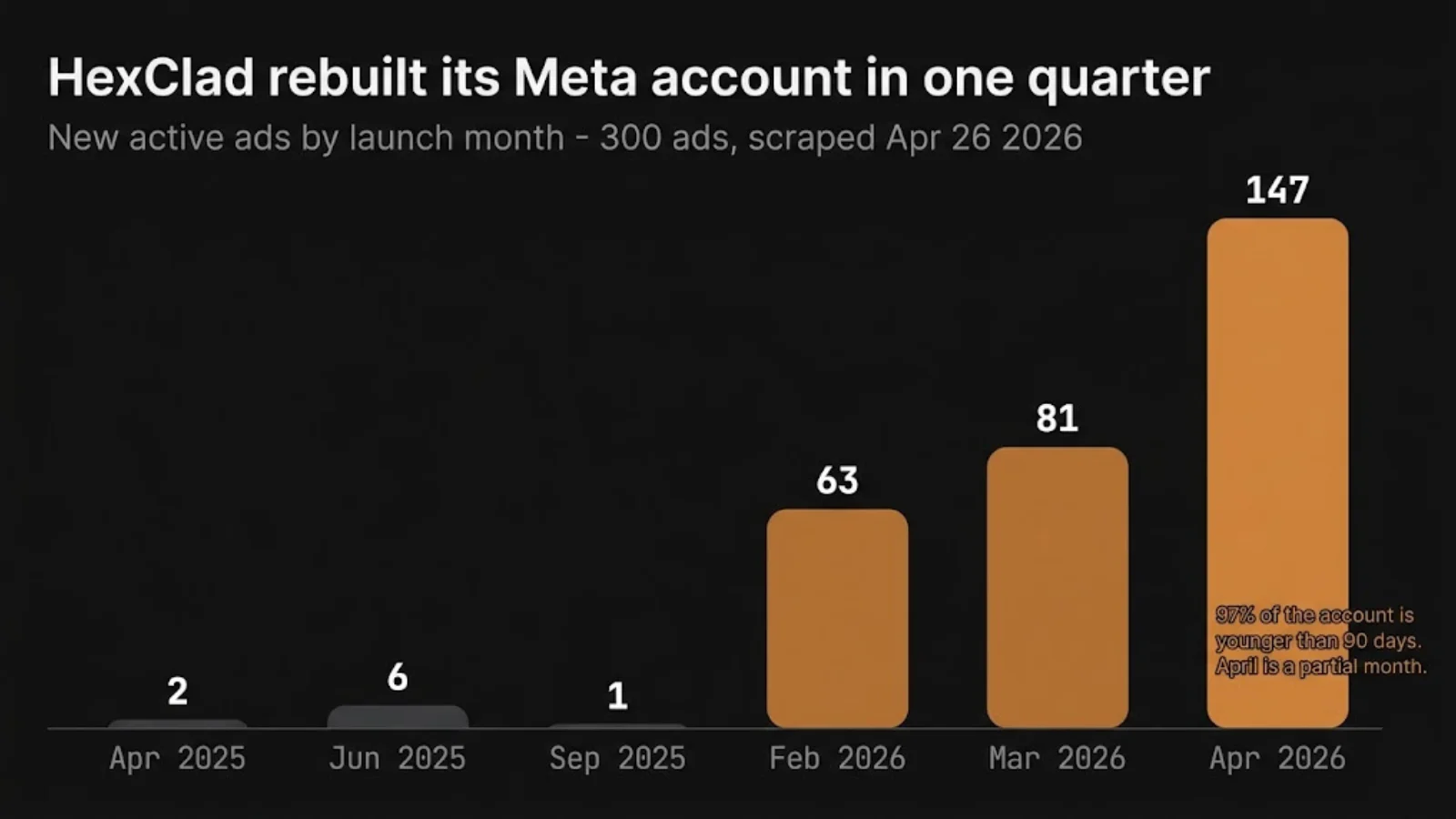
What I interpret it as is a delibrate scaling push. The old ads show that HexClad may have been running ads on Meta for a while, but they just refreshed the entire account in one quarter.
It could be seasonal, since I found a live Mother's Day sale. But events like these usually don't justify the tripling of your creative output.
Another interpretation is - a budget ramp.
Half of the "300 ads" were DCO and DPA
When I broke the account down by format, the split surprised me:
- DCO (dynamic creative): 149 ads, 50 percent
- Video: 106 ads, 35 percent
- Image: 31 ads, 10 percent
- DPA (dynamic product ads): 11 ads, 4 percent
- Carousel: 3 ads, 1 percent
Strip those placeholder ads out and HexClad has roughly 226 ads carrying real, written copy.
HexClad is using automation to cover breadth - machine volume from a catalog, hand-built effort reserved for video. It's a sensible way to run an account at this scale and just means that the number is doing some of the selling.
For comparison, when I tore down Ridge Wallet, the story was the opposite kind of efficiency. HexClad lands in a similar place by a different road.
Six of every ten written ads lean on Gordon Ramsay
Of the all the ads with real copy around 59% mention Gordon Ramsay.
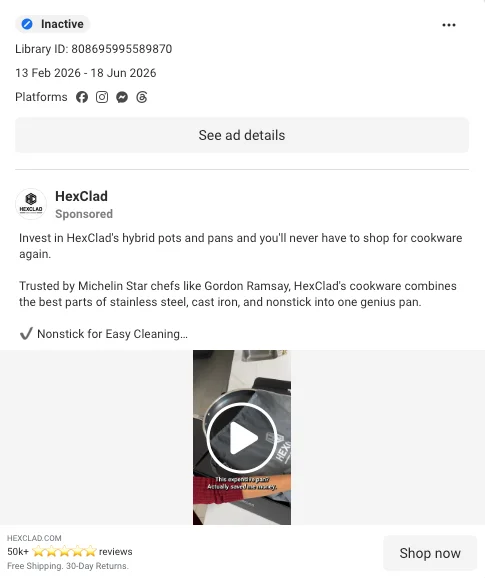
The company seems to be using him and his brand value as the single largest creative pillar in the account. There's a dedicated title that pairs him with the offer - "Gordon Ramsay's Favorite Pan - Yours Free 🔥" - and one line that gets reused word for word across at least 13 separate ads:
"There's a reason why Gordon Ramsay calls HexClad 'The best cookware on the f***ing planet.'"
On the similar playbook, after Ramsay sits a second tier - Michelin chefs.
They show up in about 13 percent of the ads.
This seems to be a masterclass in single-endorser leverage - they found the most recognizable chef on earth, he's a real investor in the company, and they're squeezing every drop out of that association.
The copy does not change but the visuals do
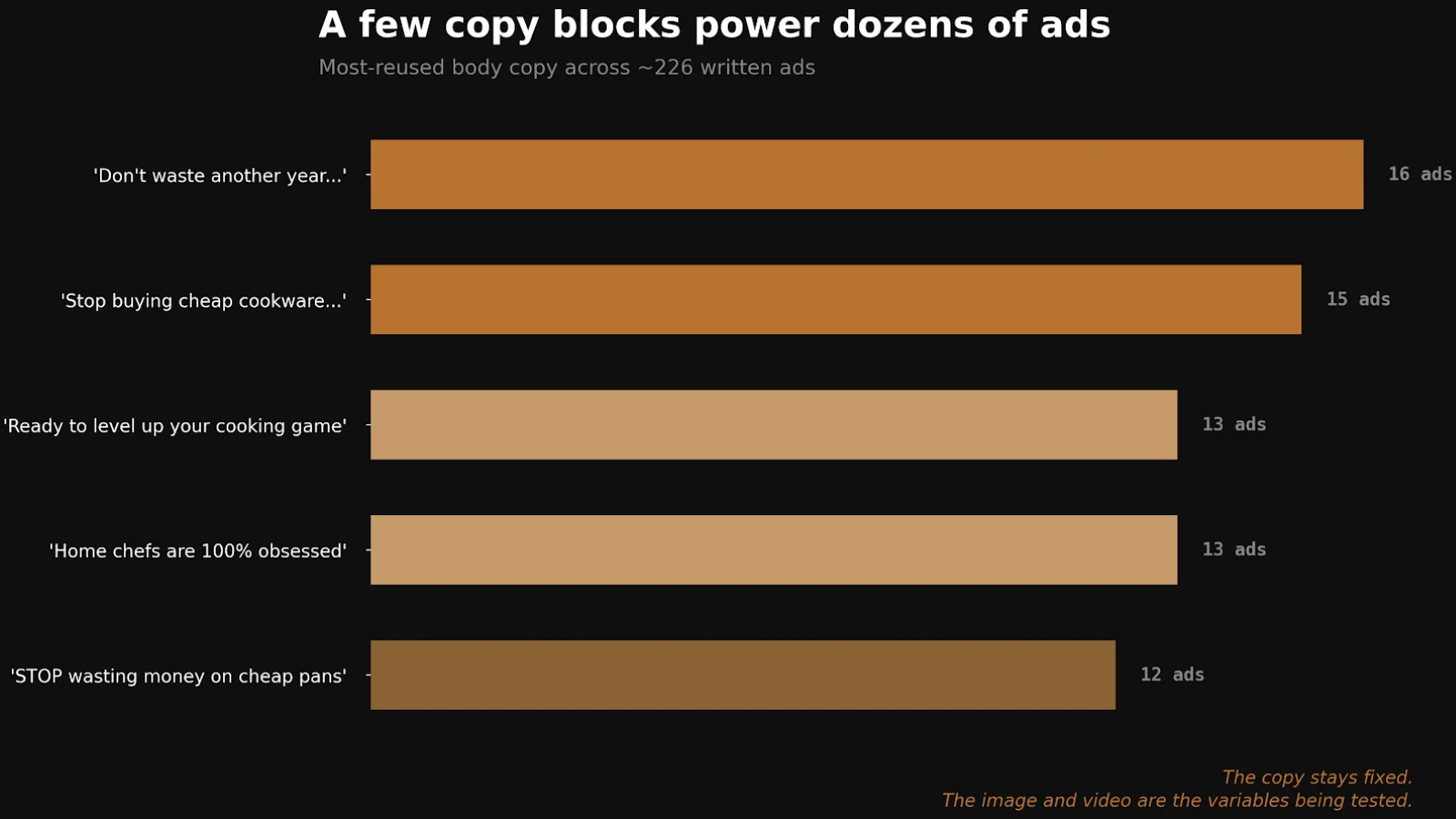
When I clustered the body copy, the same handful of openings kept repeating across dozens of different creatives. The biggest clusters:
- "Don't waste another year putting up with cheap cookware. Invest in cookware that's proven to last a lifetime." — 16 ads
- "Stop buying cheap cookware you have to replace every year!" — 15 ads
- "Ready to level up your cooking game? 🔥" — 13 ads
- "Home chefs everywhere are 100% obsessed with this cookware and here's why..." — 13 ads
- "🚫💵 STOP wasting money on cheap pans." — 12 ads
The product story underneath is just as consistent. Across the copy-bearing ads:
- 74 percent mention the hybrid technology.
- 62 percent spell out the stainless-steel-plus-cast-iron-plus-nonstick combination.
- 60 percent name the lifetime warranty.
- 50 percent (half) mention being dishwasher and oven safe.
- 35 percent feature a newer angle — "free from forever chemicals" and the nontoxic positioning.
So the same proven copy blocks get rotated across many different images and videos.
There's one more thread running through about a third of the copy worth naming. The "stop wasting money," "invest," "buy it once" framing positions HexClad against cheap cookware.
They're not selling you a better pan than a competitor, but rather - they're selling you the "end of buying pans".
I think that's the emotional core of the whole account, and the warranty and "designed for life" messaging all feed it.
One button does almost all the work
88 percent of all ads use the exact same call to action: "Shop now."
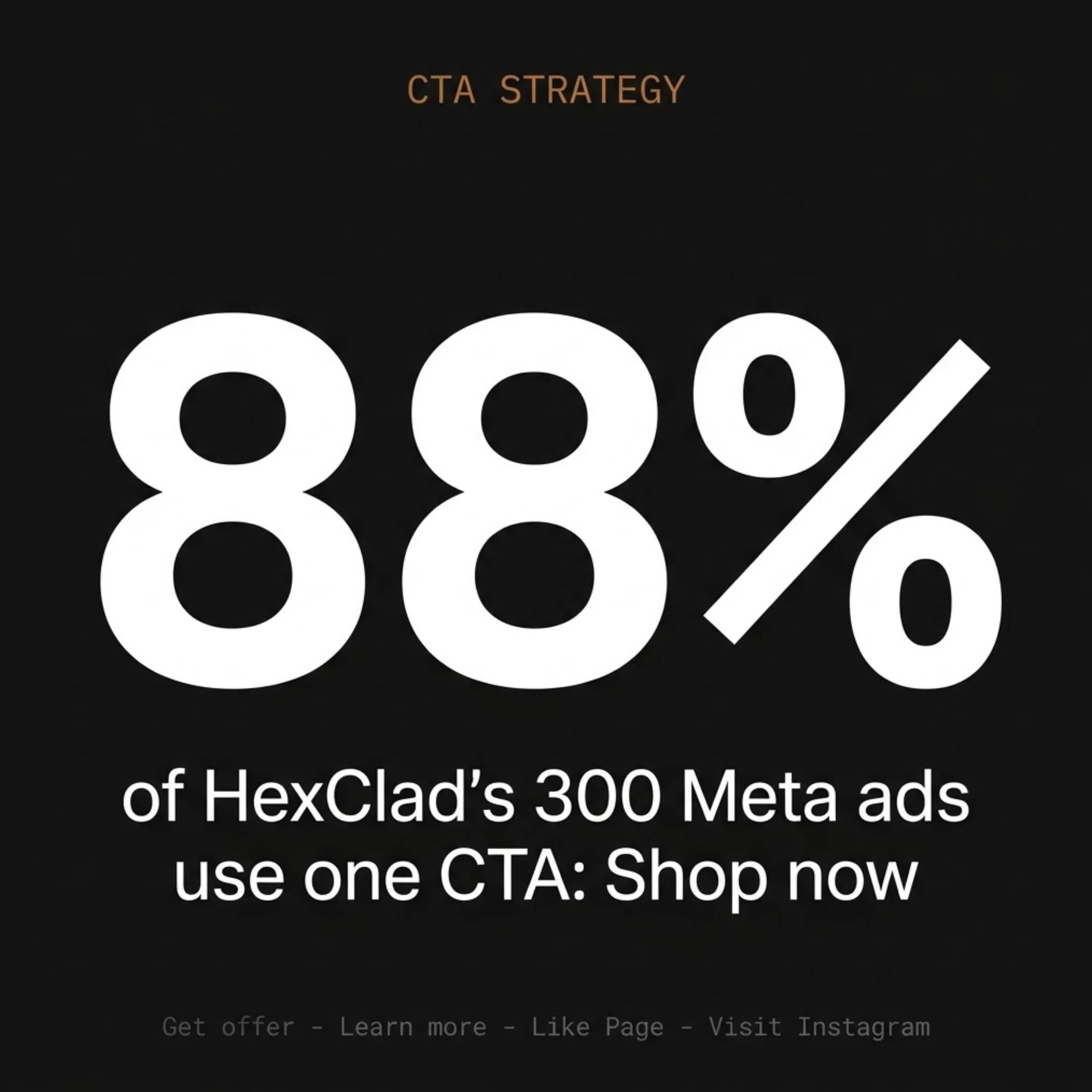
The remaining 12 percent is a thin scatter of "Get offer," "Learn more," "Like Page," and few ads pointing to "Visit Instagram profile." There's a small awareness and follower-building layer mixed in, but it's tiny.
The account is built to send people to a product page and ask for the sale.
So, for a brand running this many ads, near-zero variation on the button may be a decision (a hunch).
HexClad doesn't really discount. It gives things away.
This is where I expected to see a wall of percentages, and mostly didn't.
71 percent of the copy-bearing ads contain the word "free," but when you read what's actually free, it's overwhelmingly shipping (58 percent of ads) and the occasional free pan bundled with a set. Actual percentage-off discounts are rare. Only a handful of ads mention 30 percent off, and a small Mother's Day cluster goes up to 42 percent off.
The standard trust stack appears verbatim in a lot of ads:
"✔️ Free US Shipping ✔️ 30-Day Returns ✔️ Lifetime Warranty ✔️ 55k+ 5-Star Reviews"
That's deliberate premium protection. HexClad spends a third of its copy convincing you their cookware is worth the money and will last a lifetime. Slashing the price weekly would undercut that exact story.
Worth putting next to GORUCK: they run zero discounts on Meta; and HexClad runs almost none. Two very different brands landing on nearly the same posture, probably for the same reason - the product story can't survive constant discounting.
The social proof keeps drifting
HexClad leans on two kinds of scale at once - a customer count and a review count. Both move around inside the account.
The body copy says "over 900,000 home cooks." The title overlays say "Trusted by 1M+ home chefs."
The review count does the same thing: some ads say "50k+ 5-star reviews," newer ones say "55k+."
I wouldn't read too much into it.
Five storefronts, and one funnel that isn't even HexClad's
When I followed the "Shop now" button, the destinations split cleanly by country:
| Storefront | Ads | |---|---| | hexclad.com (US) | 118 | | hexclad.eu | 77 | | hexclad.co.uk | 26 | | hexclad.ca | 22 | | hexclad.com.au | 18 |
HexClad is running a five-country storefront strategy out of one ad account, each market pointed at its own domain. The European presence at 77 ads is nearly as heavy as the US - Europe is a real front for them, not an afterthought. I even found four ads written in German, with localized testimonial copy, not just translated landing pages.
The traffic mostly lands on purpose-built landing pages rather than raw product pages. The two biggest - /pages/12-pc-landing-page and /pages/hybrid-collection-page - take 68 ads between them. One live URL still carries a -V1 suffix on the slug, a small sign they're version-testing landing pages and left the test name in the link.
The destination that made me stop was cook.homechef.com. 13 ads don't send traffic to HexClad at all. They send it to Home Chef, the meal-kit company, offering a free HexClad pan as the incentive to sign up for a meal-kit subscription.
The quick version
If you skimmed to here, this is the Meta account in nine lines:
- 300 active ads, but 97 percent of them started in the last 90 days. The whole account was rebuilt in one quarter.
- New ad launches went 63 in February, 81 in March, 147 in April. A clear scaling ramp.
- Half the account is DCO or DPA, assembled by Meta from a product feed. Roughly 226 ads carry genuinely written copy.
- Gordon Ramsay appears in 59 percent of the written-copy ads. He's the single biggest creative pillar.
- The copy is locked into a few proven blocks and reused across many ads. The visual is the variable being tested.
- 88 percent of ads use one CTA: "Shop now."
- Almost no percentage discounting. The offer is free shipping and free-pan bundles, with a Mother's Day sale as the exception.
- Five country storefronts, a heavy European presence, and a Home Chef meal-kit partnership where the free HexClad pan is the signup bait.
- Only nine ads have survived six-plus months. Eight are content-led video. The recipe demos and chef collab outlasted everything.
What's next: I ran the same analysis on HexClad's Google Ads - 435 creatives across the Transparency Center. On Google, the format inverts. Meta was 35% video; Google is 65%. The catalog blows open - knives, a Pepper Cannon, a Pizza Steel, single pans - categories you never see in the Meta account. Ramsay goes from 59% of ads to sharing billing with Michelin. And while Meta was rebuilt in a single quarter, Google dates back to 2023. That's Part 2.
I'm tearing down a D2C brand every week. If there's a brand you want me to break down, DM me on X.
Share this teardown
Read Next
HexClad Sells One Pan on Meta and a Whole Catalog on Google
HexClad's 435 Google ads span 4 surfaces and 61 countries. The full catalog opens up beyond cookware sets, Michelin rivals Ramsay, and campaign codenames are baked into the creative.
Cozy Earth Hides the Word "Bamboo" on Meta and Shouts It on Google
418 Google creatives: luxury in 61% of copy, bamboo in 35%, Oprah in 6 search ads, a 10-year warranty Meta never mentioned, and Black Friday discounts up to 40%.
I Scraped 369 Cozy Earth Ads. The Whole Account Points at One Sunday in May.
369 Cozy Earth Meta ads, every one of them from 2026. 58% built by the algorithm, a third pointing at Mother's Day, zero Oprah mentions, and a $5,000 sweepstakes running quietly underneath.