I Scraped 273 of Ridge Wallet's Meta Ads. Here's What a $100M D2C Marketing Machine Actually Looks Like.
Most D2C teardowns go something like this: someone browses a website for ten minutes, screenshots a few ads, and writes 2,000 words of opinions dressed up as analysis.
I wanted to try something different.
I spent some time pulling apart Ridge Wallet’s entire marketing operation - not by guessing, but by scraping. 273 active Meta ads and around 50 Instagram posts with full engagement data. Their complete tech stack and their site performance. I even signed up for their email list and abandoned a cart to trigger their flows.
Then I ran everything through Python and started looking for patterns.
What came back was surprising. A $100M+ brand that runs nearly 90% of its ads without mentioning a single discount. A company that gets not so great Instagram engagement than brands a tenth its size. A marketing machine that launches 85 new ad creatives in a single week - but only writes 24 unique pieces of copy to power all of them.
This is what I found.
Insight 1
Ridge Sells Everything From Wallets to Knives. They Only Run Ads for Five Categories.
Before we look at the ads, you need to understand what Ridge actually sells - because the gap between their product catalog and their ad strategy is one of the most interesting findings in this entire analysis.
Ridge started as a Kickstarter wallet brand. Today they position themselves as an “everyday essentials” company - wallets, rings, power banks, travel luggage, phone cases, keychains, etc. It’s a big catalog.
Now here’s what they actually advertise on Meta:
| Category | Ads | Share |
|---|---|---|
| Limited Edition Collections | 112 | 41.0% |
| Rings | 52 | 19.0% |
| Wallets/EDC | 44 | 16.1% |
| Travel/Luggage | 25 | 9.2% |
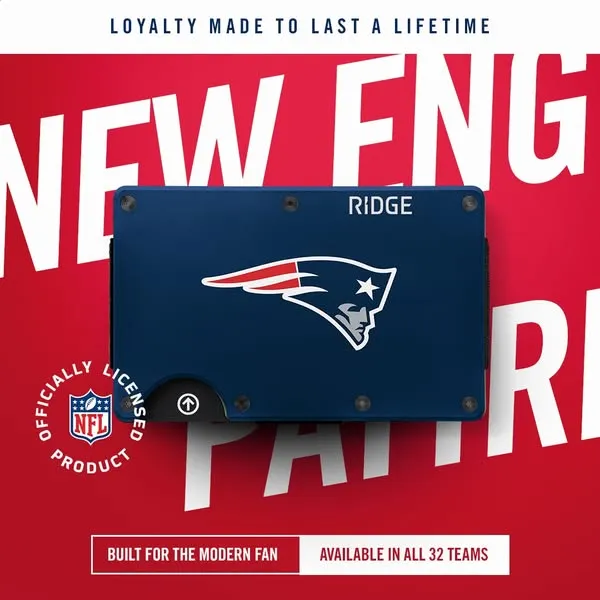
| Licensed/Fandom (NFL, Collegiate) | 19 | 7.0% |
| Power/Charging | 11 | 4.0% |
| Other/General | 10 | 3.7% |
Phone cases? Zero ads. Keychains? Zero. Knives, backpacks, passport wallets, watch straps? All zero.
These products exist on ridge.com. You can buy them right now. But Ridge doesn’t spend a single ad dollar acquiring customers for them.
Why? Because these products do their work after the ad does its job. When you add a wallet to your Ridge cart, a cross-sell module pops up - showing you keychains, phone cases, and accessories at discounted add-on prices. I saw this firsthand when I walked through their purchase flow.
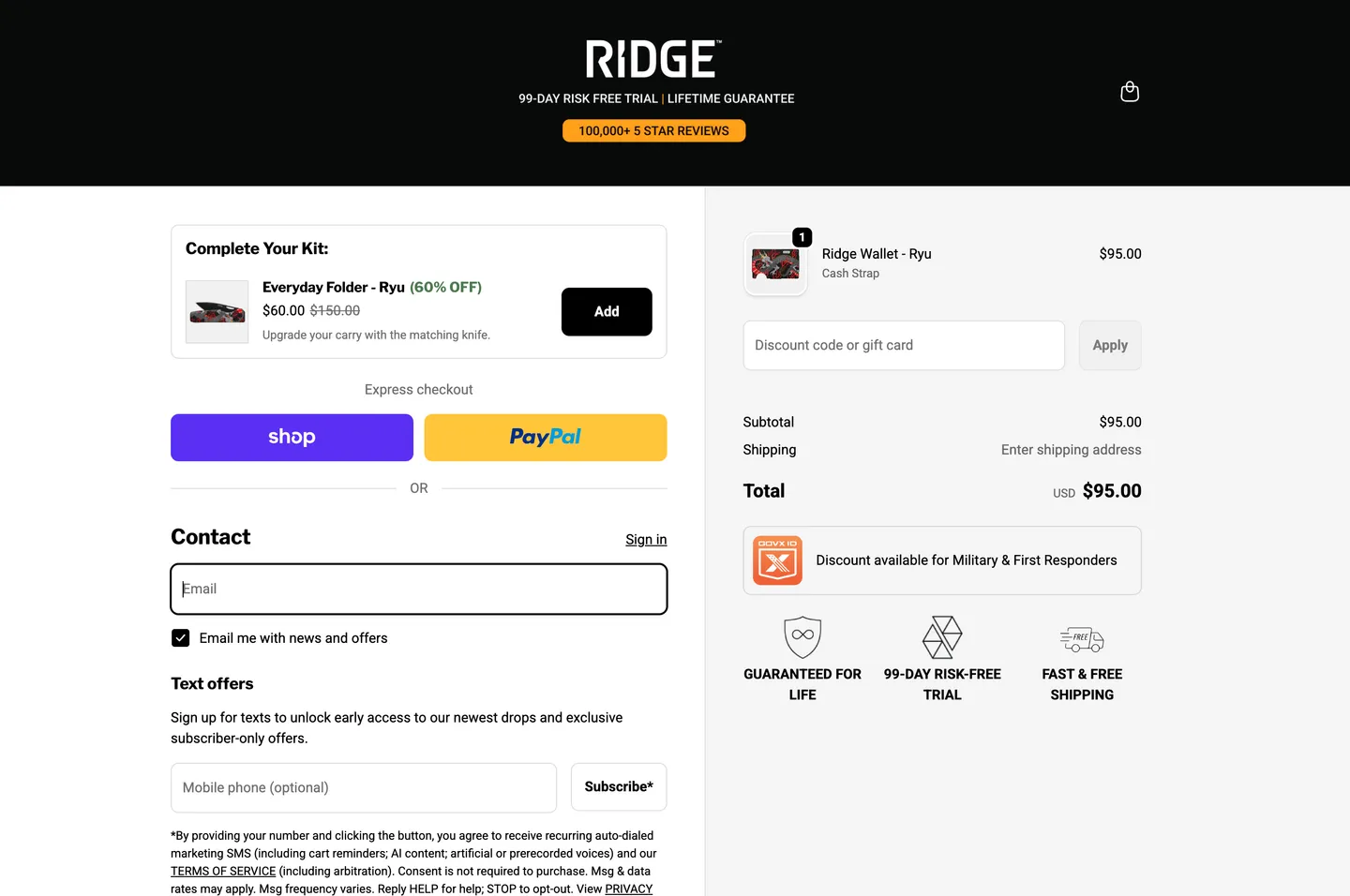
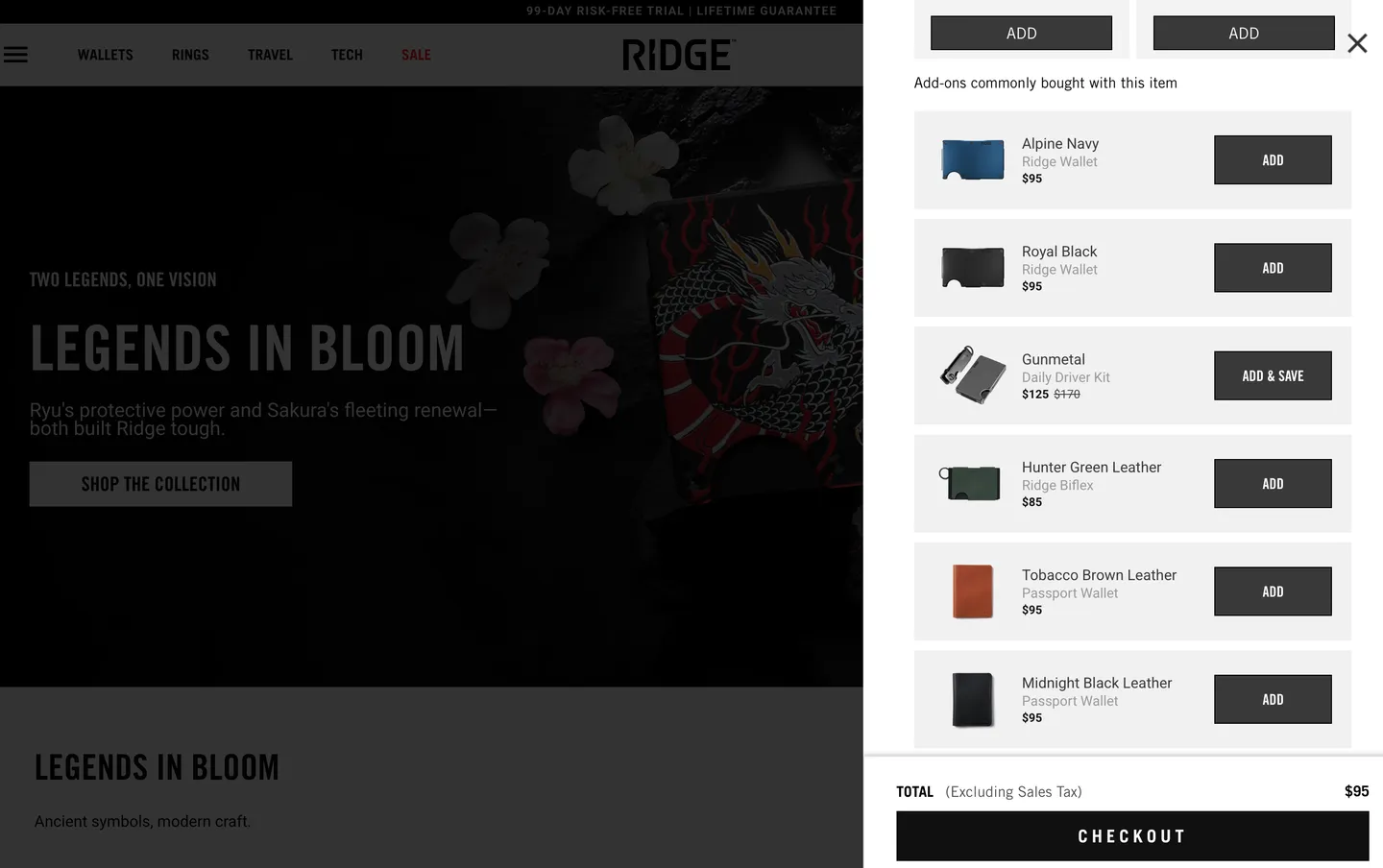
Ridge spends ad money to get you in the door with a wallet, a ring, or a limited edition drop. Then the website adds a keychain to your order. The ad acquires. The site expands the basket. Two different jobs, two different mechanisms.
This tells you something important about how they think about their catalog: not every product deserves ad spend. Some products are acquisition drivers. Others are margin builders that ride along in the cart.
Insight 2
41% of Ridge’s Ad Traffic Doesn’t Go to a Product Page. It Goes to a “Drop.”
Look at that table again. The single biggest destination for Ridge’s ad traffic isn’t wallets. It isn’t rings. It’s limited edition capsule collections - 41% of all 273 ads.
At the time I scraped this data, Ridge was running five capsule collections simultaneously:
| Collection/Capsule | Number of Ads | Description |
|---|---|---|
| Oceanlight | 30 ads | Ocean-inspired colorways photographed by underwater cinematographer Perrin James |
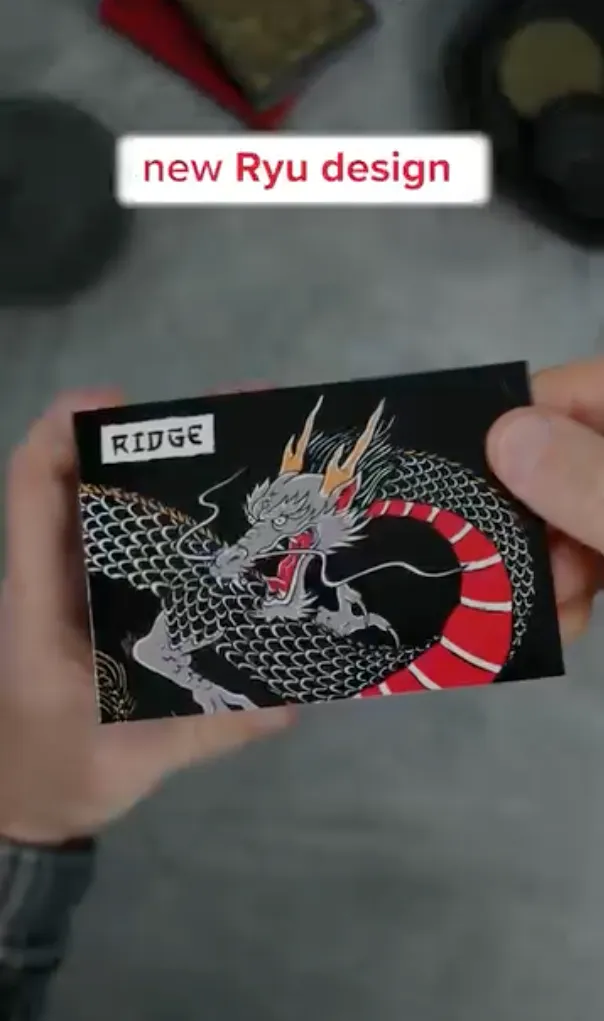
| Legends in Bloom | 30 ads | Dragon and cherry blossom designs in aluminum and carbon fiber |
| Hyper Lime | 31 ads | High-visibility yellow across wallets, power banks, and more |
| Chinese New Year | 21 ads | Year of the Fire Horse, laser-engraved with gold oil fill |
| Magnetic Power Banks Capsule | 24 ads | Power bank reframed as a curated collection |
Here’s the thing - these capsule collections ARE wallets, rings, and power banks. The products are fundamentally the same. What changes is the framing. Instead of “buy a wallet,” Ridge says “the Oceanlight collection just dropped.” Instead of browsing a category page, you’re shopping a curated, time-limited set.
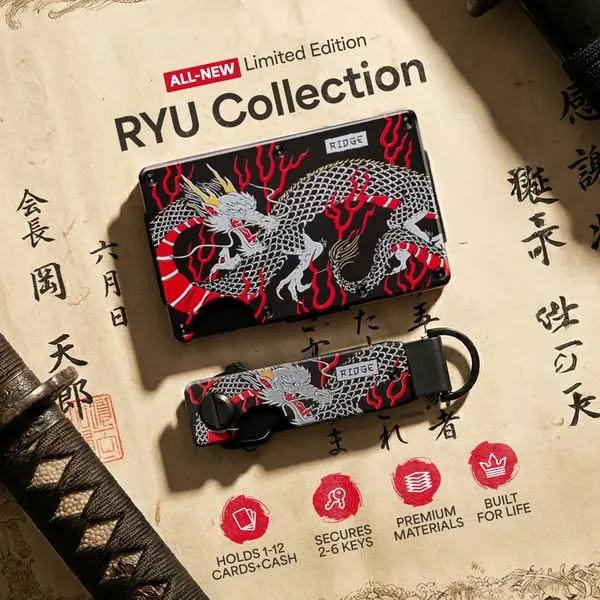
Only 16% of their ads send you to a generic wallets page. The product is the vehicle. The drop is the engine.
This is a streetwear model applied to everyday carry. Supreme built a billion-dollar brand on limited drops that create urgency without ever running a sale. Ridge is doing the same thing - but with wallets instead of box logo hoodies. The scarcity is manufactured through design and timing, not through discounting.
And the data confirms that Ridge protects this model aggressively.
Insight 3
Ridge’s Competitors May Discount Everything. Ridge Discounts Exactly One Product Line
I searched every ad’s body text, headline, and link description for discount language - percentage off, “save,” “deal,” bundle pricing, anything. Out of 273 ads, only 32 mention any kind of price incentive.
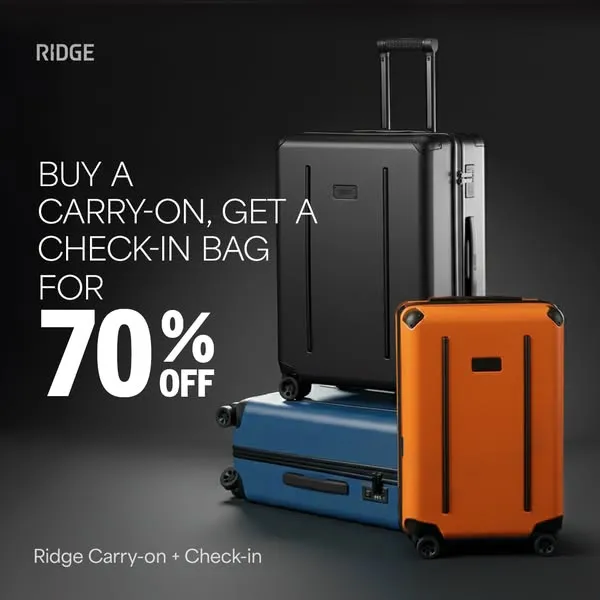
And here’s the part that makes this finding sharp: every single one of those 32 discount ads is for the same category. Travel luggage.
“Buy a check-in bag, get a carry-on for $50” - 25 ads
“Buy a carry-on bag, get a check-in bag for 70% OFF” - 7 ads
That’s it. The ONLY place Ridge leads with price is their newest, least-established product category - the one where they’re still trying to build initial trial and haven’t yet earned the brand premium that wallets and rings carry.
For everything else? The copy leads with craft, design, and emotion:
“Dark Harbor’s calm. Gold Horizon’s glow. Green Flash’s fortune. Three ways the ocean speaks in light, documented by Perrin James.”
“Choose between dragon wisdom or cherry blossom renewal crafted into Ridge’s patented slim design. Ancient mythology engineered into everyday essentials built for life.”
“Slim. Secure. Built to last. The Ridge Wallet redefines everyday carry with RFID-blocking technology and a sleek, minimalist design. Stop carrying bulk, start carrying better.”
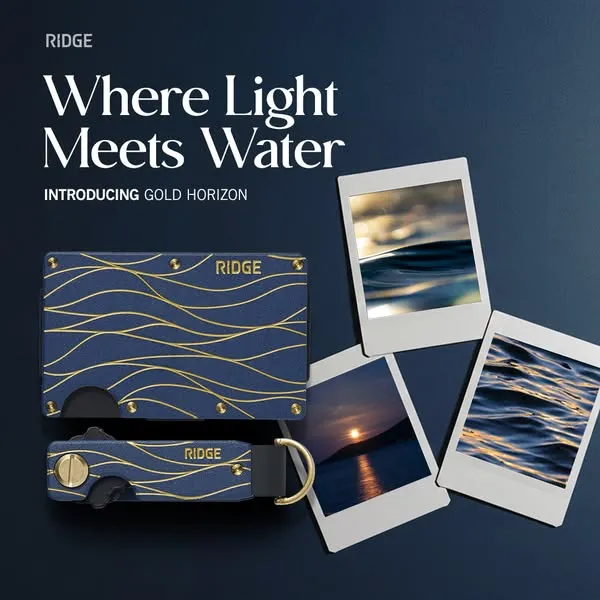
There’s a lesson here that applies to any brand: if you run “20% off” on your flagship product every month, you’re training your customers to wait for sales. Ridge creates urgency through limited drops instead - scarcity without desperation.
Insight 4
In Ads, Ridge Uses Video to Demonstrate and Images to Attract. It’s a Framework, Not a Guess.
The overall creative split is 57.5% static images vs 28.2% video. But these averages hide the real story.
Imagine you’re Ridge’s creative director. Someone drops a brief on your desk for the new Oceanlight collection - ocean-inspired wallet colorways shot by an underwater cinematographer. The product IS the visual. A gold-and-teal wallet against a dark background sells itself in a still photo. Do you spend $15K producing a video?
Ridge didn’t. 22 out of 28 Oceanlight ads are static images.
But then another brief hits your desk: rings. A new product category where people don’t know if a Ridge ring will be comfortable, how the silicone band flexes, what the fit looks like on a real hand. A photograph can’t answer those questions. You need to show the ring in motion.
Ridge agreed. 14 out of 23 ring ads - 61% - are video.
Here’s the full breakdown by campaign:
| Campaign | Video | Image | Video % | Why |
|---|---|---|---|---|
| Upgrade Your Wallet | 10 | 1 | 91% | The card-ejecting mechanism needs to be seen |
| Perfect Fit Guaranteed (Rings) | 14 | 9 | 61% | Comfort and fit need demonstration |
| Ridge Ring Sets | 2 | 1 | 67% | Same - rings sell on feel, not just look |
| Legends in Bloom | 16 | 14 | 53% | Storytelling collection - both formats work |
| IMPOSSIBLE TO MISS (Hyper Lime) | 8 | 9 | 47% | Bold color works in any format |
| 5 in 1 Powerbank | 7 | 16 | 30% | Feature specs shown well in image layout |
| Oceanlight Collection | 6 | 22 | 21% | The design IS the selling point |
| Buy a check-in bag (Travel) | 0 | 25 | 0% | Luggage sells on aesthetics |
| Represent Your School (Collegiate) | 0 | 8 | 0% | The university logo is the value prop |
| NFL / Seahawks Super Bowl | 0 | 10 | 0% | The team logo is the product |
The framework: if a customer needs to see the product in action to understand its value, use video. If the value is visible in a single frame - a colorway, a logo, a design - use an image and save the production budget.
This isn’t a Ridge-specific insight. Any brand can apply this to their own catalog. Ask: “Does my customer need to see this product move to understand why it’s worth buying?” If yes, video. If the answer is clear from a well-shot photograph, image.
Insight 5
Why Does Ridge Keep Running the Same 24 Messages Across 273 Different Ads?
Here’s a number that surprised me: across all 273 ads, Ridge uses only 24 unique pieces of body copy.
That means each copy variant powers, on average, 11 different ads - paired with different images, different videos, different layouts. The message stays the same. The creative changes.
This is a volume testing methodology. Instead of writing fresh copy for every ad and muddying the data, Ridge locks in a message that works and then asks: “Which visual executes this message best?” It’s the same approach a scientist uses when isolating variables - change one thing at a time and measure the difference.
And the copy itself reveals three distinct voices depending on the product:
Collections get emotional, poetic copy: “Dark Harbor’s calm. Gold Horizon’s glow. Green Flash’s fortune. Three ways the ocean speaks in light.”
The core wallet gets problem/solution copy: “Slim. Secure. Built to last. Stop carrying bulk, start carrying better.”
The power bank gets technical, feature-stacked copy: “Charge iPhones with magsafe, Qi phones, USB-C wired, lightning wired AND an Apple Watch and get 10,000mAh in the palm of your hand. One thing to pack, five ways to power.”
Three products. Three completely different voices. But each voice is selected. The message is settled. The visual is the variable.
If you’re running ads for your own brand and you’re writing new copy for every creative, consider flipping that approach. Find your message first. Test it. Once it’s working, stop touching the words and start testing the visuals instead.
Insight 6
They ran 85 New Ads in a Single Week - Here’s the pattern I found.
| Week | New Ads |
|---|---|
| Dec 22 | 2 |
| Dec 29 | 1 |
| Jan 19 | 60 |
| Jan 26 | 29 |
| Feb 2 | 33 |
| Feb 9 | 63 |
| Feb 16 | 85 |
For context: most D2C brands launch 5 to 15 new ad creatives per week. Ridge launched 85 in the week of February 16 alone.
But the interesting thing isn’t the volume - it’s the rhythm. Ridge doesn’t maintain a steady drip of creative. They surge around moments.
Late December: near-zero. We obviously have the holiday season.
Third week of January: a sudden 60-ad burst. This maps directly to the Oceanlight and Chinese New Year collection launches - new products need new creative.
February: a relentless ramp - 33, then 63, then 85 ads per week. Valentine’s Day gift-giving season plus the Legends in Bloom collection launch. Two demand drivers at once, fueling the biggest creative surge in the dataset.
There’s also a quiet gap between January 1 and January 18 - nearly three weeks with almost no new launches. That’s likely the production window. Shoots happening, creative being built, assets being reviewed. Then everything drops at once.
The takeaway: The current Ridge production line is not a constant assembly line. They batch-produce around collection drops and seasonal moments.
Insight 7
Rings Are Ridge’s Stealth Growth Bet - And the Data Shows Exactly How.
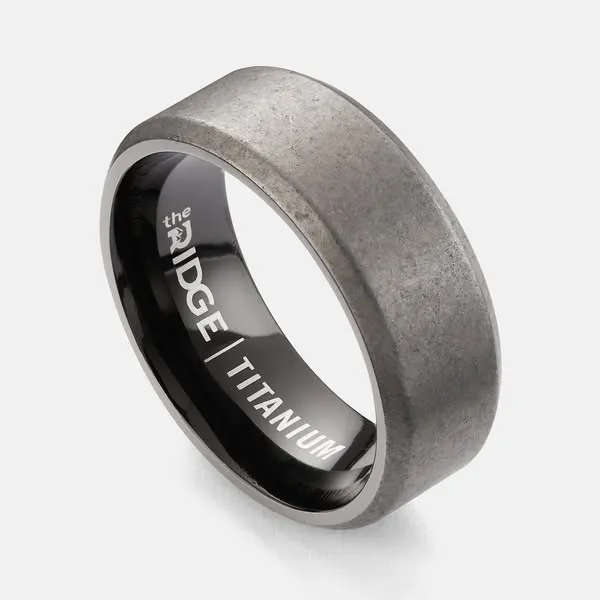
Rings account for 19% of Ridge’s total ad volume - their second-largest category behind limited collections. But the volume alone isn’t the interesting signal. The creative approach is.
Half of all ring ads - 26 out of 52 - use something called DCO, or Dynamic Creative Optimization. This is where the advertiser uploads a bunch of different images, headlines, and body texts, and Meta’s algorithm automatically mixes and matches them to find the best-performing combination. Think of it as letting the machine run hundreds of A/B tests simultaneously.
Here’s why that matters:
| Category | DCO Ads | Total Ads | DCO % |
|---|---|---|---|
| Rings | 26 | 52 | 50.0% |
| Wallets | 4 | 44 | 9.1% |
| Collections | 3 | 112 | 2.7% |
| Others | 1 | 65 | 1.5% |
When Ridge runs wallet ads, 91% are manually crafted creative. They know what works for wallets - they’ve been selling them for years. The creative formula is proven. Same with collections: 97% manual creative because the aesthetic vision is clear and deliberate.
But for rings? They’re handing half the creative decisions to Meta’s algorithm. It’s a signal that they haven’t cracked the creative formula for rings yet and they’re testing at massive scale to find it.
This is what a growth push looks like from the inside. When a company knows a category, they run proven creative. When they’re investing in a new category, they let the machine test.
The ring ads also lean video-heavy (61% for the “Perfect fit guaranteed” campaign) because rings need physical demonstration.
Insight 8
Every Ad Has the Same Call-to-Action. That Tells You More Than You’d Think.
One more finding from the ad data before we move to organic social. Across all 273 ads, the call-to-action button is “Shop Now.” Every single one.
Why does this matter? Because Meta gives advertisers options - “Learn More,” “Sign Up,” “Get Offer,” “Watch More,” and several others. Brands running awareness or consideration campaigns typically use softer CTAs like “Learn More” to drive traffic without purchase pressure.
Ridge doesn’t do any of that. Every dollar they spend on Meta ads is pointed at one outcome: a purchase. There’s no top-of-funnel “get to know our brand” campaign. No email list building. No content amplification. It’s a pure conversion machine. I think their organic channels and influencer partnerships handle the awareness job.
Speaking of which.
Insight 9
Ridge Has 505,000 Instagram Followers and 0.08% Engagement. Here’s Why That Might Not Matter.
I scraped Ridge’s 50 most recent Instagram posts - every like count, comment count, video view, video duration, and posting date..
Across 50 posts spanning November 2025 to February 2026, Ridge averages 0.08% engagement - likes plus comments divided by their 505,472 followers. For a brand this size, typical benchmarks sit around 0.5% to 1.5%. Ridge is performing at roughly one-sixth to one-twentieth of where similar accounts land.
But before we call this a failure, we need to consider that their Instagram account may not be designed to drive engagement at all - it exists as social proof. The follower count, the polished grid, the consistent posting - all of it says “this is a real, active, legitimate brand” to someone who clicks through from an ad and checks the Instagram profile before buying.
Insight 10
How Ridge Structures Their Content - And What the Engagement Data Says About Each Type
Through manually reviewing every post, I noticed Ridge’s content falls into three distinct categories.
Filler content - reels that are easy to produce at scale: product unboxing videos with quick cuts set to trending audio, simple product beauty shots with music. These are low-effort, low-risk, and get consistent but unremarkable viewership - typically 15K - 30K views. They keep the posting schedule consistent and the grid alive, but they don’t move the needle.
Example filler reel:
New format experiments - one-off creative bets that test a new hook, trend, or style. These are the high-variance plays: an ASMR “brain rot” edit, a “real or AI?” challenge, a “squint your eyes to see the hidden image” engagement trap, talking to strangers on the street. Most of these hover around 30K or more views. But occasionally one breaks through - the “Don’t look” reel hit 4.2M views, the RFID theft demo hit 1242K.
Example new format experiments:
Animation
ASMR brain rot
Squint your eyes
Spot the wallet
Carousels - static image posts displaying products, usually aligned with collection launches or promotional moments. And here’s where the data gets interesting.
The fact that carousels are meant for followers and reels for non-followers - and given that Ridge has 506k followers - Carousels have a higher engagement rate than Reels.
Example carousels:
Carousel 1
Carousel 2
Their content mix is roughly balanced - 28 reels vs 22 carousels.
Insight 11
The Video Sweet Spot Is 16-30 Seconds. Shorter Gets Views. Medium Gets Engagement.
One advantage of scraping Instagram posts rather than just browsing: you get exact video duration data. Here’s what it reveals about Ridge’s reels:
| Duration | Reels | Avg Views | Avg ER |
|---|---|---|---|
| Short (15s or less) | 12 | 29,721 | 0.049% |
| Medium (16-30s) | 10 | 23,216 | 0.110% |
| Long (30s+) | 6 | 21,001 | 0.059% |
Short reels get the most eyeballs. The algorithm pushes them because they’re easy to consume and generate quick completion rates. But they generate the least engagement.
Medium-length reels get fewer views but more than double the engagement rate. This is the sweet spot - 16 to 30 seconds is long enough to deliver something genuinely useful.
The RFID theft reel - their top performer - is 28 seconds. Right in the sweet spot. Long enough to tell the story, short enough to keep attention.
Long reels drop off on both views and engagement. Ridge’s audience doesn’t stick around for 45-second or 60-second content. The exception is collaboration content - a 110-second Thanksgiving reel with creator @themoimolina still performed reasonably.
Insight 12
Same Content, Five Platforms, Zero Adaptation. Here’s What That Tells You.
| Platform | Followers | Avg Performance | Notes |
|---|---|---|---|
| 505,472 | 25,529 views per reel | Primary organic channel | |
| 366,245 likes | ~15,000+ views per reel | Same content, decent reach | |
| TikTok | 62,700 | 1,000-5,000 views | Significantly underperforming |
| YouTube Shorts | 8,130 subs | ~1,000 views | Minimal investment |
| Twitter/X | 53,800 | ~3,000 views per tweet | Afterthought |
Ridge cross-posts identical content to every platform. The same reel that goes on Instagram goes on TikTok, Facebook, YouTube Shorts, and Twitter.
Ridge’s customer acquisition doesn’t happen through organic social. It happens through the 273 Meta ads running on Facebook, Instagram, Threads, and Messenger simultaneously. So, they’re treating organic channels as social proof infrastructure and not growth engines.
The one platform where Ridge does have a genuine organic engine is YouTube - not their own channel (8K subscribers, ~1K views), but the massive creator ecosystem. Search “Ridge wallet” on YouTube and you’ll find hundreds of sponsored reviews, EDC community content, and influencer integrations..
What All of This Means - Five Things Any Brand Can Take From Ridge’s Playbook
1. Not every product deserves ad spend.
Ridge sells 12+ product categories but only advertises five. The rest are cross-sell items that earn their keep inside the cart. Before you run ads for your entire catalog, ask which products acquire customers and which products expand orders.
2. Drops beat discounts.
88% of Ridge’s ads lead with value, not price. They create urgency through limited edition collections - scarcity without desperation. If your brand runs a sale every month, you’re training customers to never pay full price. A capsule drop creates the same urgency without eroding your margins.
3. Build a creative framework around your products.
Video for demonstration, image for aspiration. If your product needs to be seen in action, invest in video. If it sells on looks, save the production budget and shoot great photography.
What brand should I tear down next?
Subscribe for the next teardown
Data-driven D2C analysis, delivered to your inbox. No spam, no fluff.