Cozy Earth Hides the Word "Bamboo" on Meta and Shouts It on Google
Contents
In the Meta teardown, I found two strange absences: Cozy Earth almost never named its own material - "bamboo" showed up in only 10% of written ads.
The first Google search ad I found was headlined "Cozy Earth - Oprah's Favorite Sheets," with a description that opened: "luxuriously soft bedding made from premium bamboo viscose."
I went through 418 unique Cozy Earth creatives in the Google Ads Transparency Center to find this.
The format inverts: Meta automates, Google answers
Of the 418 Google creatives, 333 are text (80%), 43 are video (10%), and 42 are image (10%).
On Meta, 58% of the account was machine-assembled - DCO and DPA built to fill a feed at volume.
The vocabulary flips: "luxury" and "bamboo" come out of hiding
This is the cleanest contradiction between the two accounts.
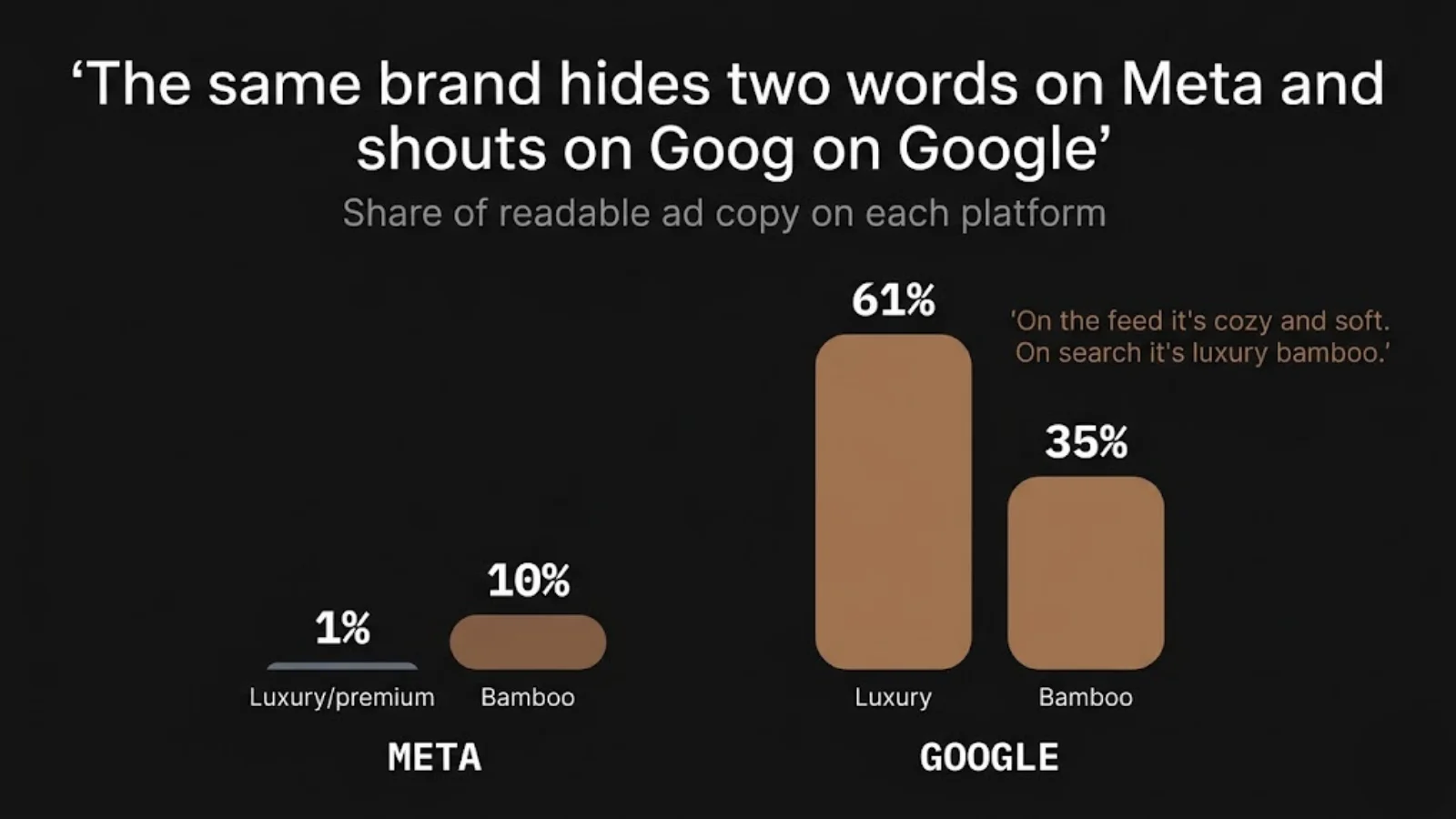
On Meta, Cozy Earth almost never called itself luxurious, but on Google, "luxury" or "premium" appears in 61% of copy.
Similarly, the word "bamboo" shows up in 35% of Google copy, versus 10% on Meta.
The comfort core holds across both - "comfort/cozy" runs through 75% of copy and "soft" through 55% - but the framing on top is different. The recurring description blocks: "Sleep better with luxuriously soft bedding made from premium bamboo viscose" (28 ads), "Live in everyday luxury with soft, premium apparel and essentials" (17), "Elevate your everyday with luxury loungewear, premium pajamas, and essential home goods" (12).
One search ad per product, the whole catalog mapped
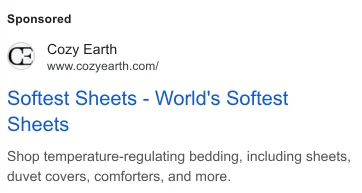
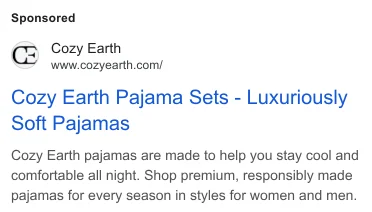
The Google headlines follow a tight template - Cozy Earth [Category] - [Luxury or Soft adjective] [Category] - and nearly every product line gets one:
- Cozy Earth Sheets & Bedding - More Breathable Than Cotton
- Cozy Earth Pajama Sets - Luxuriously Soft Pajamas
- Cozy Earth Loungewear - The Best Loungewear
- Cozy Earth Bath Collection - Luxuriously Soft Towels & More
- Cozy Earth Comforters - Bamboo Viscose Comforter
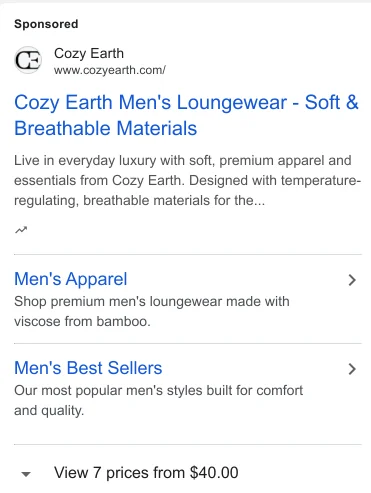
- Cozy Earth Men's Loungewear - Soft & Breathable Materials
- Cozy Earth Socks, and even Cozy Earth Gift Card
They're bidding on socks, towels, robes and men's loungewear - not just sheets. The apparel-and-home expansion I flagged on Meta shows up on the search side too. The sharpest line in the set: "More Breathable Than Cotton" - a direct comparative claim the Meta copy never made.
Where the warranty went
On Meta, Cozy Earth ran almost no risk-reversal, but on Google - warranty, trial,etc. all of it shows up.
The 10-Year Warranty appears in 17 creatives, five as the headline offer. The 100-Night Sleep Guarantee appears in 14, often paired: "10-Year Warranty. 100-Night Sleep Guarantee." A handful position products as HSA Eligible - framing bedding as a health-spending-account purchase, which never appeared on Meta. Free shipping over $100 is here too, where Meta never stated a shipping offer at all.
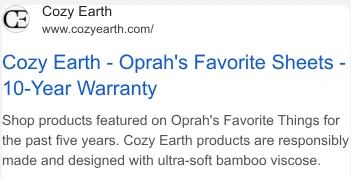
The pattern lines up with the format split. When someone is mid-comparison, actively weighing a $300 sheet set against something cheaper, Cozy Earth hits them with every reason it's safe to buy. When someone's scrolling a feed, it hits them with feeling instead. Emotion where there's no intent, proof where there is.
The Oprah stamp reappears
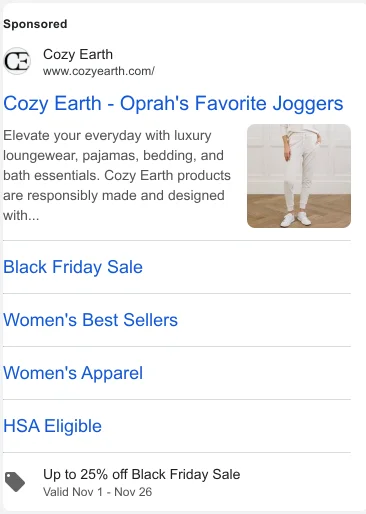
In the Meta teardown I flagged the strangest absence - not one of the 369 ads used the Oprah's Favorite Things endorsement. The Google data resolves it. At least six creatives lead with it: "Cozy Earth - Oprah's Favorite Things," "Oprah's Favorite Sheets," "Oprah's Favorite Towels," even "Oprah's Favorite Joggers."
The endorsement isn't retired. It's been assigned to the channel where it does the most work. Social proof lands hardest at the moment of decision, and on Google that moment is the search. My hunch: keep the gifting emotion clean on the feed, let Oprah close the comparison shopper on search. The missing piece from the first teardown turns out to be the hero of the second.
The entire sale calendar, reverse-engineered
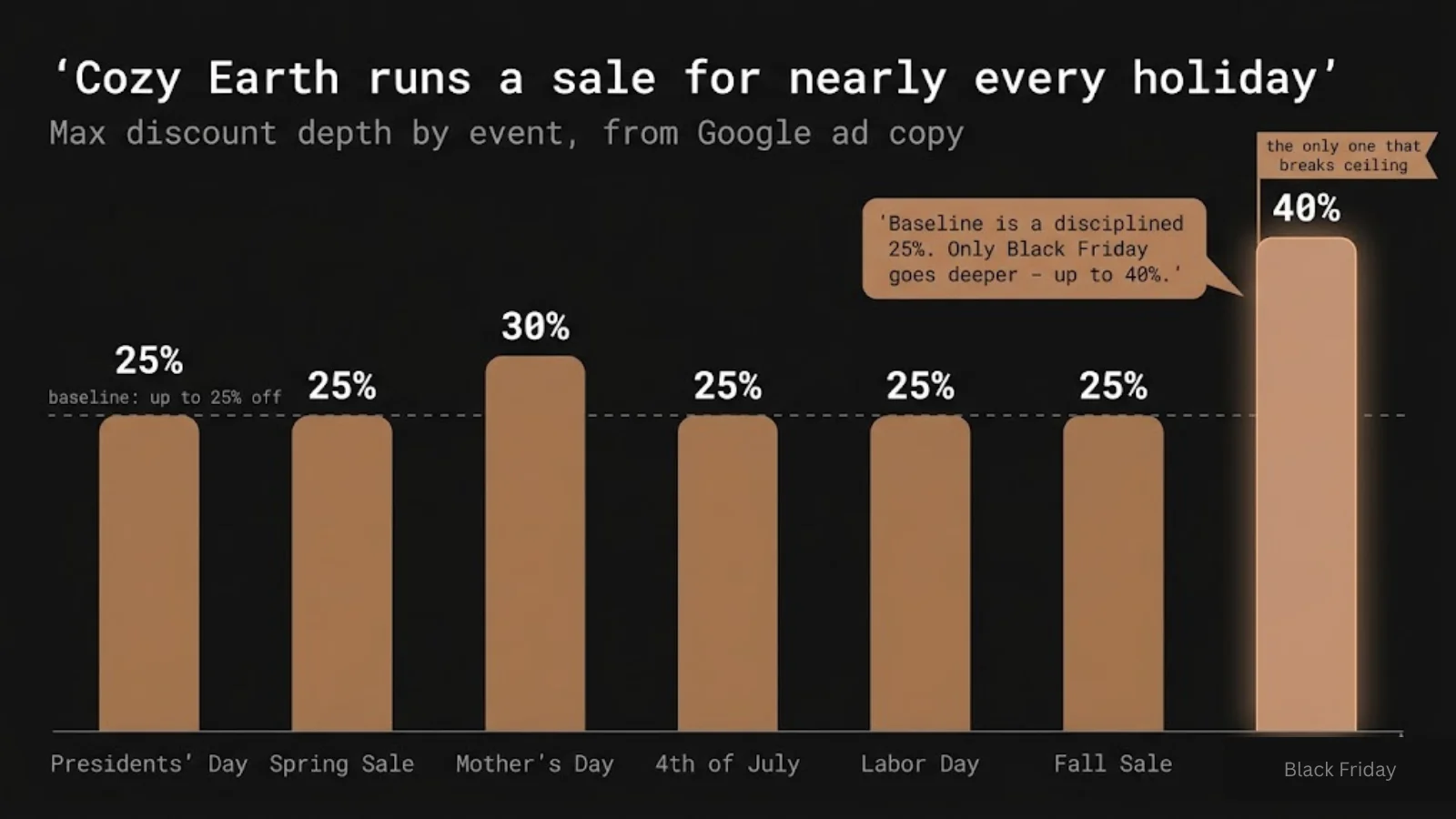
The Meta scrape caught one sale - Mother's Day - because the whole account was eight weeks old. Google reaches back roughly six months (112 creatives last shown in December 2025, 83 in February, 189 in April), and that longer window exposes Cozy Earth's full discount rhythm:
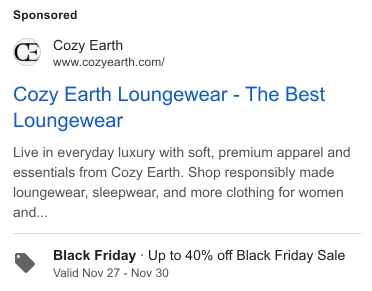
- Black Friday - up to 25%, 35%, and 40% off across different creatives
- Labor Day, Presidents' Day, 4th of July, Fall Sale, Spring Sale - up to 25% off each
- Mother's Day - up to 30% off
There's a named sale for nearly every retail moment on the calendar. The baseline is a flat "up to 25% off," and Black Friday is the only event that breaks ceiling at 35-40%. This also reframes the Meta finding: the "15% sitewide / 20% bundles" I saw on the feed is the softer face of a Google "up to 30% off Mother's Day Sale" - the two channels don't even state the same number for the same holiday.
Google shows a price. Meta never did.
Across all 369 Meta ads, Cozy Earth never put a price in front of you before the click. Google's shopping listings do: "View 7 prices from $40.00," "from $56.00," along with specific SKUs like "Silk Comforter (Size: Queen)."
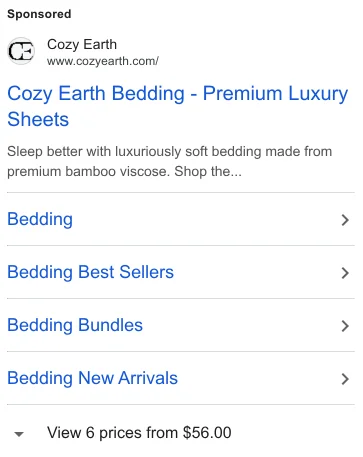
It's a function of format more than strategy - shopping ads carry a price field, feed ads don't - but it means Google is the one surface across both platforms where a prospect sees a number before they ever land on the site.
The map opens from one country to forty-eight
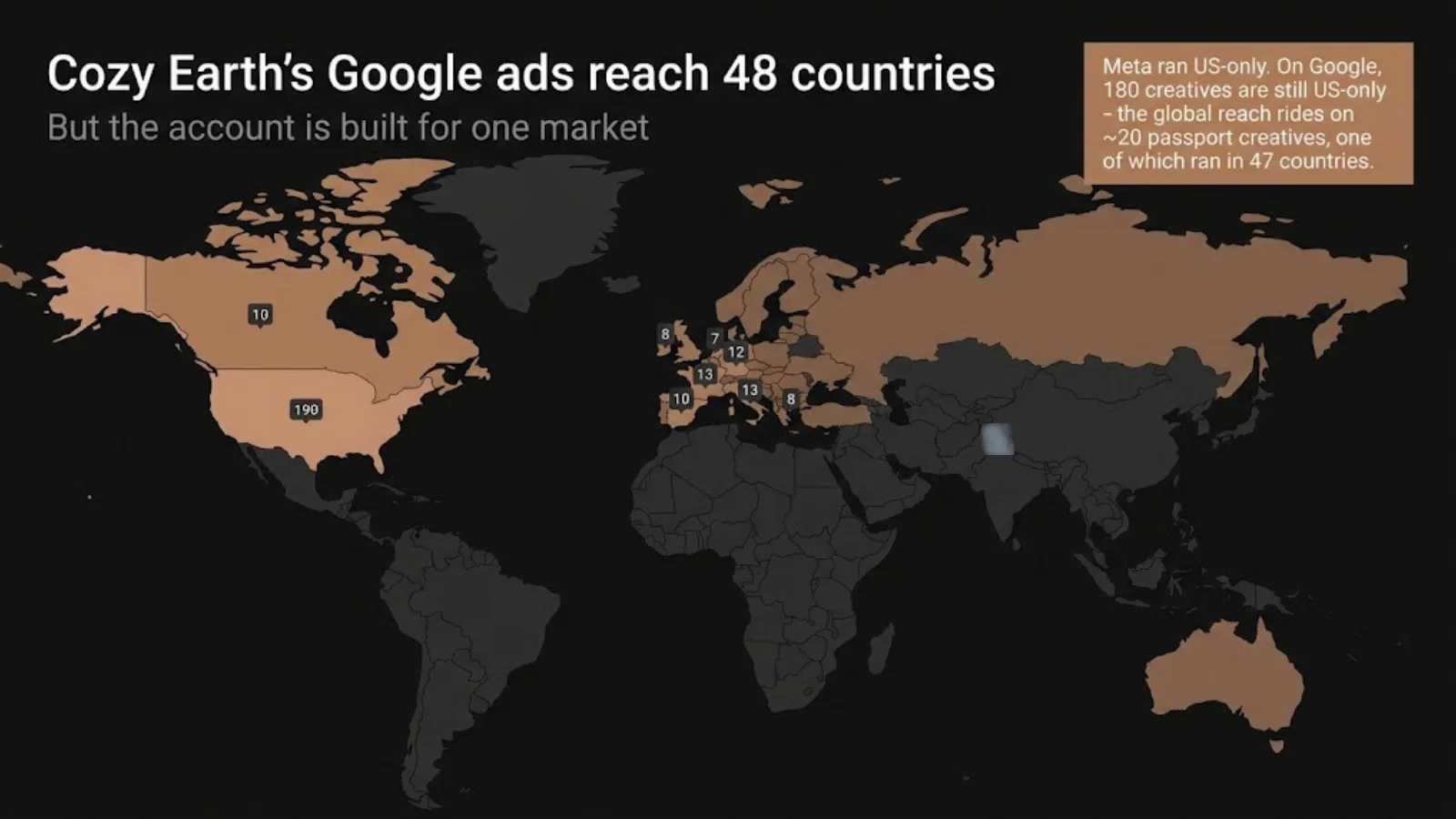
Meta was US-only. Google shows 48 countries: the US is the anchor (190 of region-tracked creatives), but the footprint spreads to Italy (13), France (13), Germany (12), Canada and Spain (10 each), Ireland (8), then a long tail through the Nordics, Eastern Europe, Australia, Mexico, India, and the Philippines.
The honest version of that number matters. 180 creatives ran US-only, just 20 ran in more than one country, and 10 never appeared in the US at all. The global reach rides on a small set of "passport" creatives - one alone ran in 47 countries - while the bulk of the account is US-specific. I'd hedge the why: a long tail of one- and two-country creatives can come from Google's auto-expansion rather than deliberate local campaigns.
Meta vs Google, side by side
| Dimension | Meta (369 active ads) | Google (418 unique creatives) |
|---|---|---|
| Dominant format | 58% machine-assembled (DCO + DPA) | 80% text search ads |
| Lead framing | Cozy + gifting ("a gift for Mom") | Luxury / premium (61% of copy) |
| Says "bamboo"? | Buried (10%) | Headline word (35%) |
| Oprah endorsement | Absent across all 369 ads | Leads ≥6 creatives ("Oprah's Favorite Sheets") |
| Risk-reversal | None (no warranty / trial / shipping) | 10-yr warranty, 100-night trial, HSA, free shipping |
| Price shown before click | No | Yes, in shopping listings |
| Discounting seen | Mother's Day only (15-20%) | Full year of sales; baseline 25%, BF up to 40% |
| Geography | US-only | 48 countries (180 US-only, 20 multi-country) |
| Time window captured | 8 weeks (one campaign) | ~6 months (full sale calendar) |
What the data showed
- 418 unique Google creatives: 80% text, 10% video, 10% image - the inverse of Meta's 58% machine-assembled feed.
- "Luxury/premium" runs through 61% of readable Google copy, versus ~1% on Meta. "Bamboo" appears in 35%, versus 10% on Meta. The brand buries both on the feed and leads with both on search.
- The comfort core holds: cozy 75%, soft 55%, cooling 32% on Google.
- Nearly every product line gets a dedicated search ad. "More Breathable Than Cotton" is the sharpest comparative hook in the account.
- The full risk-reversal stack lives only on Google: 10-Year Warranty (17 creatives), 100-Night Sleep Guarantee (14), HSA Eligible, free shipping. Meta carried none of it.
- The Oprah's Favorite Things endorsement, absent from all 369 Meta ads, leads at least six Google creatives.
- Google exposes a year-round sale calendar (Black Friday, Labor Day, Presidents' Day, 4th of July, Fall, Spring, Mother's Day). Baseline: up to 25% off; Black Friday breaks ceiling at 35-40%.
- Google shopping ads show a price before the click. Meta never did.
- Google runs in 48 countries against Meta's US-only footprint, but 180 creatives are US-only and global reach rides on ~20 multi-country passport creatives.
- Caveat: no impression or spend data; copy stats are from the ~193 of 418 creatives with a readable preview.
Put the two teardowns next to each other and one picture forms. Cozy Earth isn't running one strategy across two platforms. It's running two, split by intent. Meta is the automated, emotional, gift-led, US-only face that makes you feel the cozy. Google is the search-led, luxury-forward, proof-stacked, global face that closes the shopper who already wants it. The material, the price, the warranty, and Oprah all live on the side where someone is actually looking for them.
This is the same two-personality split I found tearing down HexClad - Meta sold one hero product while Google merchandised the whole catalog. My growing hunch across these teardowns: the bigger and more mature a D2C brand gets, the less "one strategy" it actually runs, and the more it tailors itself to where you're standing when it catches you.
I'm tearing down a D2C brand every week. If there's a brand you want me to break down, DM me on X.
Share this teardown
Read Next
I Scraped 369 Cozy Earth Ads. The Whole Account Points at One Sunday in May.
369 Cozy Earth Meta ads, every one of them from 2026. 58% built by the algorithm, a third pointing at Mother's Day, zero Oprah mentions, and a $5,000 sweepstakes running quietly underneath.
543 Google Ads. 166 Went Dark on the Same Day. Here's What Survived.
A breakdown of Fresh Clean Threads' Google Ads strategy. Why 166 ads went dark in 3 days, why 78% of active ads are Shopping, and how their Google strategy diverges from Meta.
Fresh Clean Threads Runs 150 Meta Ads. Only 17 Pieces of Copy Power All of Them.
150 active ads, 87% algorithm-driven, 17 unique copy blocks, and three simultaneous promo codes. Inside a $60M basics brand that trusts Meta's machine more than its own creative team.