I Scraped 369 Cozy Earth Ads. The Whole Account Points at One Sunday in May.
Contents
Note - This article is based on ads I went through during the April-May month.
Cozy Earth makes bamboo viscose bedding - sheets, comforters, robes, pajamas - at the premium end of the market. They've built out from there: a bath line, men's loungewear, women's clothing, a seasonal gift play.
When I scraped their 369 active Meta ads, I went in expecting the classic premium-brand setup: proven hero creatives, years of creative compounding, a campaign library built from what's worked.
That's not what the data showed.
Every single ad started running in 2026. 277 launched in April, 92 in March. The oldest ad in the account is 45 days old with the median being 16 days.
The numbers below are stated flat.
More than half the account is machine-assembled
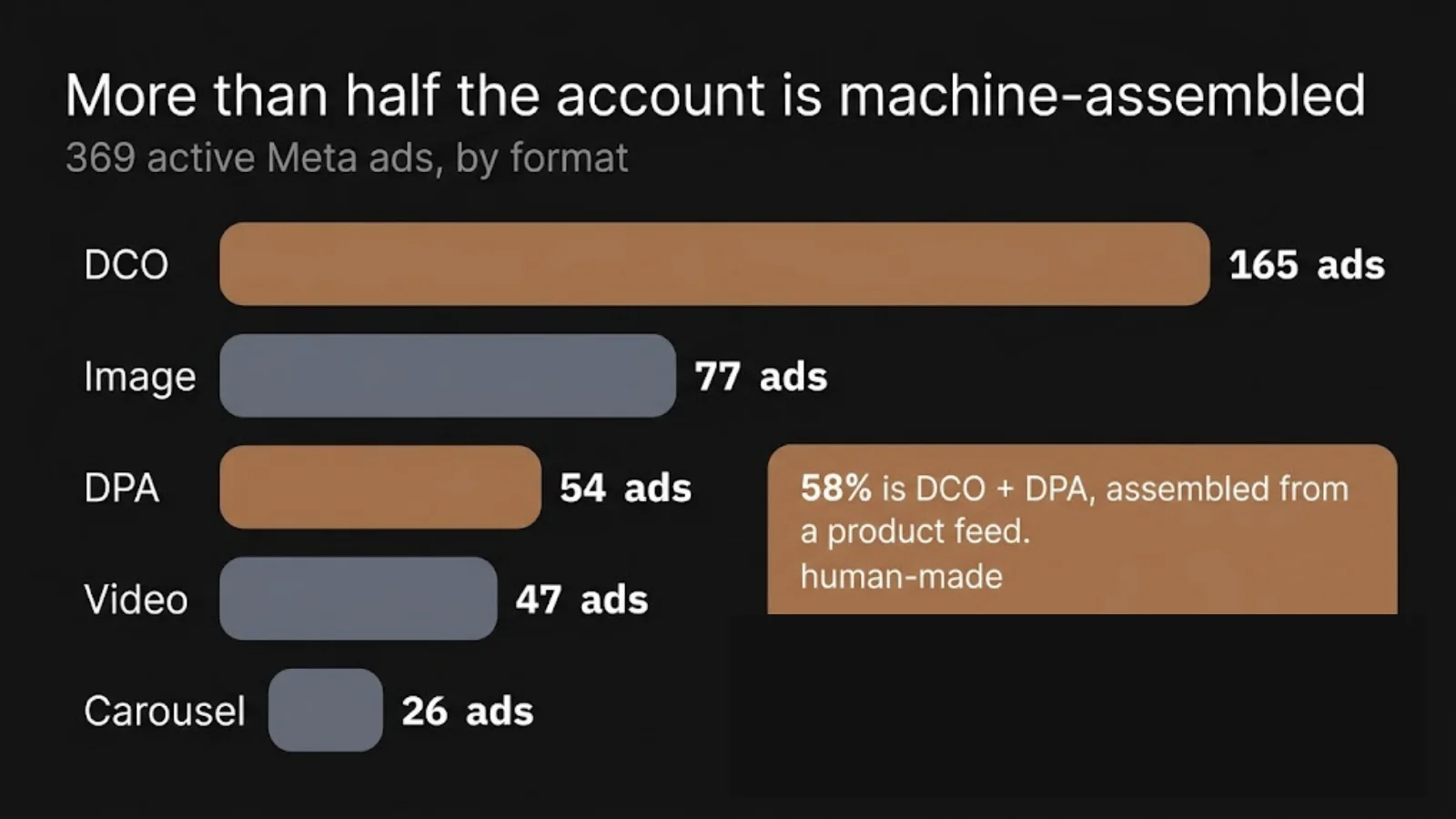
When I broke the 369 ads down by format:
- DCO (dynamic creative): 165 ads, 44%
- Image: 77 ads, 20%
- DPA (dynamic product ads): 54 ads, 14%
- Video: 47 ads, 12%
- Carousel: 26 ads, 7%
DCO hands Meta a pile of headlines, images, and copy and lets the algorithm assemble combinations at delivery. DPA goes further and pulls products straight from the store catalog. Between the two, 58% of the account is machine-assembled and static image and video are 32% combined.
Strip the template ads out and Cozy Earth has roughly 175 ads carrying real, written copy.
The whole account points at one Sunday in May
123 of the 369 ads - a third of the entire account - send traffic to a Mother's Day landing page. Two pages do the work: /pages/home-starts-with-mom (65 ads) and /pages/mothers-day-gift (58 ads).
The headlines stack the same frame: "Win Mother's Day," "Because Moms Deserve Better Sleep," "A Gift Mom Actually Wants," "Upgrade Her Nights." Link descriptions push it further - "Elevated essentials for Mom, now up to 20% off," and the one I keep coming back to: "A better gift than flowers."
The recurring body copy makes the angle explicit - one block runs across 9 ads: "This Mother's Day, give Mom her new favorite thing to relax in."
And so the emotional job isn't to sell sheets, but rather to make the gift-buyer feel like a good child or partner.
Underneath the sale, a $5,000 sweepstakes
Running in parallel with the gifting ads is something with a completely different job. 15 ads run a $5,000 sweepstakes - "This is your sign: enter to win $5,000. Quick, easy, and worth it" - landing on /pages/spring-sweepstakes. Another 10 point at /pages/loyalty-sign-up.
More like they're just there for collecting emails and phone numbers.
The account runs two speeds at once: bottom-funnel Mother's Day ads asking for the sale, and top-funnel sweepstakes ads buying a contact list cheaply, right before the heaviest gifting window of the spring. My hunch is the sweepstakes feeds the list that the Mother's Day offers then monetize - but I can only see that both engines are running side by side, not what happens after the click.
The copy is locked. The visual is the variable.
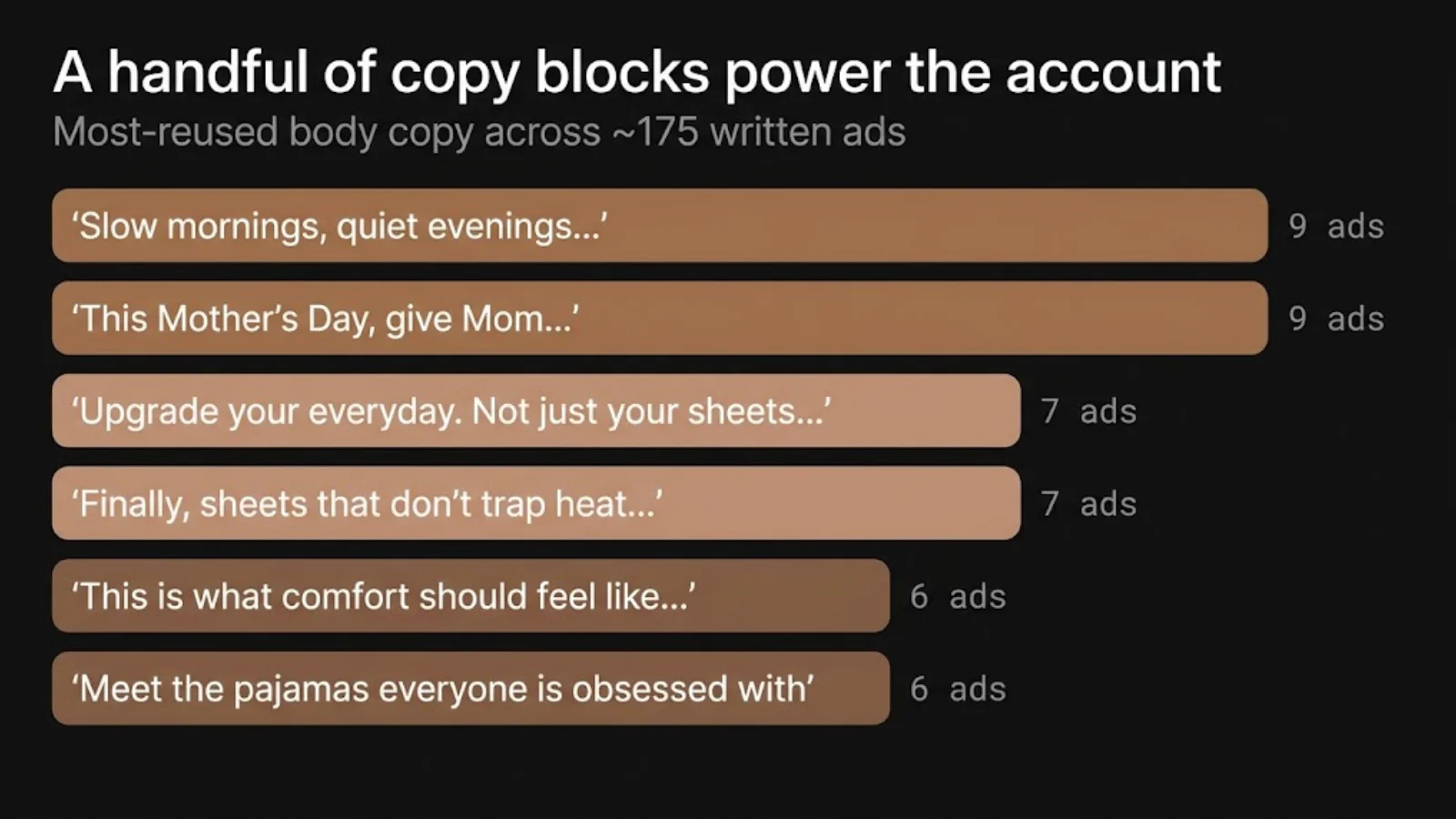
Across the 175 written ads, the same handful of openings repeat across dozens of creatives:
- "Slow mornings, quiet evenings, a moment to herself" - 9 ads
- "This Mother's Day, give Mom her new favorite thing to relax in" - 9 ads
- "Upgrade your everyday. Not just your sheets, but how you rest" - 7 ads
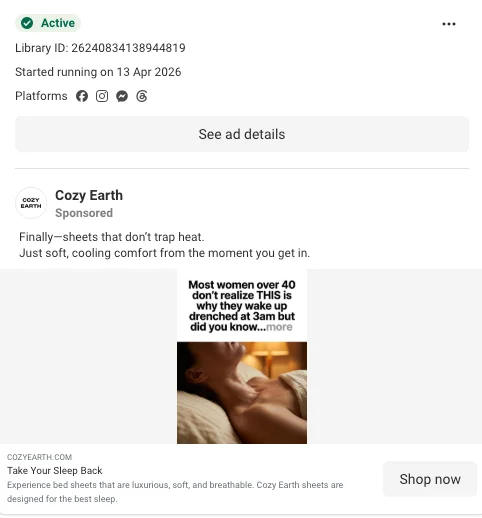
- "Finally - sheets that don't trap heat. Just soft, cooling comfort" - 7 ads
- "This is what comfort should feel like. Soft, breathable, effortless" - 6 ads
- "Meet the pajamas everyone is obsessed with" - 6 ads
124 of the 369 ads carry more than one near-identical variant - up to 5 per ad. The testing is happening; it's just on the image and the layout, not the words. Settle the copy, vary the visual. That's the Ridge Wallet playbook, and this is the third or fourth brand I've watched run it.
What they actually say: cozy, soft, and "doesn't trap heat"
Across the 175 written ads, the message clusters tight:
- Comfort / "cozy" - 63%
- Soft / "softest" - 44%
- Temperature: cooling, breathable, "doesn't trap heat" - 41%
The rational hook under the emotional wrapper is temperature. "Soft, but it won't make you sweat" is the actual product promise, and the cooling angle shows up in 41% of the copy.
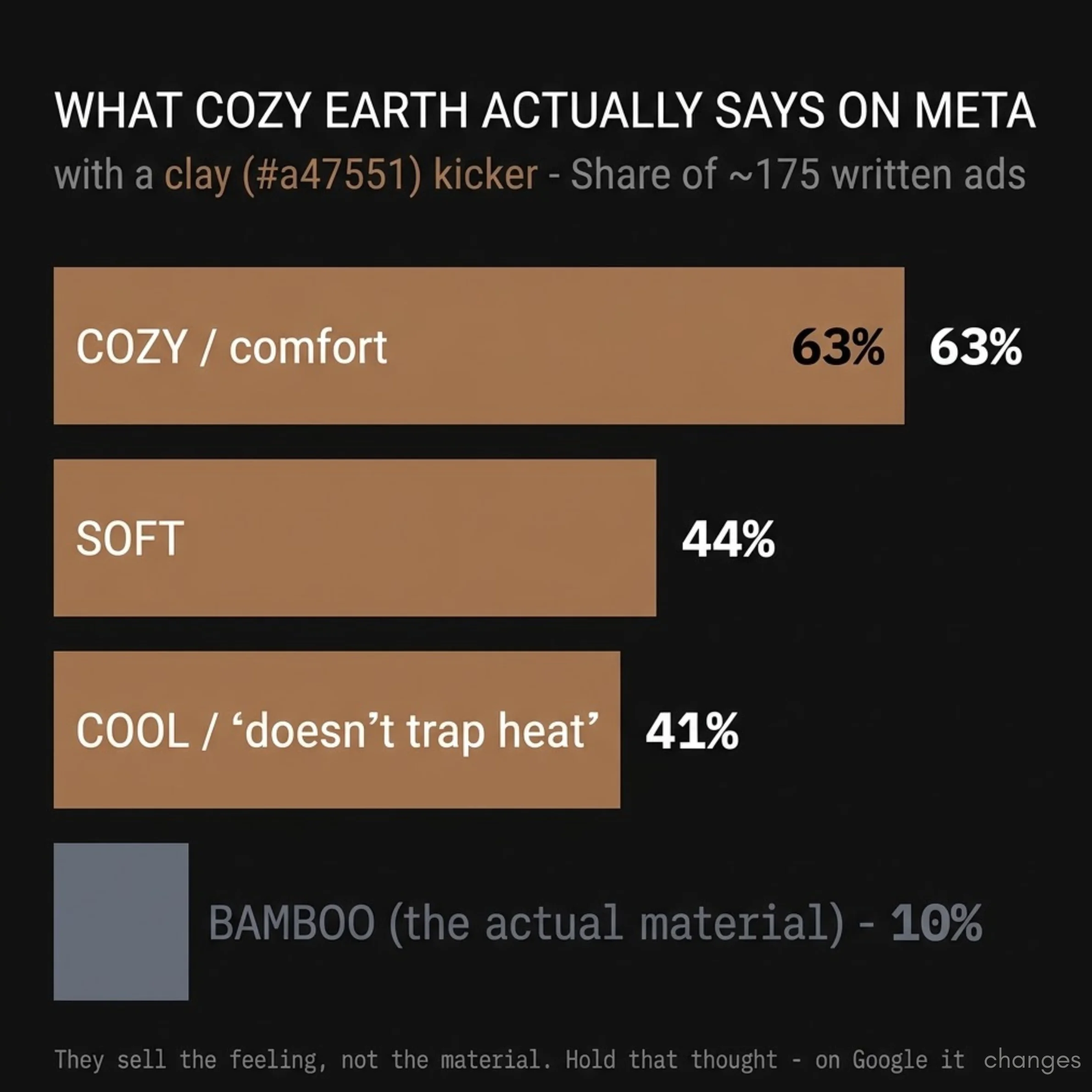
Only 10% of written ads name the material - "bamboo" or "viscose" - even though that's literally what the product is. Cozy Earth leads with the feeling and buries the spec. Hold onto that, because it doesn't survive the move to Google - bamboo goes from a buried word on Meta to a headline word on search.
The bamboo-sheets brand is quietly becoming a clothing brand
This is the finding I didn't expect. When I sorted by landing page destination:
/collections/sheets- 16 ads/collections/womens-pajamas- 16 ads/collections/robes- 9 ads/collections/comforters- 7 ads/collections/dresses- 7 ads/collections/womens-clothing,/collections/mens-clothing,/collections/bath- 4-5 ads each- plus midi skirts, cropped pants, tanks, and a "Baja Collection"
Cozy Earth is running paid ads on dresses, midi skirts, cropped pants, men's clothing, and a bath line. Headlines like "The Perfect Midi Dress" and "Maximum style, minimum effort." A brand the public still files under "the bamboo sheets company" is using its ad budget to become a full apparel and home label - and the ad mix is the evidence.
They barely discount, except through a side door
Across the 175 written ads, "% off" or "save" language appears in just 12%. "Free shipping" appears zero times. Actual discount values, where they exist, are modest: 20% off (18 ads), 15% off (15 ads). The recurring offer: "15% off sitewide, 20% off bundles. Ends May 10th" - which dates the whole sale to Mother's Day.
My read: premium protection. A brand selling $300 sheets on the promise they'll last can't slash the price weekly without undercutting the story. Same restraint HexClad showed, leaning on bundles over markdowns - though Cozy Earth doesn't even offer free shipping in-ad.
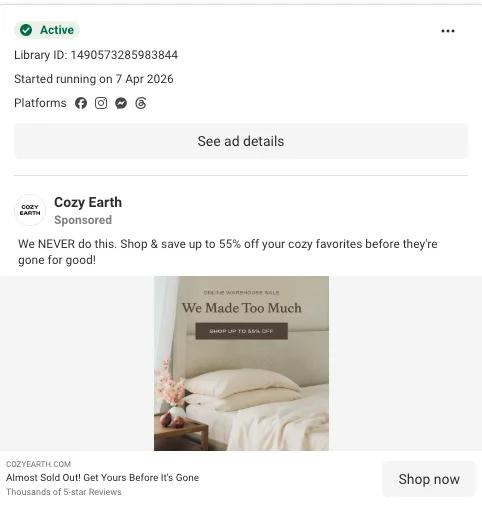
There's one exception, and it runs through a side door. 8 ads point at /collections/online-warehouse-sale, with copy like "We NEVER do this. Shop & save up to 55% off." The deep discounting exists - it's quarantined into an outlet collection, kept away from the premium front door.
One button does almost all the work
343 of the 369 ads - 93% - use "Shop now." The rest is a thin scatter of "Learn more" (25) and a single "See details." No awareness layer worth speaking of. The button is a solved variable.
The endorsement that isn't here
Cozy Earth is one of the most decorated brands in Oprah's Favorite Things history. Across all 369 ads, not one mentions Oprah, "favorite things," Forbes, or "as seen in."
The most valuable social proof the brand owns is sitting out of the entire paid-social account. My hunch is this is a channel decision rather than abandonment - and the Google teardown makes that hunch firmer, because the Oprah stamp reappears there.
Cozy Earth runs ads as a dietitian, a travel blogger, and a cat
Alongside the 369 brand ads, 31 more ads point to cozyearth.com but run from 21 different individual pages - lifestyle creators, a registered dietitian, a travel account, makeup artists, and a cat account called "Benedict the British Shorthair."
These are whitelisted partnership ads - Cozy Earth running paid creative through creators' handles to borrow their credibility. The tell: several share the exact same copy ("Maximum style, minimum effort") and some leak the same {{product.brand}} template tokens, meaning the brand is pushing its own catalog templates through other people's profiles.
The format flips too - the creator cluster is video-led (14 of 31), where the brand page is DCO-led. Two faces of one account: the automated catalog machine on the brand page, the human-feeling UGC on the creator pages.
What the data showed
- 369 active Meta ads, plus 31 more run through 21 creator/affiliate pages. Every ad started in 2026 - 277 in April. Oldest is 45 days old; median is 16 days. This is a campaign snapshot, not a creative history.
- 58% of the account is machine-assembled (44% DCO + 14% DPA). 199 of 369 ads carry Meta's
{{product.*}}template placeholders. Only ~175 ads have genuinely written copy. - A third of the account (123 ads) points at a Mother's Day landing page, all dated to a May 10 sale.
- A parallel $5,000 sweepstakes (15 ads) and loyalty signup (10 ads) run as a top-funnel list-building engine underneath the sale.
- Written copy locks into a few proven blocks; 124 ads carry multiple near-identical variants. The visual is the variable - not the words.
- The message: cozy (63%) + soft (44%) + cooling (41%). Only 10% name the material, "bamboo."
- The brand is advertising well beyond bedding: dresses, midi skirts, cropped pants, men's clothing, bath.
- Discounting is light (15-20% off, no in-ad free shipping), with deep cuts (up to 55%) quarantined to a warehouse sale page.
- 93% of ads use one CTA: "Shop now."
- Zero ads use the Oprah's Favorite Things endorsement - the single most valuable social proof the brand owns.
- The 31 creator ads (including a cat) are whitelisted partnership ads running the brand's own templates through outside profiles.
Cozy Earth's Meta account tells one story: a premium, lightly-discounted, US-facing brand that spun up an automated, gift-led campaign and pointed half of it at a product catalog instead of a copywriter.
The next article focuses on the Google account and how ads are run there. Until then ...
I'm tearing down a D2C brand every week. If there's a brand you want me to break down, DM me on X.
Share this teardown
Read Next
Cozy Earth Hides the Word "Bamboo" on Meta and Shouts It on Google
418 Google creatives: luxury in 61% of copy, bamboo in 35%, Oprah in 6 search ads, a 10-year warranty Meta never mentioned, and Black Friday discounts up to 40%.
543 Google Ads. 166 Went Dark on the Same Day. Here's What Survived.
A breakdown of Fresh Clean Threads' Google Ads strategy. Why 166 ads went dark in 3 days, why 78% of active ads are Shopping, and how their Google strategy diverges from Meta.
Fresh Clean Threads Runs 150 Meta Ads. Only 17 Pieces of Copy Power All of Them.
150 active ads, 87% algorithm-driven, 17 unique copy blocks, and three simultaneous promo codes. Inside a $60M basics brand that trusts Meta's machine more than its own creative team.