543 Google Ads. 166 Went Dark on the Same Day. Here's What Survived.
Contents
Previous article, I broke down Fresh Clean Threads’ 150 Meta ads. A $60M basics brand that handed 87% of its creative to the algorithm, ran three promo codes simultaneously, and launched 90 ads in 13 days for a St. Patrick’s Day push.
Now here’s what 543 Google ads reveal - and it’s a completely different operation.
On Meta, every single ad is active. 150 out of 150.
On Google, only 266 out of 543 are currently running.
The other 277 are dead. And most of them didn’t die gradually - 166 ads went dark within three days at the end of September 2025. That’s not attrition. That’s someone pulling a switch.
What survived, and what replaced them, tells a different story about how FCT uses Google versus Meta.
Here’s what the data shows.
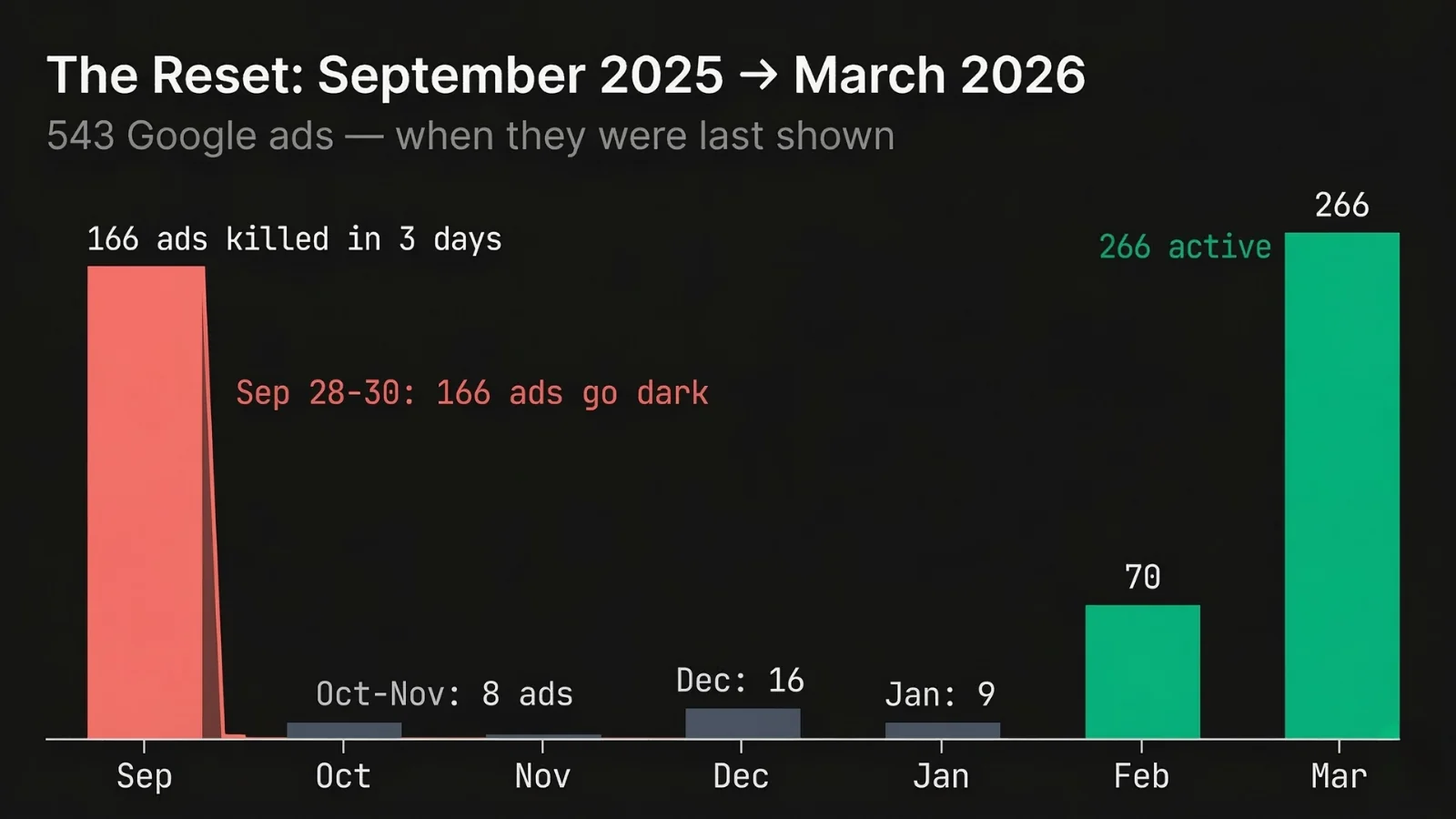
On September 28, 2025, Someone Turned Off 166 Ads in Three Days.
This is the most dramatic pattern in the dataset.
Between September 28 and September 30, 2025 - three days - 166 ads stopped showing. The breakdown:
- September 28: 26 ads went dark
- September 29: 135 ads went dark
- September 30: 5 ads went dark
Almost all of them were IMAGE format (162 out of 166). The remaining 4 were VIDEO. None of them have ‘firstShown’ dates in the data, so I can’t tell how long they’d been running before they were killed.
Then near-silence.
- October through November: 8 ads total.
- December: 16 ads came back.
- January: 9.
- February: 70.
- March: 266 active.
The timeline looks like a reset - either a campaign restructure, a budget reallocation, an agency change, or a strategic pause. The data doesn’t tell me which. But the pattern is unmistakable: FCT wiped their Google operation clean and rebuilt it from scratch over the following five months.
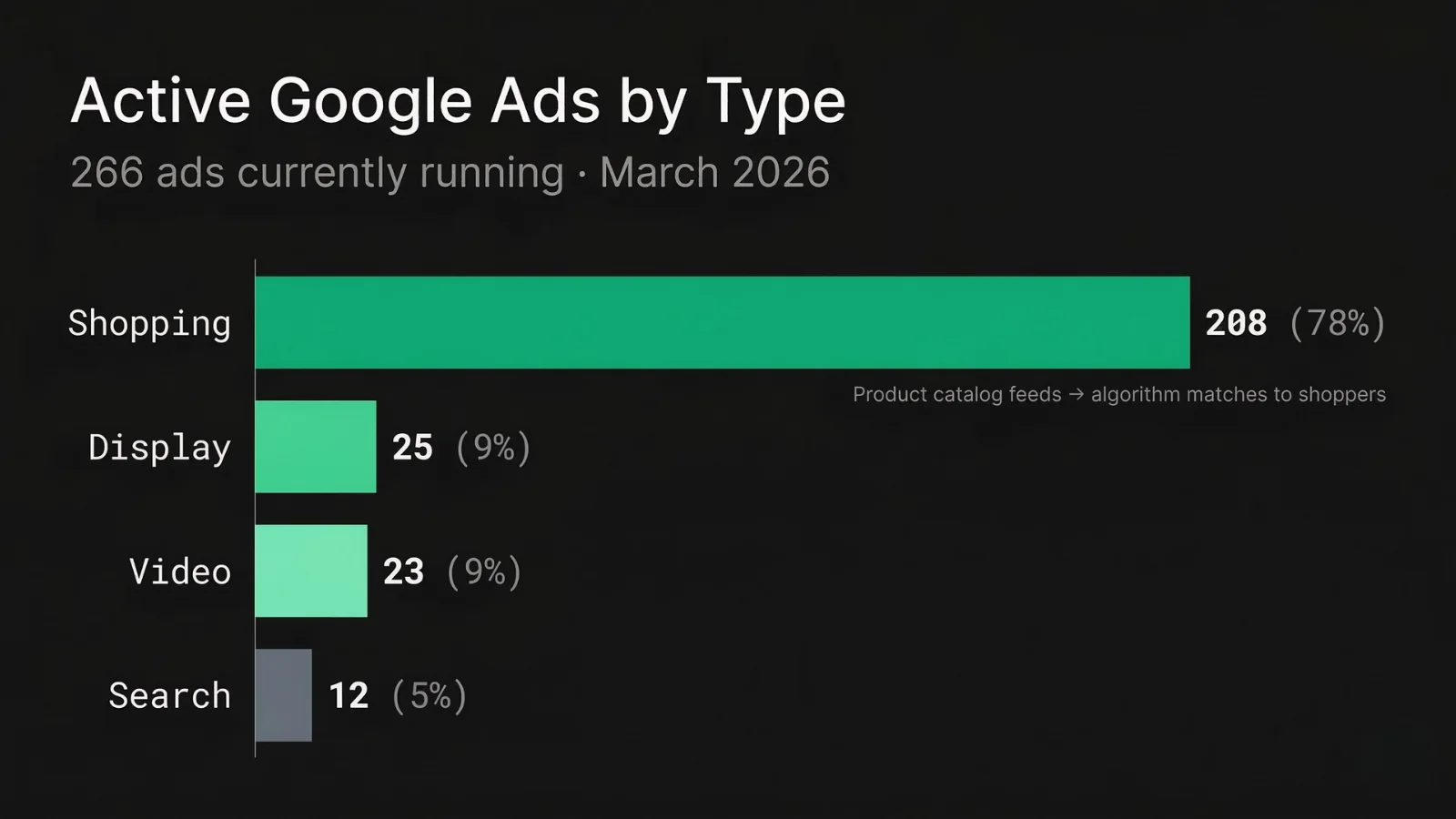
78% of Active Google Ads Are Shopping Ads. The Product Catalog Does the Selling.
Of the 266 currently active Google ads, the breakdown by ad type (from OCR classification):
- Shopping ads: 208 (78%) - product-catalog-fed, auto-generated from their Merchant Center feed
- Display ads: 25 (9%) - remarketing and awareness banners
- Video ads: 23 (9%) - YouTube pre-roll and discovery
- Search ads: 12 (5%) - keyword-intent text ads
Shopping dominates. 208 of 266 active ads are product catalog ads where the descriptions are auto-generated. The men’s-to-women’s catalog ratio is roughly 5:1 (56 “Men’s” descriptions versus 12 “Women’s”).
This mirrors the Meta philosophy. On Meta, 87% of ads are DCO - the brand uploads creative building blocks and lets the algorithm optimize. On Google, 78% are Shopping - the brand uploads a product catalog and lets the algorithm match products to shoppers.
In both cases, FCT is using the automation.
For context - the format split of the full 543-ad dataset (including stale ads) is 76.6% Image, 16.4% Text, 7% Video.
But the active picture shifts: Image stays dominant (221 active), Video holds at 23, and Text drops to just 22 active out of 89 total.
Text ads are where the highest kill rate happened - 75% of all text ads FCT ever ran on Google are now dead.
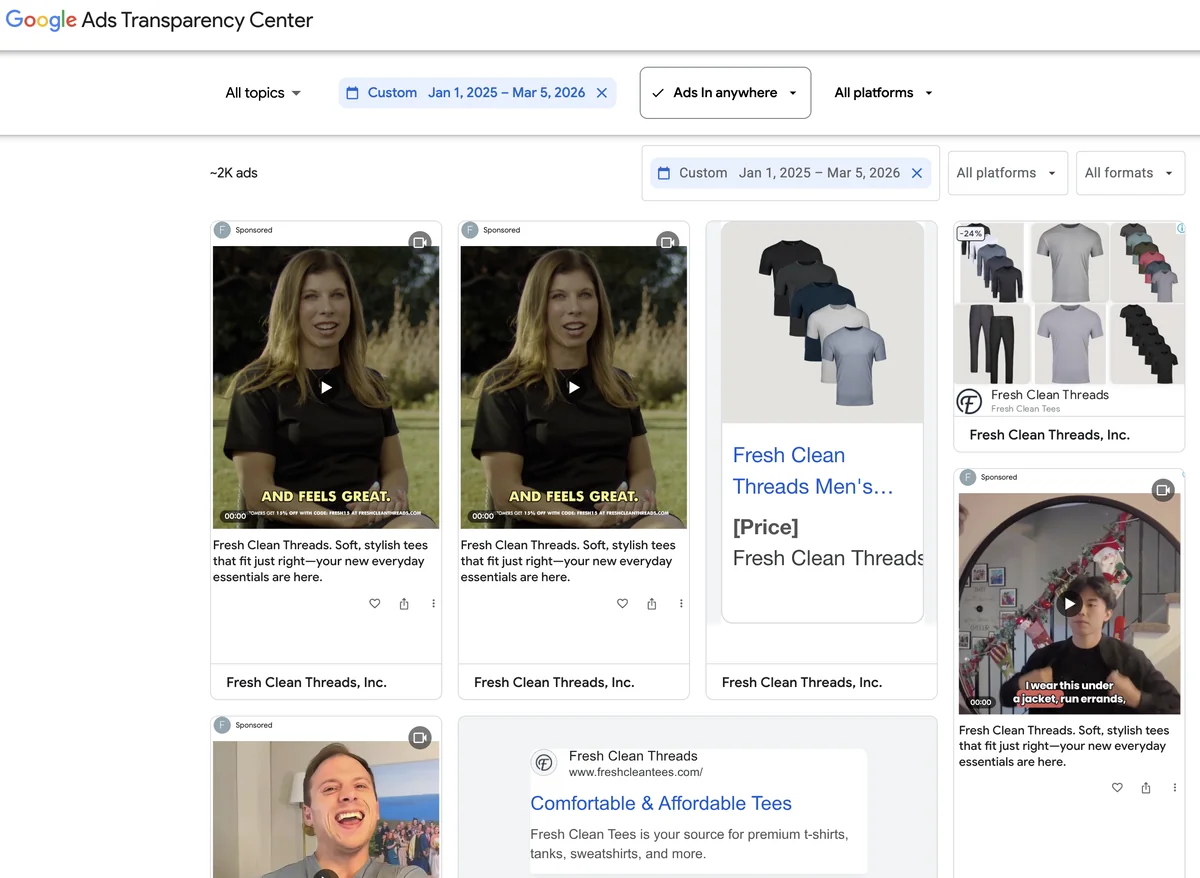
Google Captures Something Meta Can’t: Someone Searching “T-Shirts for Short Men.”
25 search ads in the dataset. And they reveal a targeting strategy that doesn’t exist anywhere on the Meta side.
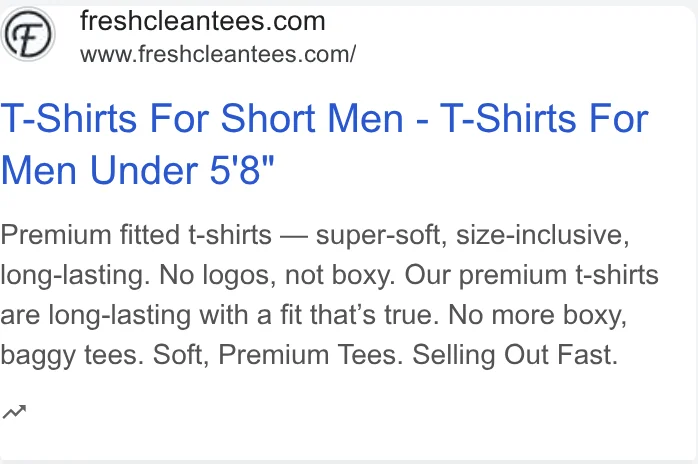
FCT runs search ads segmented by body type:
- Short men - “Short Length T-Shirts - T-Shirts For Men Under 5’8"" → landing at
/shirts/tees - Tall men - “Tall Length T-Shirts - T-Shirts For Tall Men” → landing at
/shirts/tees - Big guys - “T-Shirts For Big Guys - Men’s Basics, True to Size” → homepage
- DadBod - “Shop Fresh Clean Threads - Order Your Fresh Clean Tees” → landing at
/dadbod/tees - Women - “Women’s Classic Tees - The Best T-Shirts For Women” → homepage then
/womens/tees - General men - “Best T-Shirts For Men - Men’s Basics, True to Size” → homepage
7 of 25 search ads target a specific body type. Each gets a dedicated headline. Some get dedicated landing page URLs. This is Google doing what Meta structurally can’t - capturing someone at the exact moment they search “t-shirts for short men” or “big and tall tees.”
The search ad copy
The descriptions cluster around a few repeating phrases:
“Premium fitted t-shirts - super-soft, size-inclusive, long-lasting. No logos, not boxy.” (appears in 7+ ads)
“STOP spending $30+ on a single t-shirt. Your search for the comfiest fitted tees is over!” (appears in 5+ ads)
“Affordable style. Free shipping. Easy returns. Best wardrobe decision you’ll ever make.” (appears in 2 ads)
That “best wardrobe decision” line - same phrase as the 123-day survivor copy on Meta. It crosses platforms.
One conquest ad
“Fresh Clean Tees Vs True Classic - Shop Fresh Clean Threads.”
One ad out of 543 directly names a competitor. It’s an active search ad - last shown March 13, 2026 - with demographic and location targeting enabled. FCT knows who their competitor is and they’re bidding on the brand name.
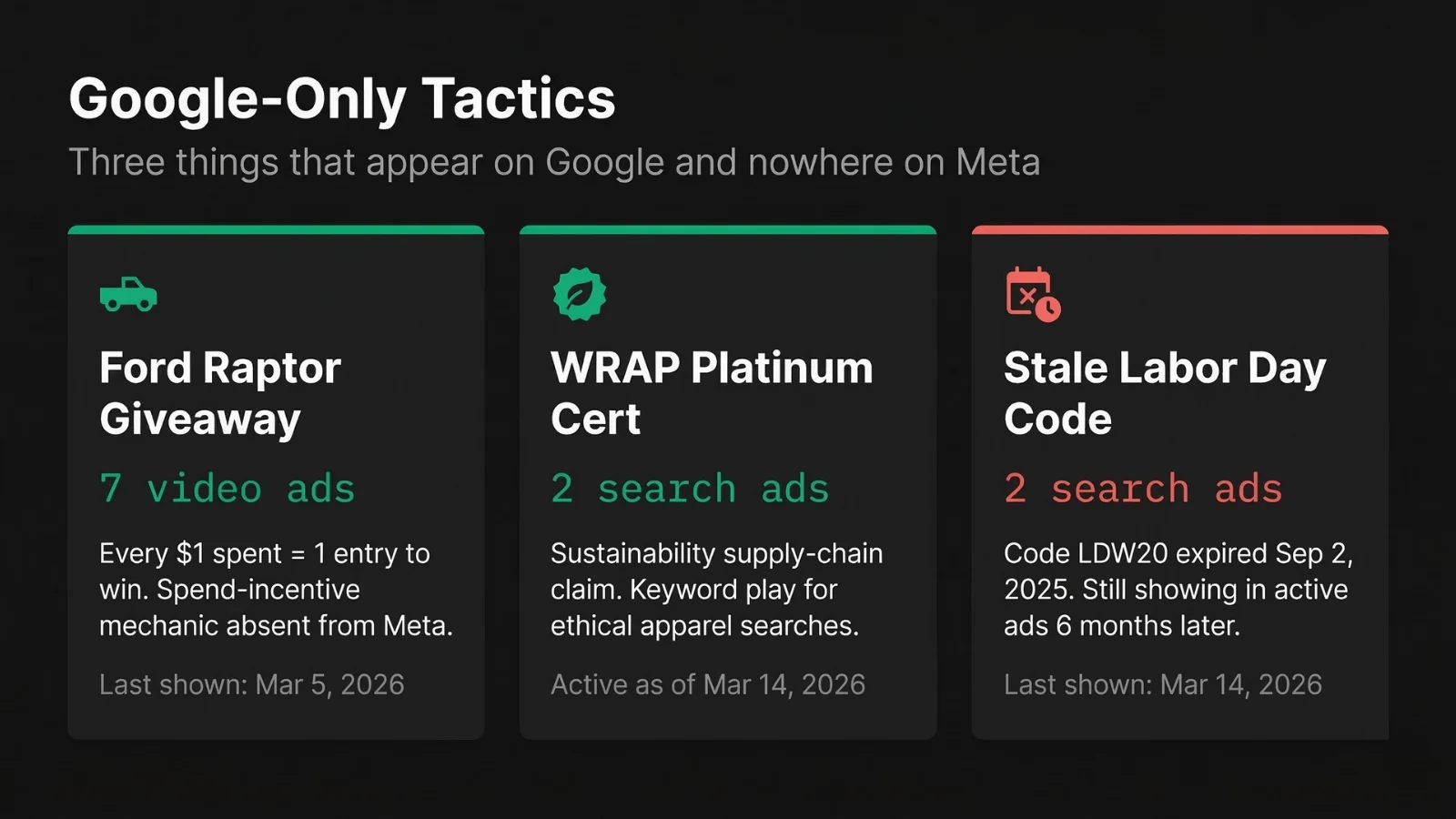
A Ford Raptor Giveaway, a Stale Labor Day Code, and a Sustainability Claim - All on Google, None on Meta.
Three tactics that only show up on the Google side:
1. The Ford Raptor giveaway
7 video ads, all last shown March 5, 2026. The messaging:
“WIN A FORD RAPTOR + $15K IN CASH, OR $100K IN CASH - EVERY $1 SPENT = 1 ENTRY TO WIN.”
This is a spend-incentive mechanic - the more you buy, the more entries you get. It doesn’t appear anywhere on Meta. My hunch is this targets a different buying mindset. On Meta, someone sees the ad in their feed and maybe clicks. On Google, someone is already searching for t-shirts - they’re closer to purchase. The Raptor giveaway gives them an extra push to spend more per order.
2. WRAP Platinum certification
Two search ads mention:
“Our shirts are WRAP platinum-certified, emphasizing our dedication to sustainability.”
WRAP is a supply-chain ethics certification for apparel manufacturing. This doesn’t appear once in any of the 150 Meta ads. On Google, it shows up in ad descriptions - likely a keyword play targeting people searching for ethical or sustainable apparel. It’s a credibility signal for intent-based searches, not a brand storytelling element.
3. Stale Labor Day promo
Two active search ads still carry:
“Labor Day · 20% off All Orders Code LDW20 · Valid Aug 26 - Sep 2.”
That promo expired over six months ago. These ads were last shown March 14, 2026 - with an expired coupon code still in the copy.
Likely an ad extension or sitelink that hasn’t been updated. Small detail, but it tells you something about how closely the Google account is being monitored versus Meta (where the PADDY20 code was precision-timed to launch March 12 for St. Patrick’s Day).
Targeting on Google: Barely There.
On Meta, FCT blankets every placement - 150 of 150 ads across Facebook, Instagram, Messenger, Threads, and Audience Network. No visible audience segmentation. Let the algorithm figure it out.
Google is similar, but with a few exceptions.
Out of 543 total ads:
- 10 ads use demographic targeting (including) - all search ads
- 10 ads use location targeting (including) - same 10 search ads
- 6 ads use location exclusions - excluding certain geographies
- 0 ads use customer list targeting - zero
The 10 targeted search ads are the same ones with demographic + location enabled. These include the women’s ad, the True Classic conquest ad, the men’s classics ad, and a few body-type-specific ads. The other 533 ads - Shopping, Display, Video, and the remaining Search - run with no targeting refinement at all.
Zero customer list targeting on Google is notable. No lookalike audiences. No retargeting based on CRM data through Google. All retargeting appears to happen through Meta’s DPA ads (the 7 DPA ads in the Meta account dating back to October 2025).
Geographic reach is wider than Meta
Google ads show region data across the United States (447 region hits), Canada (42), and a spread across Europe - Spain, Italy, France, Poland, Austria, Portugal, Germany, Greece, India, Ireland. On Meta, FCT is strictly US + Canada (with a dedicated Canadian landing page).
I think this means Google Shopping may be running on a wider geographic net through Google Merchant Center’s international targeting - while Meta is kept tighter to core markets where they have localized landing pages.
Same Brand. Same Products. Completely Different Ad Machines.
Here’s how the two platforms compare side by side.
Scale
- Meta: 150 ads, 100% active
- Google: 543 total, 266 active (49%)
Algorithm reliance
- Meta: 87% algorithm-driven (123 DCO + 7 DPA)
- Google: 78% algorithm-driven (208 Shopping)
- Both platforms: FCT lets the machine optimize. On Meta it’s dynamic creative. On Google it’s product catalog. The philosophy is the same - supply the building blocks, let the platform figure out the combinations.
Hand-crafted creative
- Meta: 13% (20 ads - 19 Video + 1 Image)
- Google: 22% (58 ads - 25 Display + 12 Search + 21 Video non-Shopping)
- Google gets slightly more human attention in the ad creation process, but “slightly more” is relative - it’s still overwhelmingly automated on both sides.
Format strategy
- Meta: DCO carousel dominates (82%). Video is the UGC layer (12.7%).
- Google: Shopping images dominate (78%). Video is the giveaway/brand layer (9%). Text is the search intent layer (5%).
- The formats match the platform’s strength. Meta gets the visual storytelling. Google gets the catalog + search intent.
Discount strategy
- Meta: 35% of ads contain promo language. Three active codes (PADDY20, FRESH15, PRES20). Up to 75% off sale collection.
- Google: 6% of active ads show offers. Ford Raptor giveaway as the main incentive. Stale LDW20 code still lingering.
- Meta is the promo-forward channel. Google barely discounts - it relies on the product catalog and the giveaway mechanic instead.
Sizing segmentation
- Meta: Segments by gender. Men’s landing page vs Women’s landing page.
- Google: Segments by body type within gender. Short men, tall men, big guys, DadBod, women - each with dedicated search headlines and some with unique landing URLs.
- Google goes one level deeper than Meta on sizing. This makes sense - people search Google for “t-shirts for short men.” Nobody searches Meta that way.
Geographic reach
- Meta: US + Canada (with dedicated Canadian landing page and funnel)
- Google: US + Canada + Spain, Italy, France, Poland, Austria, Portugal, Germany, Greece, India, Ireland
- Google casts a wider net internationally through Shopping, while Meta stays focused on the two markets with localized infrastructure.
Shared messaging across platforms
Some phrases appear on both:
- “No logos” - Meta: 6 mentions, Google: 13 mentions
- “Best wardrobe decision” - Meta: 38 mentions, Google: 2 mentions
- “Stop spending $30” - Meta: 38 mentions, Google: 5 mentions
But some messaging is platform-exclusive:
- Meta only: “No gimmicks,” “wash after wash,” “StratuSoft™”
- Google only: Body-type sizing keywords, WRAP Platinum certification, Ford Raptor giveaway
The shared messaging is the value proposition. The platform-specific messaging is the tactical hook designed for how people use each platform.
What this looks like across the series
Every brand in this series has a different platform balance:
- Ridge - Meta only (273 ads). 82% hand-crafted. Zero discounts. Zero algorithm reliance beyond standard delivery optimization.
- Obvi - Meta + Google (149 ads). 70% video on Meta, story-led. Google was the keyword workhorse. Zero discounts on Meta.
- RYZE - Meta + Google (800 ads). One copy formula at 56%. 94% Shop Now workhorse with a hidden brand campaign. 15% Spanish-language expansion.
- FCT - Meta + Google (693 ads). 87% algorithm-driven on Meta, 78% on Google. Discount-forward. Body-type keyword segmentation on Google. Women’s expansion in progress.
FCT is the most algorithm-reliant brand in the series by a significant margin. And the only one comfortable running heavy discounts on Meta.
Data Limitations
A few things the data can’t tell us:
- No spend data on either platform. I can’t tell you how much FCT spends on Meta vs Google.
- No impression or CTR data. Longevity is the closest proxy for performance on Meta. On Google, even that’s limited - I have lastShown dates but no firstShown for most ads.
- 261 Google ads had no preview URLs - I can see their format and dates but not their actual creative or copy.
- The September kill-off has no context. It could be strategic, budget-driven, or agency-related. The data shows the event clearly but not the reason.
- Google Shopping descriptions are auto-generated from the product catalog. The copy quality depends on the feed, not an ad copywriter.
- No Snapchat data. There’s no public Snapchat ad library to check.
What the Data Shows - Summary
- 543 Google ads scraped, 266 currently active (49%). The other 277 are historical - mostly killed in a mass event September 28-30, 2025.
- 166 ads went dark in 3 days (Sep 28-30). Almost all IMAGE format. No context on why - but the rebuild took 5 months.
- 78% of active Google ads are Shopping - product-catalog-driven, auto-generated descriptions. The catalog IS the creative.
- Search ads segment by body type - short men, tall men, big guys, DadBod, women. 7 of 25 search ads target specific body types with dedicated headlines and landing URLs. This doesn’t exist on Meta.
- 1 conquest ad targets True Classic by name. Active as of March 13, 2026.
- Ford Raptor giveaway - 7 Google-only video ads. Spend-to-enter mechanic absent from Meta.
- WRAP Platinum certification appears in 2 Google search ads. Sustainability claim that doesn’t appear on Meta - likely a keyword play.
- Stale Labor Day promo (LDW20) still running in 2 active ads. Expired 6+ months ago.
- Targeting is minimal. 10 ads with demographic targeting, 10 with location, 0 with customer lists. 533 of 543 ads run untargeted.
- Geographic reach is wider than Meta. Google ads span US, Canada, and 10+ European countries. Meta is US + Canada only.
- Cross-platform philosophy is identical: let algorithms optimize. Meta = 87% DCO. Google = 78% Shopping. Both platforms get the building blocks, the machine does the rest.
- Discount strategy diverges: Meta is promo-forward (35% of ads). Google barely discounts (6%).
I’m tearing down a D2C brand every week. If there’s a brand you want me to break down, DM me on X.
Share this teardown
Read Next
Fresh Clean Threads Runs 150 Meta Ads. Only 17 Pieces of Copy Power All of Them.
150 active ads, 87% algorithm-driven, 17 unique copy blocks, and three simultaneous promo codes. Inside a $60M basics brand that trusts Meta's machine more than its own creative team.
Graza Has 128 Google Ads Spanning a Full Year. The Meta Account Is 11 Days Old.
128 Google ads across 12 months - EVOO cans, Amazon Shopping, a 20.74% Black Friday sale, and a video-only glass bottle launch. The platform where Graza has been experimenting long before Meta.
Graza Runs 76 Meta Ads. 54 of Them Launched on the Same Day.
76 ads, two product lines, and 54 launched in a single day. Inside a $48M olive oil brand's first real step into the paid social machine.