Graza Runs 76 Meta Ads. 54 of Them Launched on the Same Day.
Contents
Every brand in this series has had months - sometimes years - of ad history to dig through. Ridge Wallet had 273 ads spanning multiple seasons. Little Sleepies had 350 ads with some running for 81 days. RYZE Superfoods had 400 ads and copy survivors dating back 9 months.
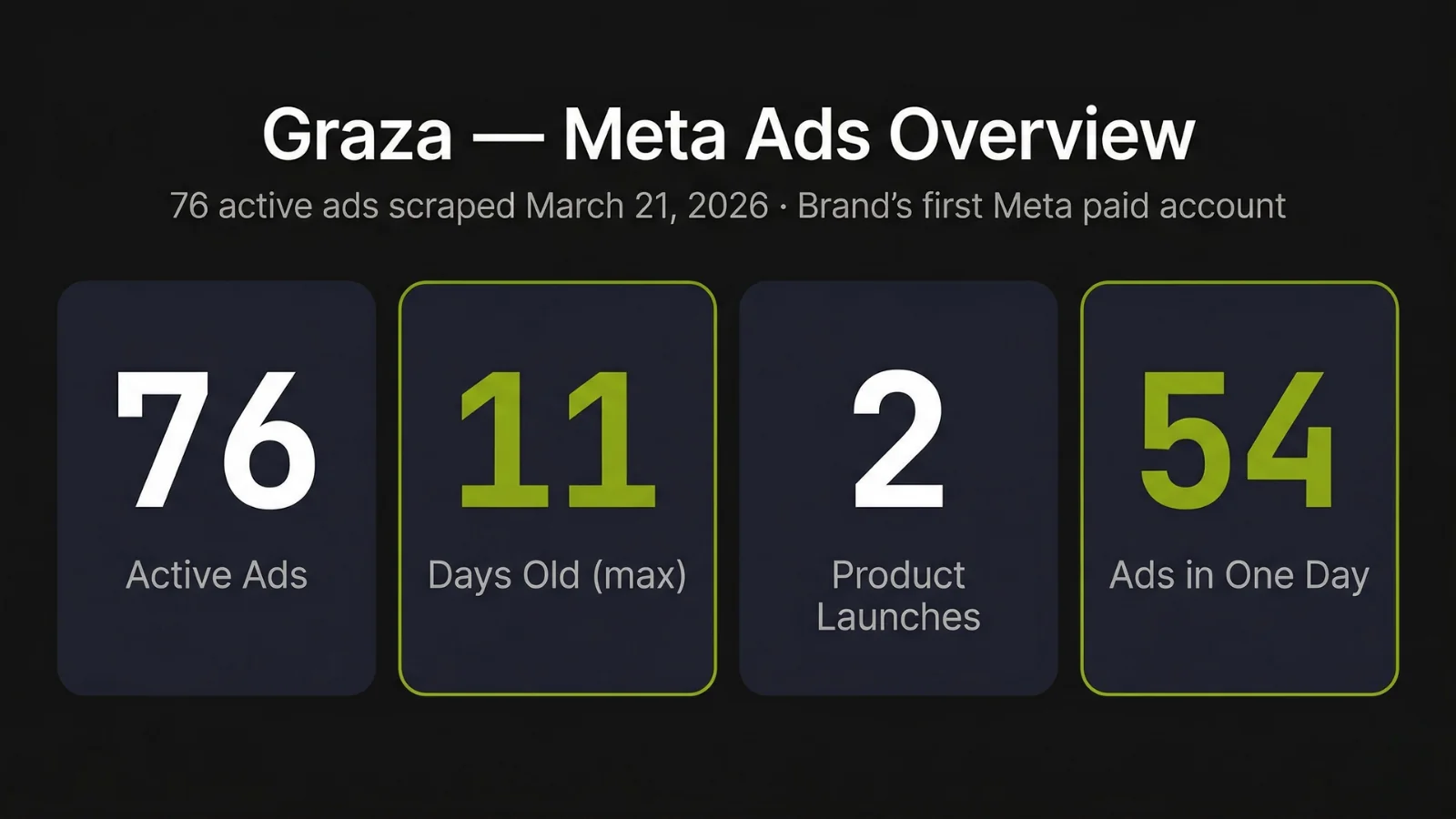
Graza has 76 ads. The oldest one is 11 days old.
What I’m looking at isn’t a mature ad account. It’s a launch. Specifically, it’s two launches - a mayo campaign that started March 10, followed by a massive olive oil catalog drop on March 20 where 54 ads went live in a single day. Two product lines. Two creative strategies. Zero overlap in timing.
Some context on the brand. Graza is a ~$48M olive oil company founded in 2022 by Andrew Benin and Allen Dushi. Benin worked at Warby Parker, Casper, and Magic Spoon before falling in love with olive oil while living in Spain. His mentor, chef Mike Anthony of Michelin-starred Gramercy Tavern, told him the world didn’t need another expensive boutique olive oil - it needed great oil that regular people could actually afford. So Benin put it in a squeeze bottle and priced it at $16.
The squeeze bottle was the moment. Graza sold out in their first week - $100K in revenue without a single paid ad. They hit $500K within three months, entirely through influencer seeding. By end of 2024, revenue reached $48.4M and the product was stocked in 13,000+ retailers including Whole Foods, Target, Costco, and Walmart.
For a brand that grew to $48M without paid Meta ads, this account is their first real step into the paid social machine. And the way they’ve built it tells you a lot about how they think.
Two Launches, Two Weeks Apart, Zero Overlap.
The most interesting pattern in this account isn’t any single ad. It’s the timeline.
The 76 ads didn’t launch all at once. They rolled out in two distinct phases:
Phase 1: The Mayo Launch (March 10–15)
19 ads. 16 of them point to /products/original-mayo. 8 are video, 11 are DCO. This is a dedicated new-product launch - Graza Mayo, their first product outside of olive oil.
The videos are a mix of brand-produced content (“FACT: We tasted 150+ mayo formulas about 150 times each”) and UGC recipe content from food creators (lobster rolls, ribeye with curry mayo, chorizo crostinis). The DCO ads carry the product education cards.
Then from March 16 to 19 - one ad. Just one, on March 19 (a brand video about their olive oil sommelier). A near-complete pause.
Phase 2: The Olive Oil Catalog Drop (March 20–21)
57 ads. 54 on March 20 alone. Zero mayo ads. This is the full olive oil product line hitting Meta for the first time:
- The Trio (Sizzle + Drizzle + Frizzle bundle) - 20 ads
- Sizzle + Drizzle Combo - 13 ads
- Frizzle Squeeze - 7 ads
- Duo Glass - 7 ads
- Subscribe page - 5 ads
- Olive Oil Collection - 3 ads
- Starter Kit - 2 ads
Two product lines. Two launch windows. The mayo got a week-long runway with creator content before the olive oil catalog flooded in. I think the sequence is deliberate - launch mayo when it’s the only thing in the account, let it get traction, then bring in the core products.
77.6% DCO on a Single Template. The Same Machine Everyone’s Using.
59 of 76 ads (77.6%) are DCO - Dynamic Creative Optimization. All using the exact same template: {{product.brand}} for body text, with the real messaging inside the cards.
If you’ve been following this series, this number might look familiar. Little Sleepies was 82.3% DCO. FCT was 82%. RYZE had heavy DCO. The template-driven, algorithm-optimized approach is now standard across every D2C brand I’ve covered.
What makes Graza different isn’t the DCO structure - it’s the scale. 59 DCO ads carrying 127 total cards with only 19 unique card bodies. That’s lean. Little Sleepies had 927 cards across 37 collections. RYZE had 400 ads with 28 copy variants. Graza is running a tighter operation - fewer products, fewer messages, more focused.
The remaining 17 non-DCO ads are:
- 16 video ads - each with hand-written body copy, 13 unique texts
- 1 static image ad - the only one in the entire account
No static image strategy. If you’re seeing a still photo from Graza on Instagram, it’s coming through a DCO card, not a standalone ad.
Every Ad Is a Single-Product Push. 100% Uniformity.
Same pattern as Little Sleepies. Across all 59 DCO ads, every card within a given ad points to the same product URL. When an ad pushes The Trio, all cards go to /products/the-trio. When it’s Mayo, all cards go to /products/original-mayo.
Zero mixed-product carousels. Zero ads where one card sells olive oil and another sells mayo. Each ad is one product, one message, one landing page.
But unlike Little Sleepies - which sent ads to 37 different collection URLs - Graza only has 8 product destinations. This isn’t a drop calendar. It’s a product catalog. The brand has fewer products, so each one gets more concentrated attention.
The product hierarchy
Ad + card URL appearances tell you where they’re putting the most weight:
- The Trio: 56 total appearances - the hero bundle
- Original Mayo: 41 - the newest product, getting outsized push
- Sizzle + Drizzle Combo: 37 - the core duo
- Frizzle Squeeze: 21 - the high-heat cooking oil
- Subscribe page: 19 - subscription funnel
- Duo Glass: 11 - premium glass format
- Olive Oil Collection: 9 - broad catalog page
- Starter Kit: 6 - entry-level bundle
Mayo is 10 days old in this account but already commands the #2 spot with 41 appearances. That’s a meaningful allocation for a brand-new product. They’re not testing mayo quietly - they’re pushing it hard from day one.
Two Different Voices for Two Different Products.
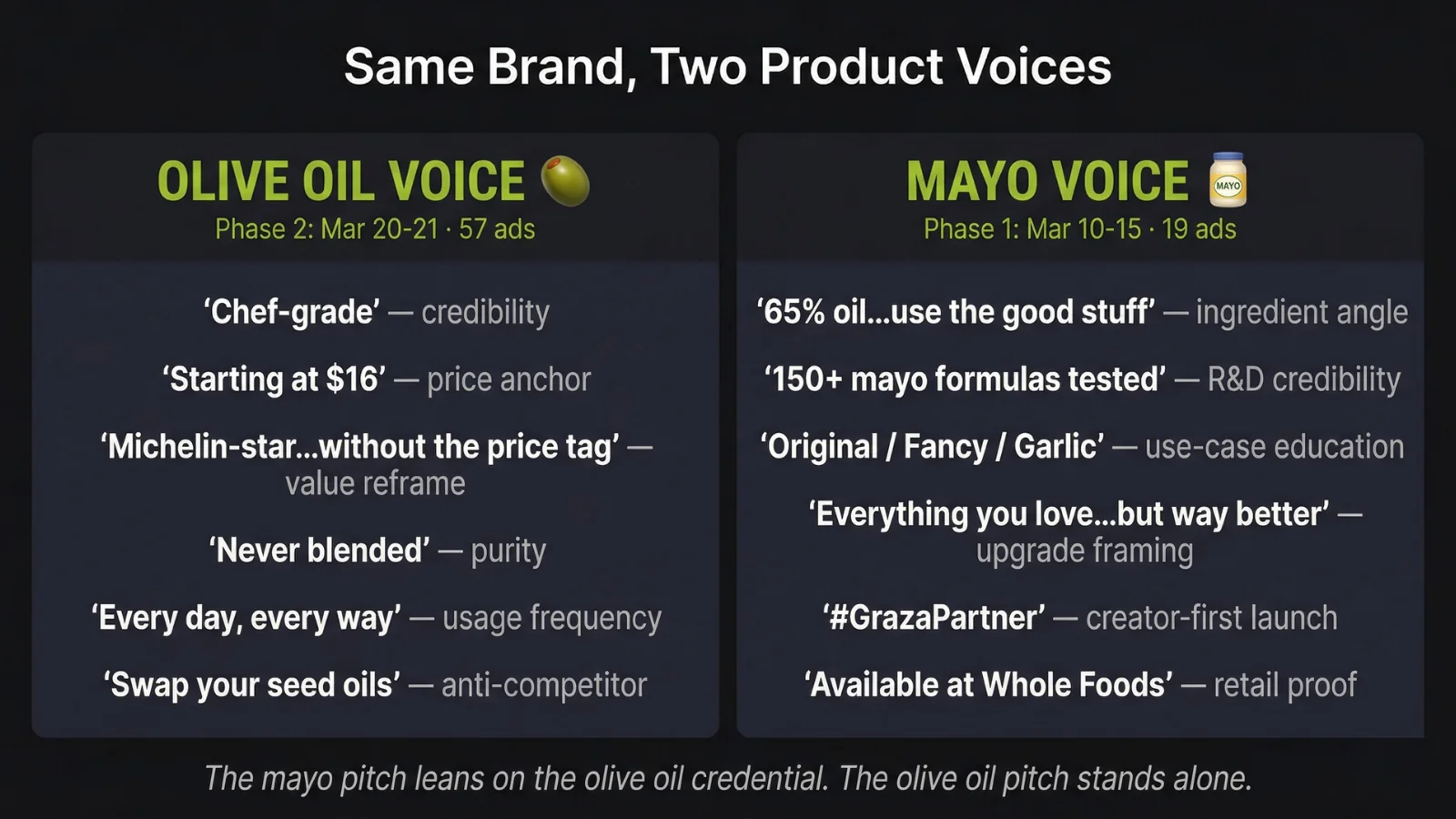
The 19 unique card bodies split into two distinct messaging worlds. I categorized them by which product they serve, and the voices are noticeably different.
The olive oil messaging
Product education meets accessible luxury:
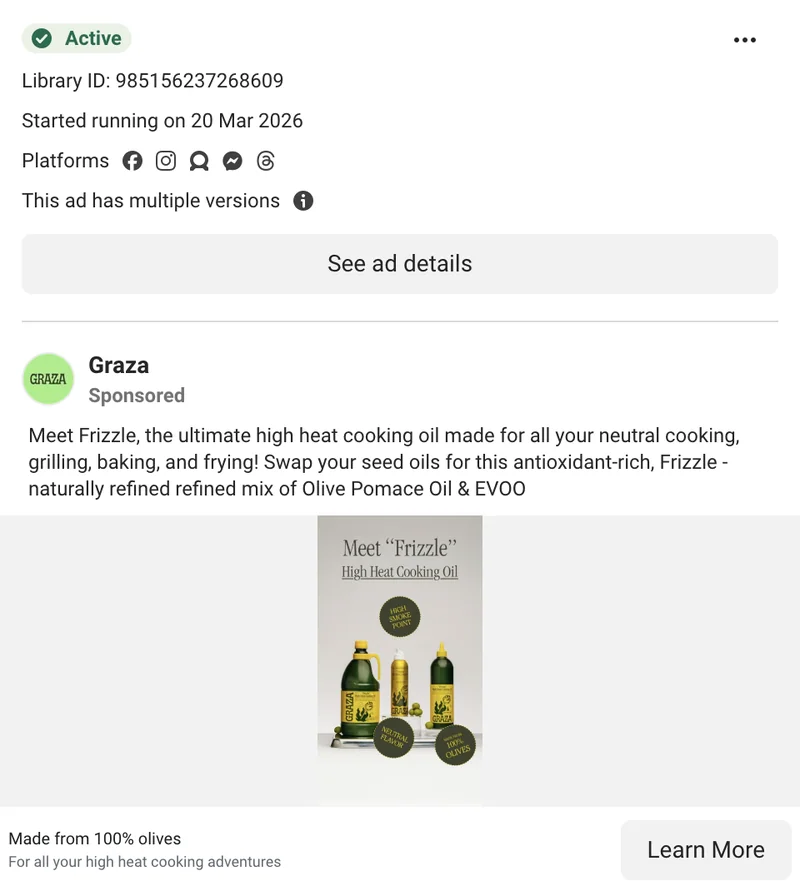
”🫒✨Meet Sizzle, Drizzle, & Frizzle: three must-have olive oils for all your cooking, dressing, and grilling!”
“One olive, two very different oils. Use ‘Sizzle’ for cooking, and ‘Drizzle’ for dipping & dressing!”
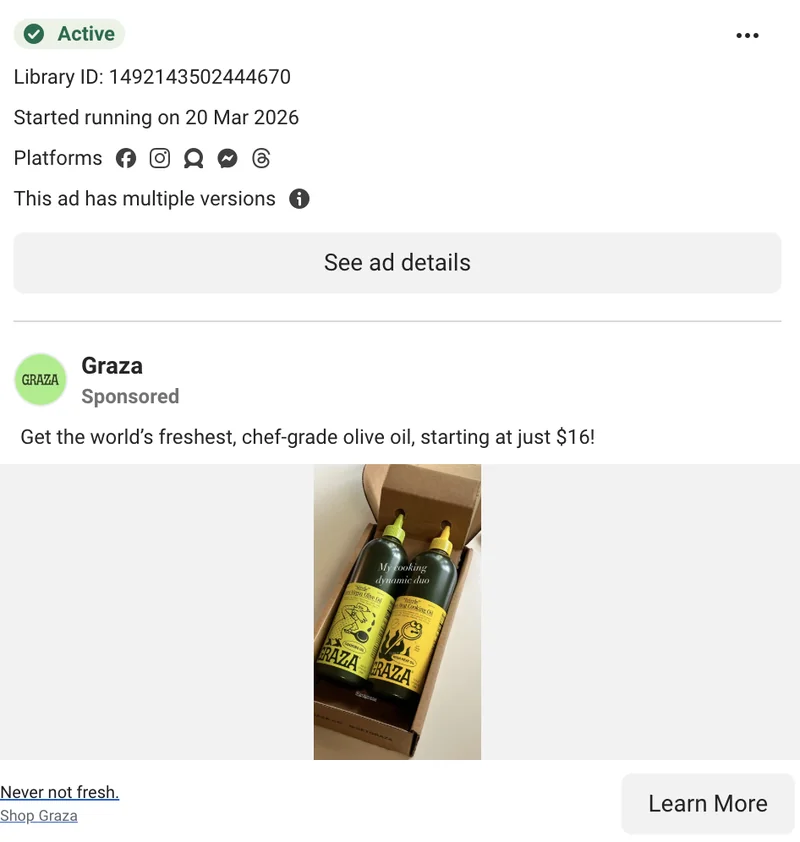
“Get the world’s freshest, chef-grade olive oil, starting at just $16!”
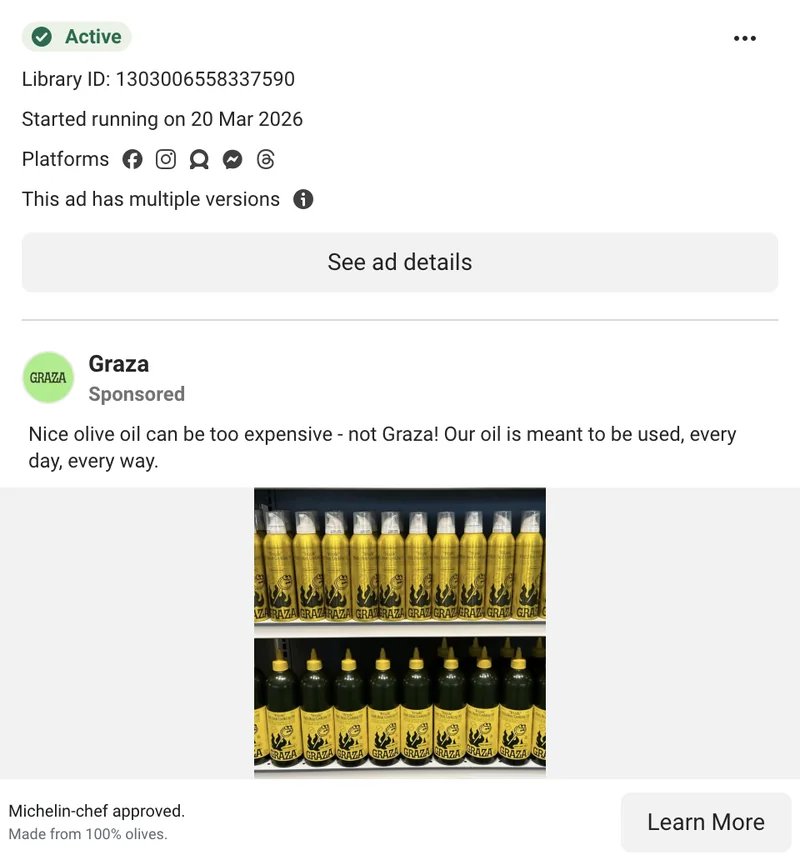
“Nice olive oil can be too expensive - not Graza! Our oil is meant to be used, every day, every way.”
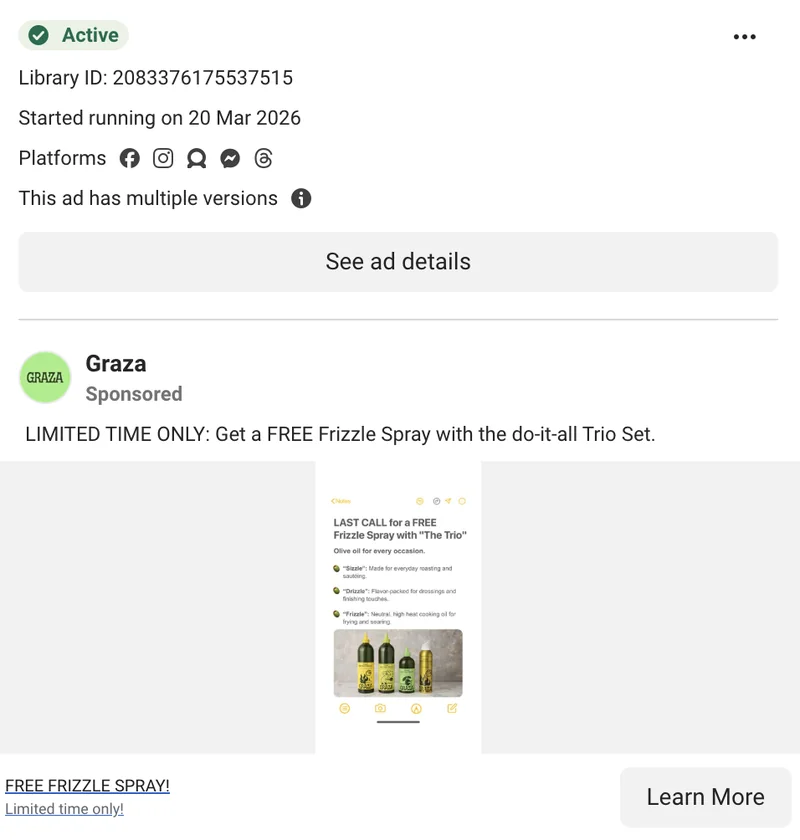
“LIMITED TIME ONLY: Get a FREE Frizzle Spray with the do-it-all Trio Set.”
“Always fresh, never blended. This is Michelin-quality olive oil that’s made to be used.”
The messaging does three things simultaneously: educates you on which product to use when (Sizzle vs Drizzle vs Frizzle), anchors the price at $16, and uses Michelin-star credibility to justify why the $16 price point is actually a steal. Classic value reframing - they don’t say “cheap olive oil,” they say “Michelin-quality olive oil at a real-person price.”
The mayo messaging
Product launch meets ingredient credibility:
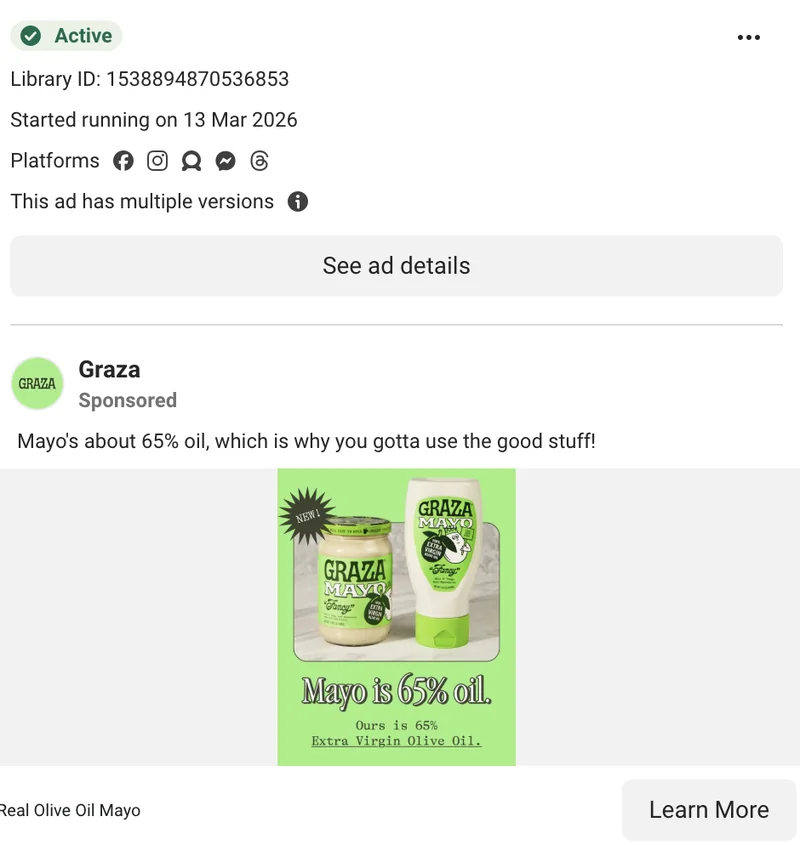
“Mayo’s about 65% oil, which is why you gotta use the good stuff!”
“Meet Graza Mayo: everything you love about mayo… but way better. 🫒 Use ‘Original’ Mayo for potato salad or deviled eggs! 🫒 Use ‘Fancy’ Mayo for whipping up a salad dressing! 🫒 Use ‘Garlic’ Aioli for dolloping on tacos!”
The mayo pitch doesn’t stand on its own. It leans on the olive oil credential as its differentiator. “Mayo’s about 65% oil” - the first thing they tell you about the mayo is that it’s mostly oil. Then the implication: if you already trust Graza’s olive oil, you should trust their mayo. The olive oil reputation IS the mayo’s selling point.
Five Messaging Pillars - Each Targeting a Different Objection.
Across all card bodies and ad copy, the messaging clusters around five distinct pillars. Each one answers a different reason someone might not buy.
1. Product education (dominant)
“Sizzle” appears 48 times. “Drizzle” 52. “Frizzle” 51. “Cooking” 65. “Grilling” 30. “Dressing” 36. Most of the copy is teaching people what each product does and when to use it. The three-product naming system (Sizzle/Drizzle/Frizzle) is both the brand identity and the education framework - the names tell you the use case.
2. Value and price anchoring
“$16” appears 14 times. “Too expensive” 12 times. “Michelin” 7 times as a price anchor. “Nice olive oil can be too expensive - not Graza!” directly addresses the objection that good olive oil is a luxury purchase. The Michelin reference reframes the price: you’re not buying cheap oil, you’re getting restaurant-quality oil at a fraction of the restaurant price.
3. Freshness and purity
“Fresh” 21 mentions. “Never blended” 8. “Single origin” 4. “100%” 4. This is the quality story - Graza is made from 100% Picual olives, single origin, cold-pressed in Spain. “Never blended” is a direct jab at the grocery-store olive oil market, where most extra-virgin olive oil is blended or fraudulent (a well-documented industry problem).
4. Anti-seed-oil positioning
“Seed oil” 7 mentions. “Swap” 7.
“Swap your seed oils for Frizzle - our new high heat cooking oil made from 100% olives!”
This taps into the health-conscious anti-seed-oil movement that’s been gaining traction online. Graza isn’t just selling olive oil - they’re positioning as the replacement for canola, vegetable, and other seed oils. The competitor isn’t another olive oil brand. It’s the bottle of Wesson in your cabinet.
5. Mayo as olive oil extension
“Mayo” 70 total mentions across all text. “65% oil” 15. “Aioli” 18. The mayo messaging doesn’t try to compete with Hellmann’s on mayo-ness. It competes on ingredient quality.
“Mayo’s about 65% oil, which is why you gotta use the good stuff”
One sentence that turns an olive oil brand into a mayo brand.
Video Splits Cleanly - UGC for Mayo, Brand-Produced for Olive Oil.
16 video ads. Two completely different content strategies depending on the product.
Mayo videos: UGC recipe content (5 ads)
All five mayo video ads are creator-generated. Real food people making real recipes with Graza mayo:
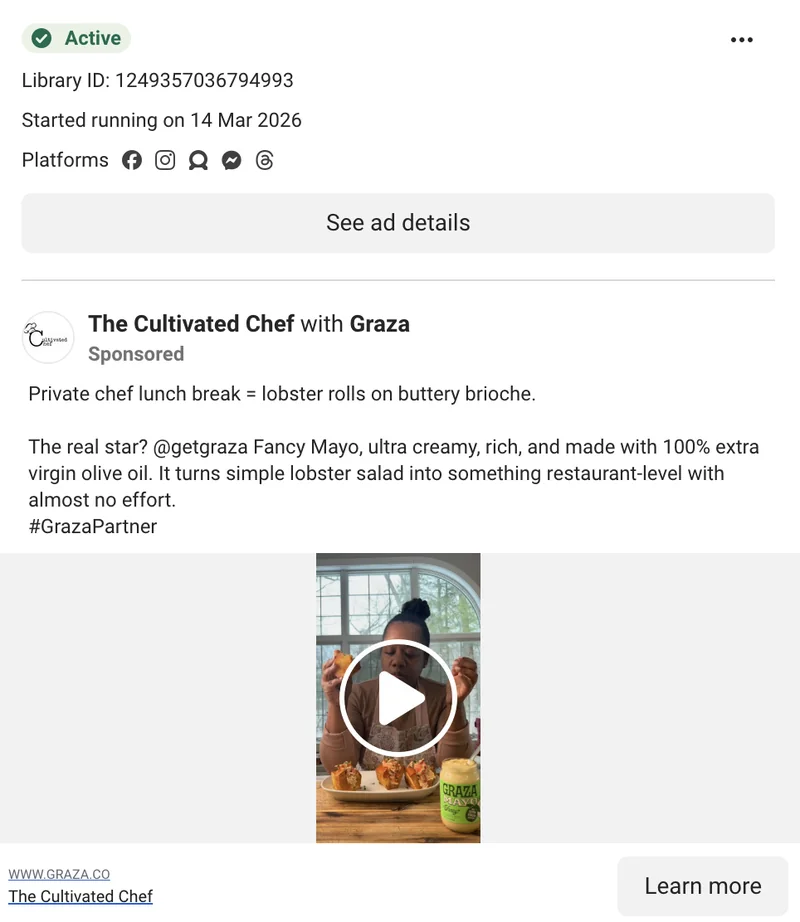
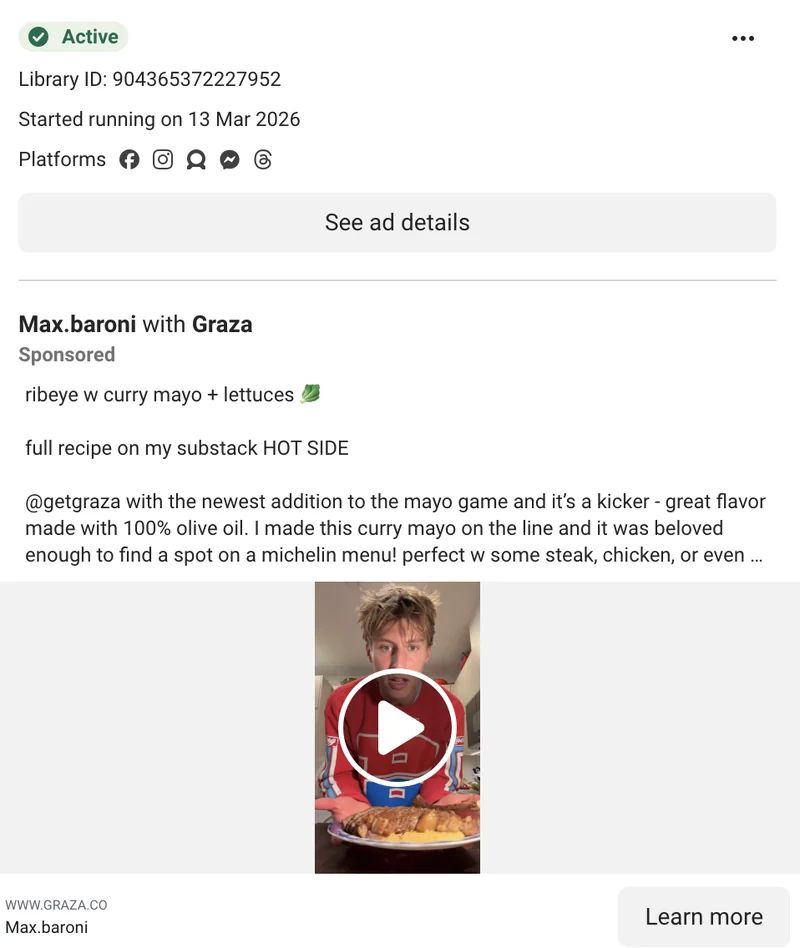
- Private chef making lobster rolls with Fancy Mayo
- Michelin-experienced cook doing ribeye with curry mayo (from their Substack “HOT SIDE”)
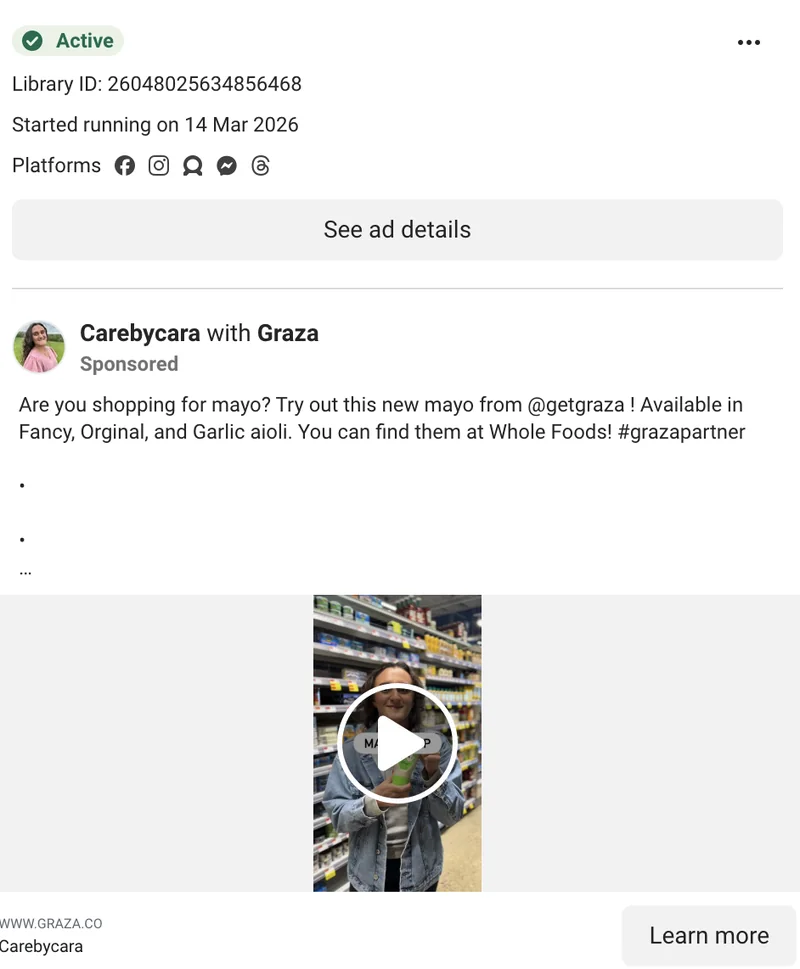
- “Are you shopping for mayo?” - a straightforward product review from a Whole Foods shopper
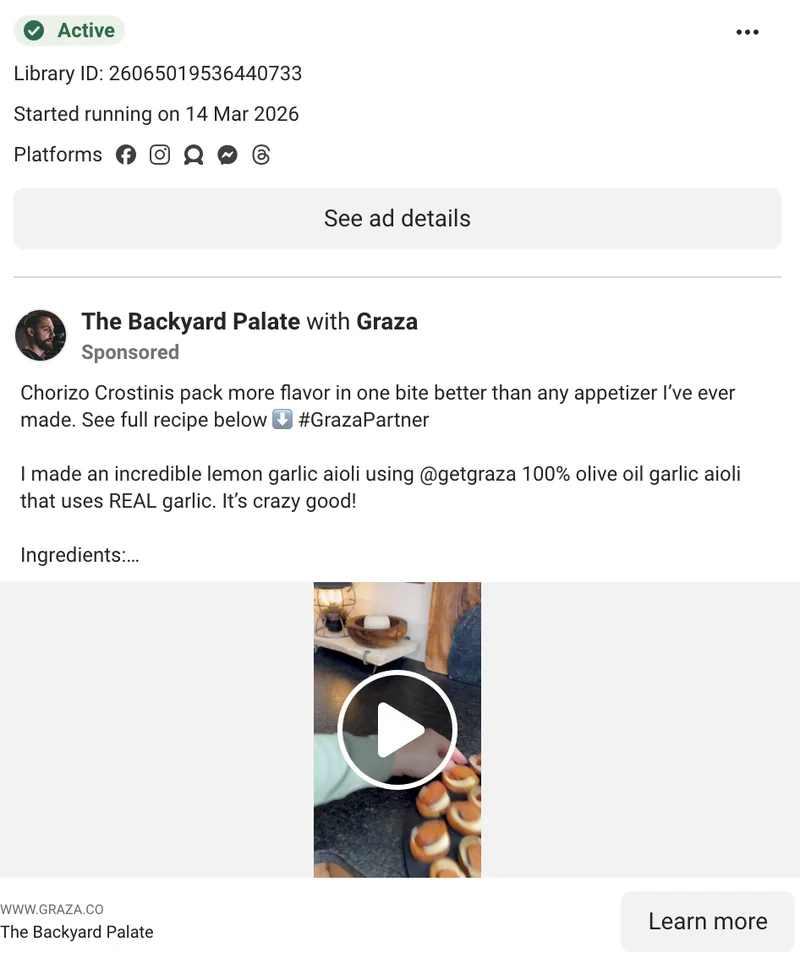
- Chorizo crostinis with lemon garlic aioli - #GrazaPartner
- Smoked chicken salad recipe with full ingredient list in the caption
These all launched March 13–15, during the Phase 1 mayo window. The mayo launch strategy is creator-first - let food people show you what to do with it. The brand isn’t explaining the product. Cooks are demonstrating it.
Olive oil videos: Brand-produced (11 ads)
The olive oil videos are brand voice, not creator voice:
- “FACT: We tasted 150+ mayo formulas about 150 times each” - a behind-the-scenes credibility play
- “FACT: We have our own certified olive oil sommelier” - expertise signaling
- “Michelin-star olive oil - without the Michelin-star price tag” - the value proposition in one line
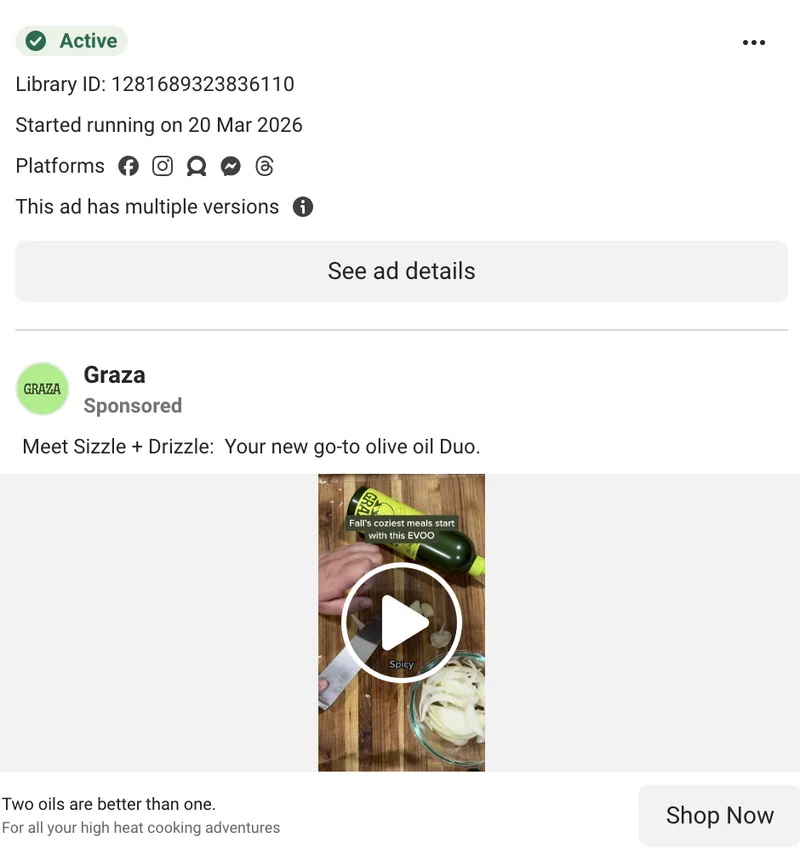
- “The dynamic olive oil duo made for all your cooking adventures!” - product intro
- “This recipe leans on The Trio from Graza to build layers of flavor fast” - brand-produced recipe content
The split is clear: mayo gets UGC because it’s a new product that needs social proof. Olive oil gets brand-produced content because the brand itself IS the credibility. Graza’s founder came from the Michelin restaurant world. That story is best told in-house.
The CTA Split Is a Funnel Signal.
40 ads use “Learn More” (52.6%). 33 use “Shop Now” (43.4%). 3 have no CTA.
This is a meaningful split. For comparison:
- Little Sleepies: 99.1% “Shop Now”
- Ridge: Majority “Shop Now”
- RYZE: Heavy “Shop Now”
Graza running majority “Learn More” tells you something about where they are in the customer journey. This is a brand that grew through influencer seeding and word-of-mouth. Their Meta ad audience isn’t the VIP group who already knows the product - it’s new people who’ve maybe seen a Graza bottle on Instagram but haven’t bought yet.
But the CTA also maps to products:
- Mayo: 100% “Learn More” - they’re not asking anyone to buy a brand-new product category on first exposure. They’re asking people to click and learn
- Sizzle + Drizzle Combo: 100% “Shop Now” - this is the core product, the one people already know from retail shelves and social media
- The Trio: Split between “Learn More” (8) and “Shop Now” (12) - the hero bundle gets both CTAs, likely A/B testing
The funnel logic: new products (mayo) get “Learn More.” Established products (Sizzle + Drizzle) get “Shop Now.” The flagship bundle (Trio) gets tested with both.
The FREE Frizzle Spray - A Bundle, Not a Discount.
16 card bodies push the same promo:
“LIMITED TIME ONLY: Get a FREE Frizzle Spray with the do-it-all Trio Set.”
This is the only promotional offer in the entire Meta account. No percentage discounts. No promo codes. No “sale” language. The card title for these is “FREE FRIZZLE SPRAY!” in all caps - the most energetic text in the dataset.
The promo does two things at once. First, it drives people to The Trio (the hero bundle) by adding free value instead of cutting price. Second, it introduces Frizzle - their newest olive oil product, a high-heat cooking spray - by putting it in people’s hands for free. It’s a trial mechanic disguised as a deal.
Ridge runs zero promos. Little Sleepies runs near-zero on Meta. Graza uses one, but it’s a free product, not a price cut. The distinction matters: discounts train customers to wait for sales. Free product bundles introduce new SKUs.
12 other card bodies mention “$16” as a price anchor - “starting at just $16.” So the value story is there, but it’s communicated through price transparency, not through discounting.
Cards Tell You Which Products Need Video.
Not all products get the same creative treatment at the card level. The video-vs-image split varies by product:
- The Trio: 72% video cards - the most video-heavy. Three products with multiple use cases need demonstration
- Frizzle Squeeze: 71% video - the spray format and high-heat use case benefit from motion
- Sizzle + Drizzle Combo: 42% video - mixed testing
- Original Mayo: 8% video, 92% image - mayo is visually self-explanatory. A jar of mayo on a sandwich doesn’t need a video demo
- Subscribe, Duo Glass, Starter Kit, Olive Oil Collection: 0% video - all image
The pattern maps to what I’ve seen across the series. Ridge used video when products needed physical demonstration (wallet opening, ring fit) and images when aesthetics sold the product (limited edition colors). Graza follows the same logic: products with a use-case story (spray for grilling, trio for different cooking stages) get video. Products that sell on visual appeal or simplicity (mayo, glass bottles) get images.
The Brand Voice - “Do Not Use Sparingly.”
The card titles carry a personality that’s distinct from anything else in this series:
- “Do not use sparingly.” - the anti-premium positioning in four words. Most luxury food brands tell you to use their product carefully. Graza tells you to use it on everything
- “Never not fresh.” - a double negative that’s more memorable than “always fresh”
- “Your favorite chef’s favorite olive oil.” - third-party credibility as a casual flex
- “Real Olive Oil Mayo” - straightforward. The product name IS the value proposition
- “Crazy fresh extra virgin olive oil” - “crazy fresh” is not typical olive oil language
- “Made from 100% olives” - a quality claim that sounds absurdly obvious until you realize most “olive oil” isn’t
The emoji footprint is minimal - just 🫒 (44x) and ✨ (14x). Two emojis. Compare that to Little Sleepies (20+ emoji types, 💛💕🤩 everywhere). Graza’s tone is food-world casual, not Instagram-cute. It reads like a restaurant menu board, not a lifestyle brand caption.
9,924 Page Likes. This Brand Grew Somewhere Else.
For a ~$48M brand stocked in Whole Foods, Target, Costco, and Walmart, 9,924 Facebook page likes is tiny. For comparison:
- Little Sleepies: 371K
- Ridge: 366K
- FCT: 161K
- Graza: 9,924
This tells you everything about how Graza grew. They didn’t grow through Facebook. They grew through influencer seeding (300 packages sent at launch, no paid ads), through food media coverage (Bon Appétit, Food & Wine, NYT “Best All-Around Olive Oil”), through retail expansion, and through TikTok and Instagram organic.
The Meta paid account is new. It’s an addition to their growth engine, not the foundation of it. This is the first brand in the series where the ad account is catching up to the brand, rather than the brand being built by the ad account.
The Subscription Play Is Price-Objection Messaging.
5 DCO ads point to /pages/subscribe. The card messaging for these ads is distinct from every other product:
“Nice olive oil can be too expensive - not Graza! Our oil is meant to be used, every day, every way.”
“Nice olive oil can be too expensive - not Graza! Our never blended Sizzle and Drizzle are meant to be used, every day, every way.”
This is the only copy in the account that directly addresses price as an objection. Every other product page gets feature-led or benefit-led messaging. The subscription page gets “we know good olive oil feels expensive, and here’s how to make it affordable.”
The card titles reinforce it: “Michelin-chef approved” and “Always fresh, never blended, real EVOO.” Quality proof + price accessibility. Subscribe = get Michelin-quality oil without feeling like you’re splurging every time.
A Few More Things.
Runs on Audience Network
All 76 ads run on Facebook, Instagram, and Audience Network. 73 on Messenger and Threads. Unlike Little Sleepies (which pulled Audience Network for a children’s brand), Graza has no reason to restrict placements. An olive oil brand showing up on third-party apps isn’t a brand safety concern.
Zero AI-generated content
All 76 ads show false for Meta’s digital created media flag. Everything is photographed, filmed, or designed by humans. Still haven’t found a single D2C brand in this series using AI-generated creative on Meta.
No country targeting data
All 76 ads show empty country arrays. The brand is US-headquartered and the retail footprint is domestic, but the ad library doesn’t surface geo-targeting specifics. On Google (Part 2), they actually reach 28 countries - but that’s a different story.
The typo
One card body reads:
“Meet Frizzle, the ultimate high heat cooking oil made for all your neutral cooking, grilling, baking, and frying! Swap your seed oils for this antioxidant-rich, Frizzle - naturally refined refined mix of Olive Pomace Oil & EVOO.”
“Refined refined” - a doubled word. It appears in 2 of 127 cards. Small detail, but it suggests these ads were launched quickly (54 in one day) and the copy wasn’t scrubbed at the card level. Another variant of the same copy (10 cards) has the correct version: “trusted by chefs” instead of the typo version.
Summary
Here’s what I found in Graza’s 76 active Meta ads:
- Two-phase launch. Phase 1 (Mar 10–15): 19 mayo ads - UGC recipe content + DCO. Phase 2 (Mar 20–21): 57 olive oil ads - 54 launched in a single day. Zero overlap between phases
- 77.6% DCO (59 ads) on a single template, with only 19 unique card bodies across 127 cards. A lean, focused account compared to Little Sleepies (927 cards, 37 collections)
- 100% card uniformity. Every DCO ad sends all cards to the same product URL. 8 product destinations total - this is a product catalog, not a drop calendar
- The Trio is the hero (56 appearances). Mayo is #2 at 41 - outsized push for a 10-day-old product
- Five messaging pillars: Product education (dominant), value/price anchoring ($16, Michelin), freshness/purity (never blended, single origin), anti-seed-oil positioning (swap your seed oils), and mayo-as-olive-oil-extension (65% oil = use the good stuff)
- Video splits by product. Mayo gets UGC recipe content from food creators. Olive oil gets brand-produced “FACT:” videos and product demos. Creator content is mayo-first
- CTA maps to funnel stage. Mayo = 100% “Learn More.” Sizzle+Drizzle = 100% “Shop Now.” Trio = split-tested. New products get consideration. Established products get conversion
- One promo: FREE Frizzle Spray with The Trio. No discounts, no promo codes. The promo is a trial mechanic for a newer product, not a price cut
- Card media varies by product. Trio and Frizzle get 71-72% video cards (need demonstration). Mayo gets 92% image cards (visually self-explanatory)
- 9,924 page likes. This is a $48M brand that grew through influencer seeding, food media, and retail - not Facebook. The Meta ad account is catching up to the brand
- Subscription ads use price-objection messaging - the only copy that directly addresses “olive oil is too expensive”
- Zero AI-generated content, all platforms including Audience Network, oldest ad is 11 days old
What’s next: I scraped Graza’s Google Ads - 128 ads spanning a full year. On Google, the story is completely different. The EVOO Can campaign has been running for 9 months. They’re driving traffic to Amazon. They ran a Black Friday sale at exactly 20.74% off (yes, that specific). And mayo has barely arrived - one Shopping ad. That’s Part 2.
I’m tearing down a D2C brand every week. If there’s a brand you want me to break down, DM me on X.
Bonus: Ad Gallery
A selection of additional ads from Graza’s 76-ad Meta account.
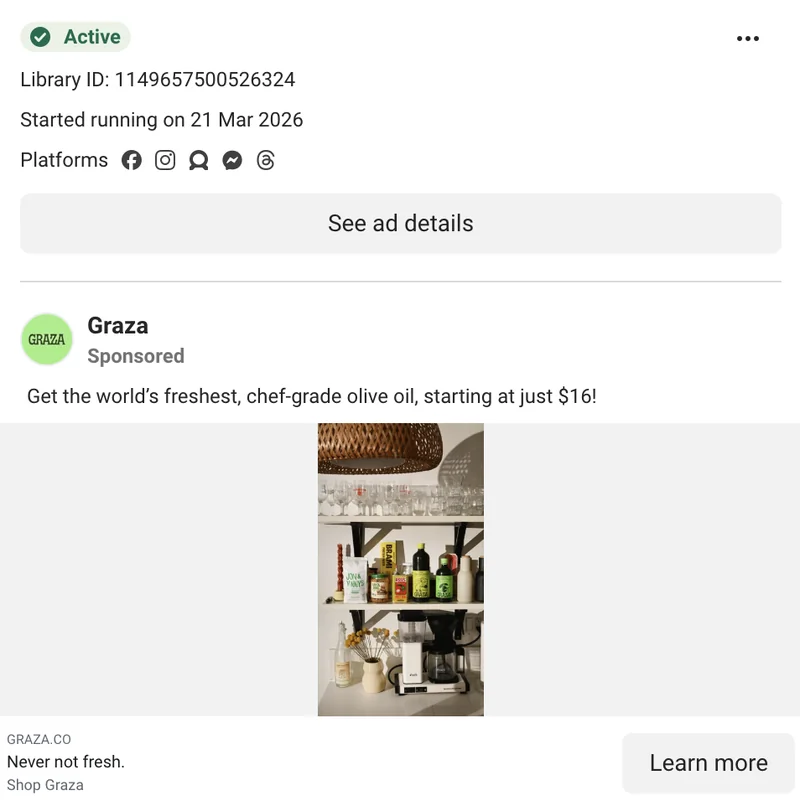
The only static image ad
One static image ad in the entire account. The rest is video, DCO carousels, and dynamic creative.
Share this teardown
Read Next
Graza Has 128 Google Ads Spanning a Full Year. The Meta Account Is 11 Days Old.
128 Google ads across 12 months - EVOO cans, Amazon Shopping, a 20.74% Black Friday sale, and a video-only glass bottle launch. The platform where Graza has been experimenting long before Meta.
543 Google Ads. 166 Went Dark on the Same Day. Here's What Survived.
A breakdown of Fresh Clean Threads' Google Ads strategy. Why 166 ads went dark in 3 days, why 78% of active ads are Shopping, and how their Google strategy diverges from Meta.
Fresh Clean Threads Runs 150 Meta Ads. Only 17 Pieces of Copy Power All of Them.
150 active ads, 87% algorithm-driven, 17 unique copy blocks, and three simultaneous promo codes. Inside a $60M basics brand that trusts Meta's machine more than its own creative team.