MUD\WTR Has 48 Meta Ads. It Has 480 on Google. And 19 of Them Are About ASMR.
Contents
In Part 1, I broke down MUD\WTR’s 48 Meta ads. The story there was a nearly bootstrapped brand ($1M total funding) running the most video-heavy account in the series (81.3%), with a “Fix Your Fix” campaign that framed coffee dependence as “reckless caffeination” - complete with a pharmacologist endorsement and PSA-style copy.
The Google account is a different universe.
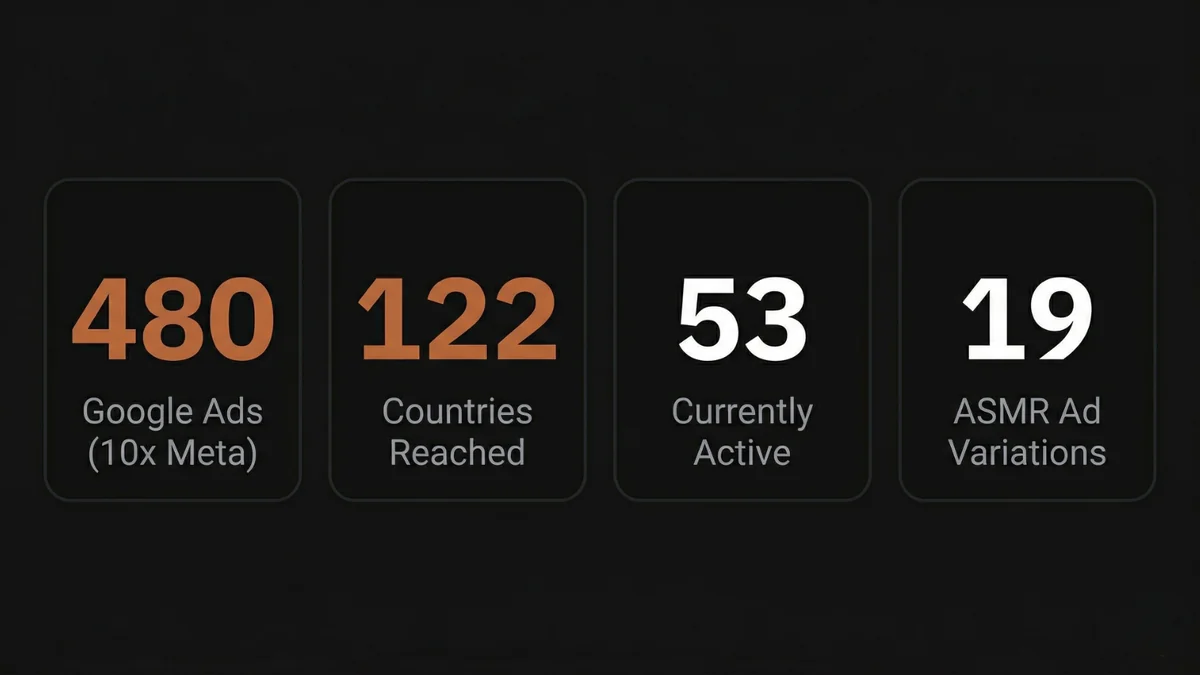
480 ads. Ten times the Meta account. Spanning March 2025 to March 2026. But only 53 are currently active. The rest is a year of campaigns that reveal something I haven’t seen from any brand in this series: MUD\WTR runs blog articles as paid Google display ads. Not product ads. Not search headlines. Actual content - ASMR explainers, banana bread recipes, breathwork tutorials, intermittent fasting guides - promoted as display campaigns. And the most-repeated piece of content in the entire Google account isn’t about mushrooms or coffee. It’s about ASMR.
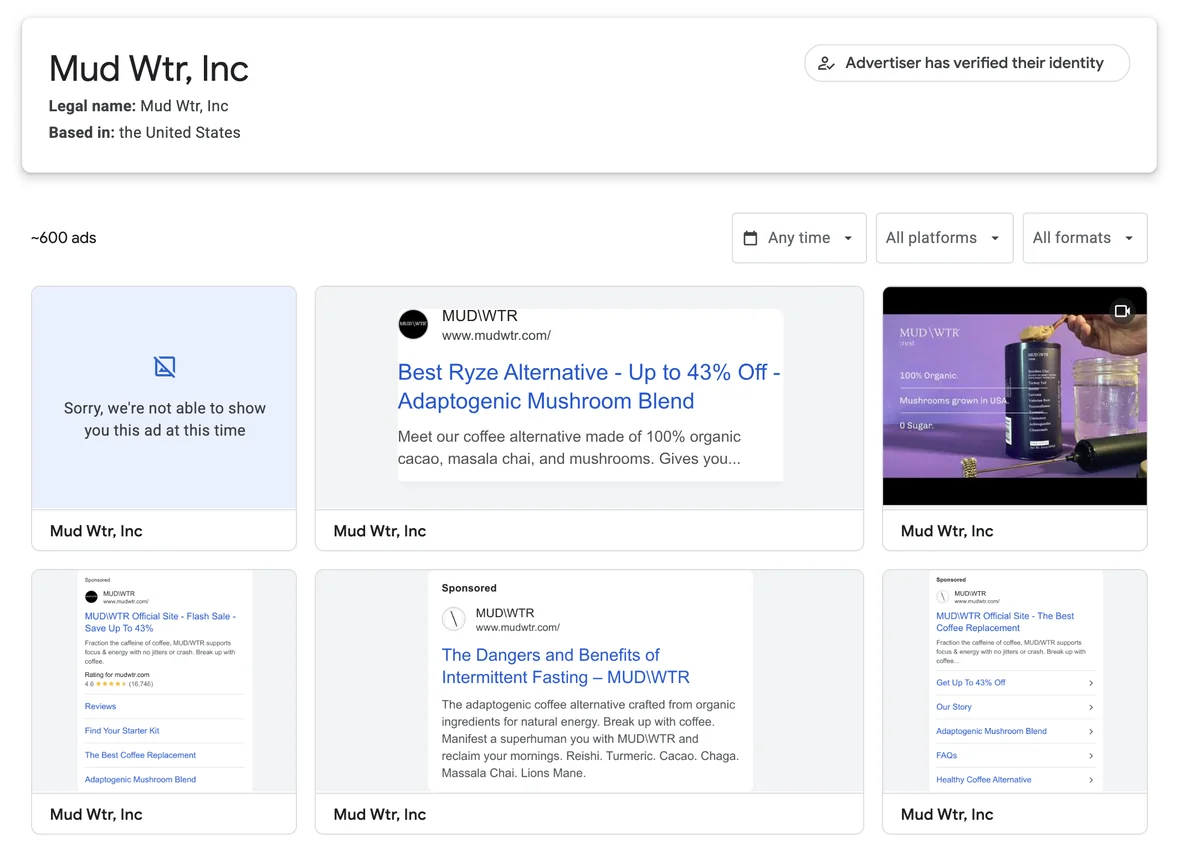
Blog Posts as Google Display Ads. The Most Unusual Strategy in This Series.
No brand I’ve covered has done this. Every Google account in this series has run some combination of search, shopping, display, and video ads - all pointing to product pages, landing pages, or collection pages. MUD\WTR does that too. But it also runs a parallel content strategy through Google display.
Here’s the content library running as paid display ads:
The ASMR Article - 19 Variations
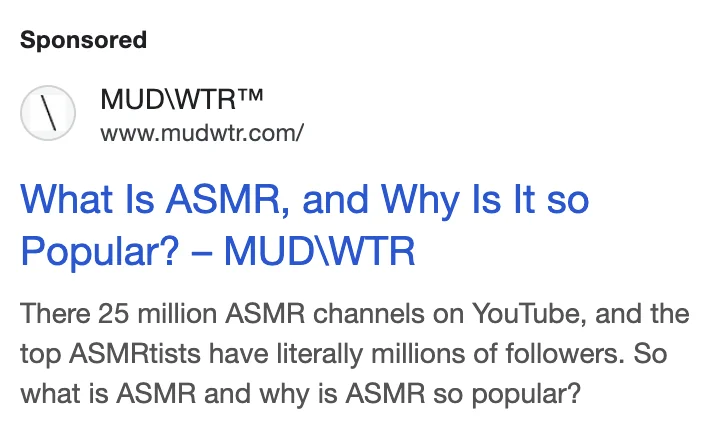
“What Is ASMR, and Why Is It so Popular?” appears 19 times with different headline variations and formatting across the display network. The description: “There are 25 million ASMR channels on YouTube, and the top ASMRtists have literally millions of followers.” This article has nothing to do with mushrooms, coffee, or the product. It’s a general-interest piece about a YouTube phenomenon, published on the MUD\WTR blog, promoted through paid display.
19 ad variations for a single blog post about ASMR. More than the entire Fix Your Fix campaign on Meta (8 ads).
The Rest of the Content Library
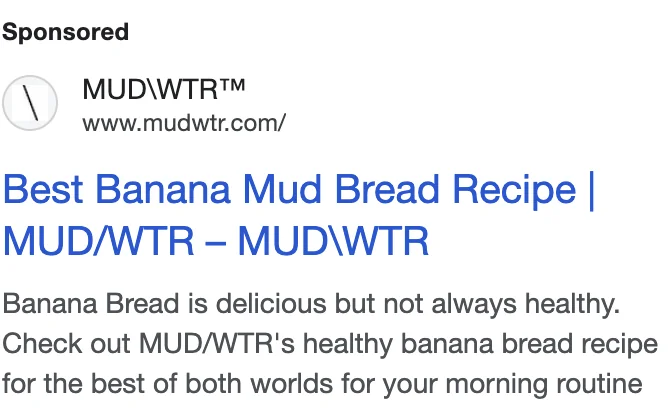
- “Best Banana Mud Bread Recipe” - 6 variations. A recipe that incorporates MUD\WTR into baking.
- “The Dangers and Benefits of Intermittent Fasting” - 4 variations. Wellness content.
- “Cacao vs. Cocoa” - 4 variations. Educational, product-adjacent.
- “How to take your breath hold from 2 to 4 minutes” - 2 variations. Breathwork content referencing Wim Hof and Tim Ferriss.
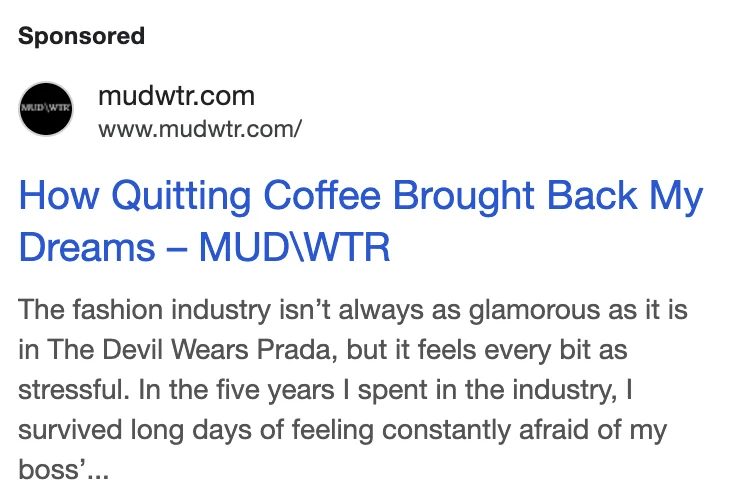
- “How Quitting Coffee Brought Back My Dreams” - 1 ad. Directly on-brand.
- “The Science Behind the Flow State” - 1 ad.
- “How to Overcome Anxiety” - 1 ad.
- “3 signs you are suffering from brain fog” - 2 variations. Product-adjacent.
Most of this content is tangentially related to MUD\WTR’s audience but not to the product itself. A person reading about ASMR or breathwork or intermittent fasting is probably wellness-curious - and that’s the top of MUD\WTR’s funnel. The blog article gets them on the site. The site does the rest.
All of these are display ads, mostly last shown September–October 2025. I think this was a specific campaign window for content-led acquisition that has since been scaled down. But the strategy itself is notable: use Google display to drive cheap traffic to educational content, then retarget those readers with product ads on Meta. The data doesn’t confirm that retargeting loop, but the two platforms fit together that way.
205 Text Ads. 205 Video Ads. A Perfectly Balanced Account.
The format split on Google:
- TEXT: 205 ads (42.7%)
- VIDEO: 205 ads (42.7%)
- IMAGE: 18 ads (3.8%)
- No format data: 52 ads (10.8%)
On Meta, MUD\WTR is 81.3% video. On Google, it’s a perfect 50/50 between text and video. The text ads carry the content marketing, search campaigns, and display promotions. The video ads carry brand awareness and the Fix Your Fix campaign. Neither format dominates - a very different allocation than Meta.
The ad type breakdown from OCR analysis:
- Video thumbnails: 127 (26.5%)
- Display ads: 96 (20%)
- Search ads: 46 (9.6%)
- Shopping ads: 4 (0.8%)
- Uncategorized: 207 (43.1%)
Search is a small slice - 46 ads. Display does the heavy lifting for text-based campaigns, which is consistent with the content marketing strategy.
Search Ads Lead with Individual Mushroom Ingredients.
On Meta, mushroom names appear in 12.5% of ads - buried in product descriptions. On Google, individual mushrooms are the headlines.
The active search ads (March 2026):
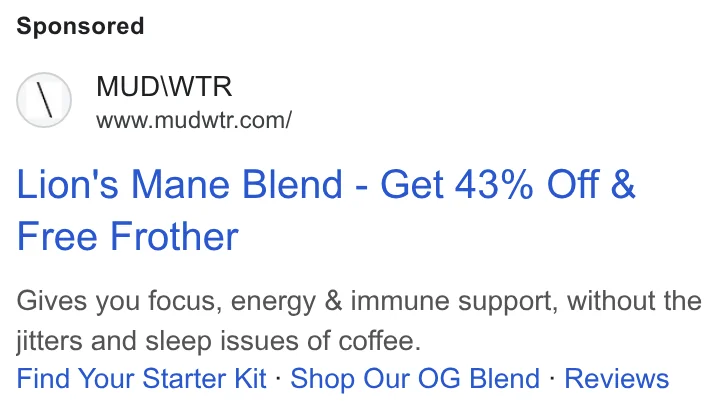
- “Lion’s Mane Blend - Get 43% Off & Free Frother”
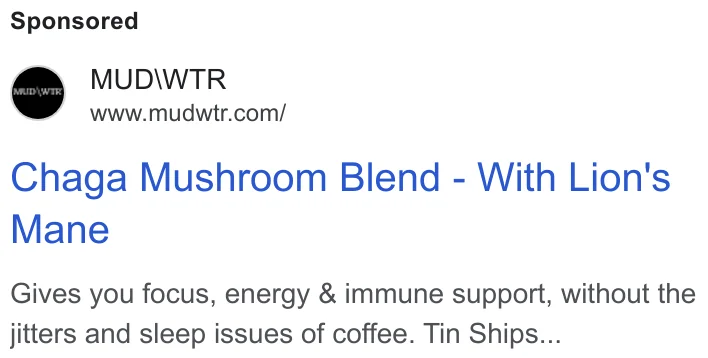
- “Chaga Mushroom Blend - With Lion’s Mane”
- “Cordyceps Blend - Beneficial Mushroom Blend”
- “Ashwagandha Drink - 100% Organic Ingredients”
- “Cacao Mushroom Blend - Beneficial Mushroom Blend”
- “Supports Cognitive Function - No Brain Fog”
- “Supports Focus - Choose Rise 2.0 - MUDWTR”
Someone searching “lion’s mane supplement” or “cordyceps for energy” or “ashwagandha drink” lands on a MUD\WTR search ad. This is ingredient-level acquisition - capturing people who already know what functional mushrooms do and are looking for a product that contains them. Meta can’t do this because you can’t target by search intent on a feed platform.
The descriptions fall into two copy blocks:
- “Gives you focus, energy & immune support, without the jitters and sleep issues of coffee.” - benefit-led, for search terms like “coffee alternative”
- “Fraction the caffeine of coffee, MUD/WTR supports focus & energy with no jitters or crash.” - the workhorse, appearing 13+ times
Competitor Targeting - Four Sigmatic
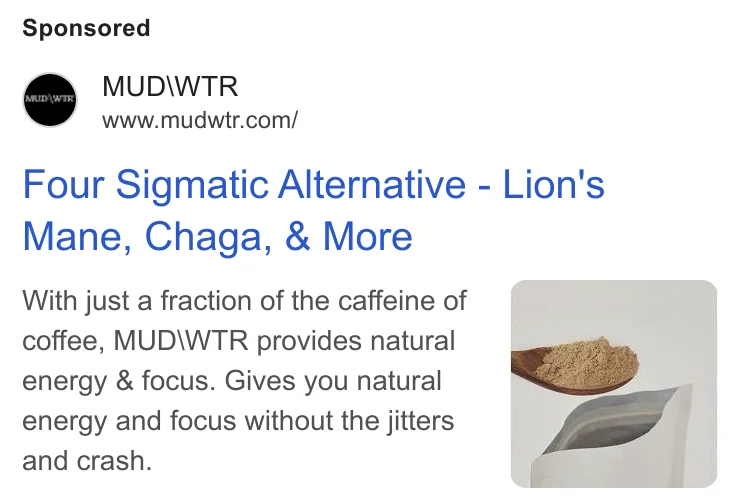
One search ad headlines: “Four Sigmatic Alternative - Lion’s Mane, Chaga, & More.” A direct competitor conquest ad. Four Sigmatic is another mushroom coffee brand. MUD\WTR is bidding on their competitor’s brand name and offering itself as the alternative. No other brand in this series has run a named-competitor search ad.
Fix Your Fix Exists on Google - But Barely.
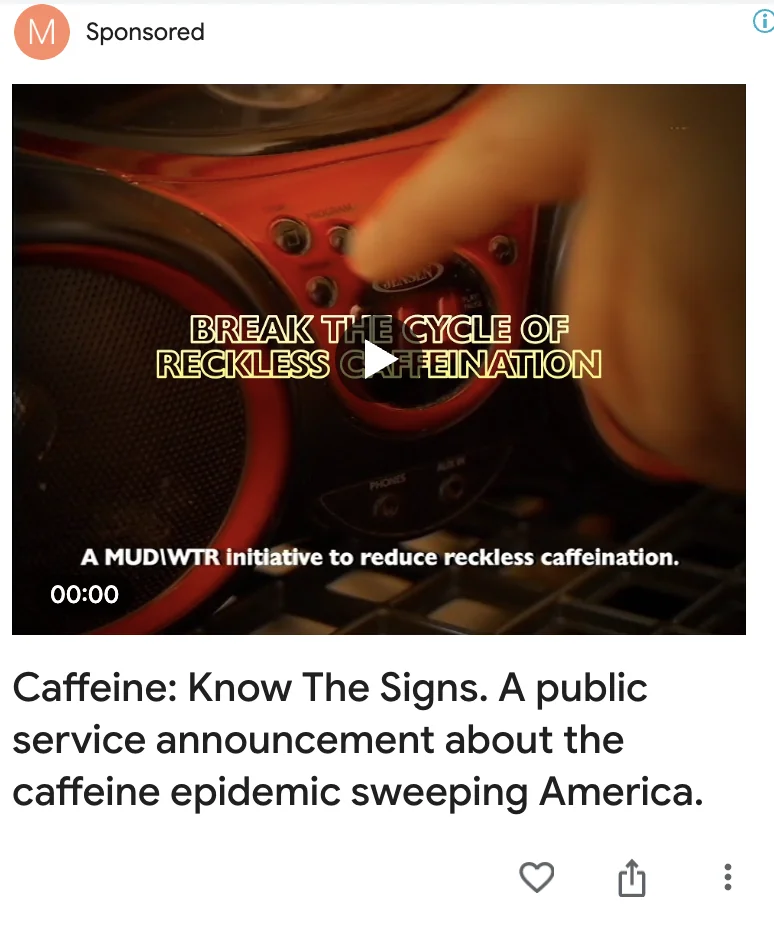
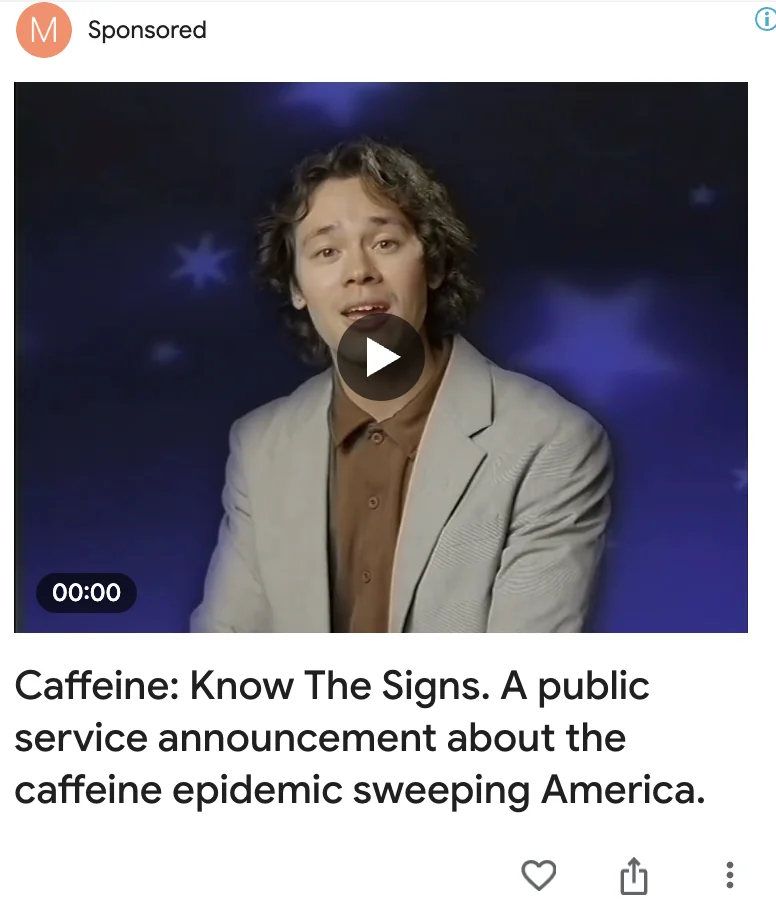
The campaign that dominates 16.7% of the Meta account barely registers on Google. 4 video ads. One headline: “Caffeine: Know The Signs. A public service announcement about the caffeine epidemic sweeping America.”
That’s it. No search ads. No display ads. No branded content partnerships. No Hamilton Morris. No founder’s art page. Just 4 videos with PSA framing.
The Fix Your Fix campaign is Meta-native. The rich, narrative copy - “reckless caffeination doesn’t stop with you, it gets passed down” - lives on social feeds where storytelling works. Google gets the stripped-down video version. The campaign was built for interruption-based platforms, not intent-based ones. You don’t search for “reckless caffeination.” You scroll past a video that makes you think about it.
The Discount Machine - 43%, 50%, 60%, 80% Off.
MUD\WTR runs the most aggressive discount structure in the series. Here’s the tiered breakdown:
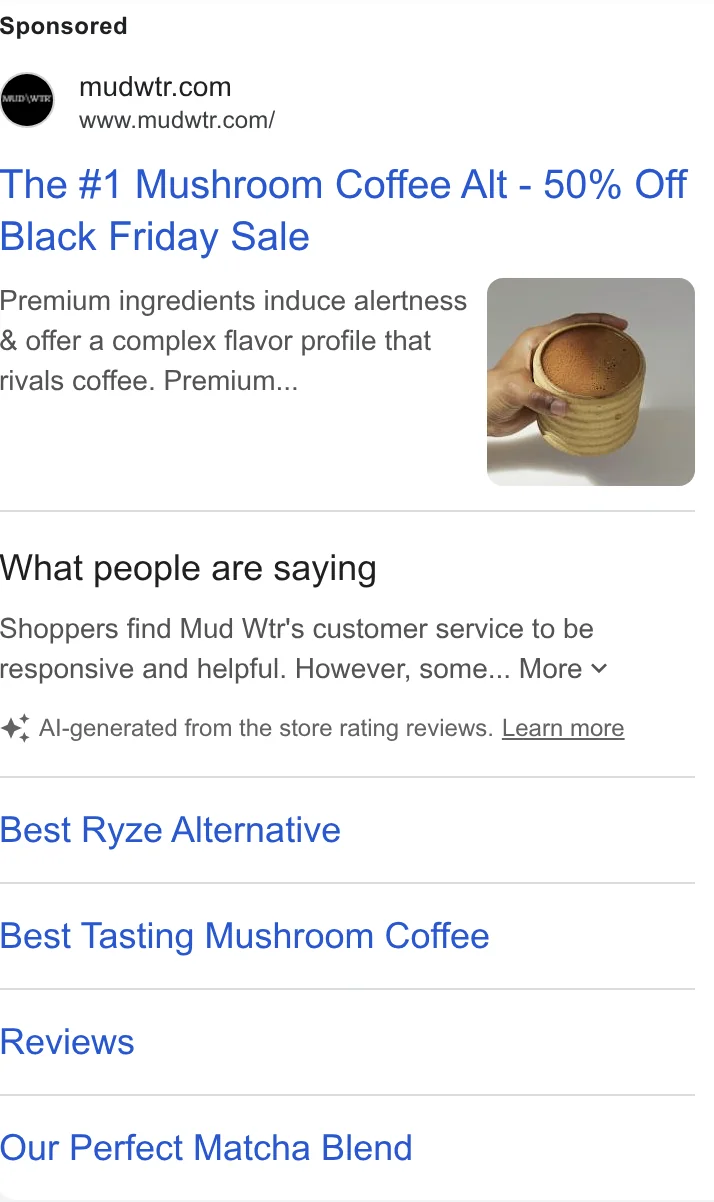
- 43% off - 43 ads. The evergreen “Flash Sale - Save Up To 43%.” This is the primary Google offer.
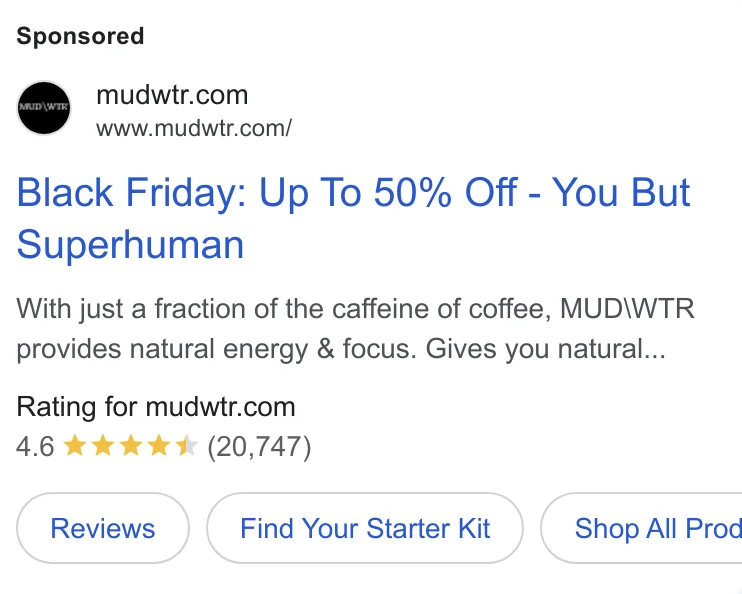
- 50% off - 39 ads. Black Friday pricing that persists.
- $20 off + free frother - 23 ads. Same offer as Meta’s DCO cards.
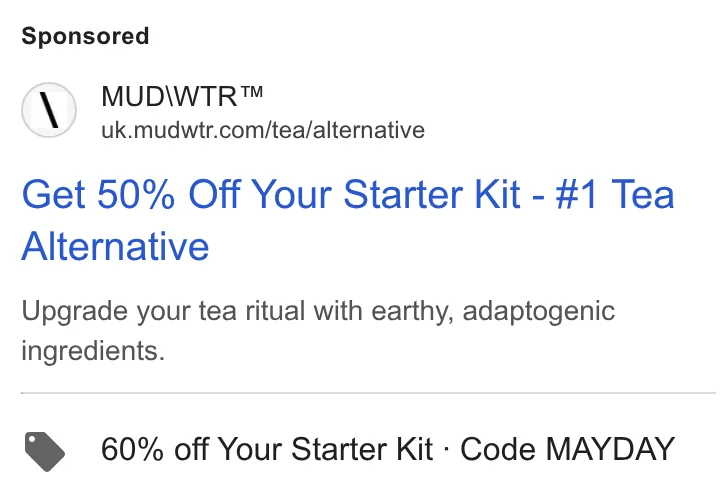
- 60% off - 2 ads. Code MAYDAY.
- 80% off - 1 ad. The steepest discount in any brand I’ve covered.
On Meta, discounts are limited to DCO card titles - $20 off + frother and 43% off. On Google, discounts run in headlines, descriptions, and offer fields across search, display, and video. The “Flash Sale - Save Up To 43%” headline alone appears 19 times (12 as MUD\WTR, 7 as MUD/WTR - the backslash vs forward-slash brand name inconsistency shows up throughout the Google account).
Black Friday - 39 Ads, 6 Still Running in March
The Black Friday campaign (November–December 2025) accounts for 39 ads. “Up To 50% Off,” “Our Biggest Sale,” “Black Friday Sale.” 17 were last shown in November, 16 in December. But 6 Black Friday ads were still showing in March 2026 - more than 3 months after the event. Same stale-seasonal pattern I found with Little Sleepies’ Black Friday ad and Graza’s Friendsgiving ad. Deliberate or forgotten - the data doesn’t say.
122 Countries. The Most International Brand in the Series.
Graza reached 28 countries. MUD\WTR reaches 122.
United States (225 ads), Canada (74), and then a long tail: Italy (19), Portugal (19), Spain (19), France (18), Mexico (17), Germany (16), Greece (15), Netherlands (15) - all the way down to Zimbabwe, Papua New Guinea, and Yemen.
A dedicated UK subdomain (uk.mudwtr.com) appears in 5 ads. One of them positions MUD\WTR as a “tea alternative” - not a coffee alternative. That’s a market-specific pivot: in a tea-drinking country, you don’t sell against coffee. You sell against the thing people actually drink.
The international footprint is massive for a brand that raised $1M total. Every other brand in this series with global reach has had significant venture backing. MUD\WTR’s 122-country distribution runs through Google’s ad network - the cheapest way to test international demand without opening retail in each market.
Meta vs Google: The Cross-Platform Map.
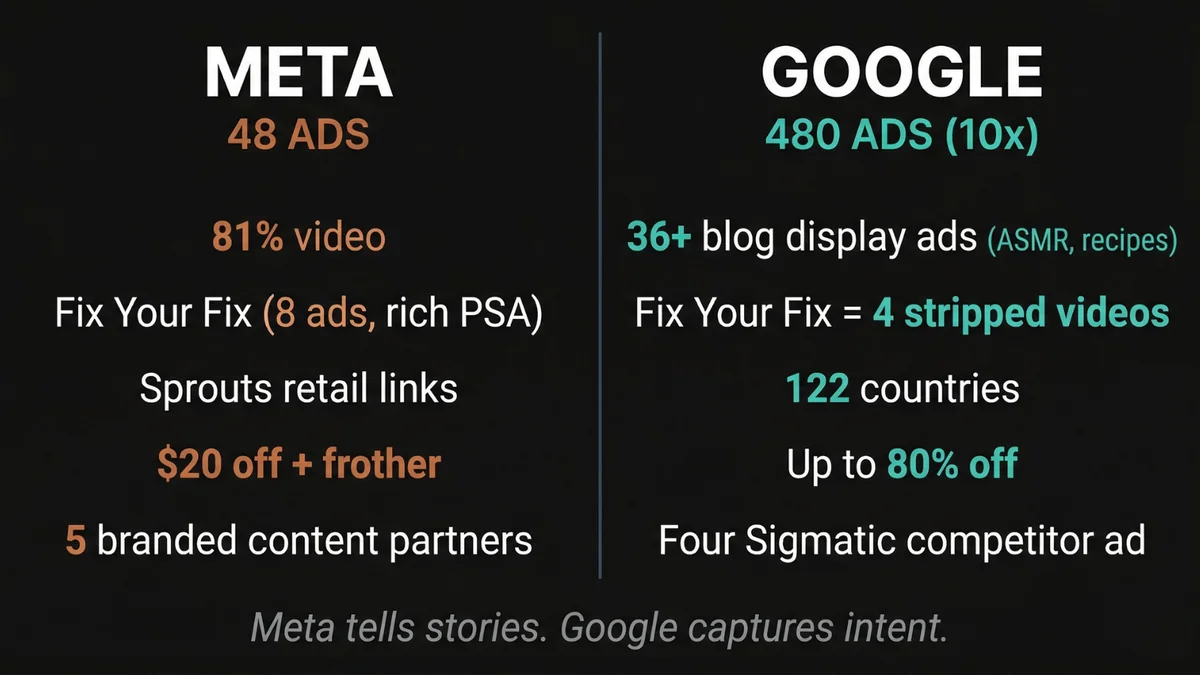
| Meta (48 ads) | Google (480 ads) | |
|---|---|---|
| Scale | 48 ads | 480 ads (10x) |
| Currently active | All 48 | 53 of 480 |
| Format | 81.3% video | 42.7% text, 42.7% video (balanced) |
| Fix Your Fix | 8 ads, rich PSA copy, Hamilton Morris, branded content | 4 video ads, stripped-down |
| Content marketing | Zero | 36+ blog display ads (ASMR, recipes, fasting, breathwork) |
| Product focus | Rise + Nourish + Mushroom Coffee + Fix Your Fix | Rise/general + ingredient-specific search |
| Discounting | $20 off + frother, 43% off (DCO only) | Full spectrum: 43%, 50%, 60%, 80% off |
| Black Friday | None | 39 ads (6 still showing in March) |
| Countries | No data (likely US) | 122 countries |
| Retail push | Sprouts direct links (4 ads) | None |
| Competitor targeting | None | ”Four Sigmatic Alternative” |
| Mushroom ingredients | Named in 12.5% of ads | Individual ingredients as search headlines |
| Content as ads | None | ASMR (19x), banana bread (6x), fasting (4x), cacao vs cocoa (4x) |
| Branded content | 5 partnerships (Hamilton Morris, Shane Heath Art) | None |
| UK positioning | N/A | ”Tea alternative” (not coffee alternative) |
What the Comparison Tells You
Google is 10x the size because it does 3 jobs Meta doesn’t. Meta runs product ads and the Fix Your Fix campaign. Google does that plus content marketing (blog display), seasonal promotions (Black Friday), and ingredient-level search capture. The content marketing alone accounts for ~36 ads. The Black Friday campaign adds 39. Remove those two programs and the Google account shrinks to roughly 400 ads - still 8x Meta, but the gap narrows.
The content marketing strategy is the differentiator. No other brand in this series runs blog posts as paid display ads. MUD\WTR promotes ASMR explainers, banana bread recipes, and breathwork guides to get wellness-curious readers onto the site. The product sell happens after. This is a fundamentally different acquisition model: educate first, sell second. On Meta, that philosophy shows up in the Fix Your Fix campaign (education-as-advertising). On Google, it shows up as literal blog content distribution.
Discounts escalate from Meta to Google. Meta holds at $20 off + frother and 43% off through DCO cards. Google runs the full spectrum up to 80% off. The escalation makes sense: Meta builds the brand at moderate discounts. Google captures high-intent searchers who need a price incentive to convert now. A person who already searched “mushroom coffee alternative” is closer to purchase than someone scrolling past a video - the deeper discount matches the higher intent.
The RYZE comparison gets sharper here. I covered RYZE Superfoods earlier in this series - a direct competitor in the mushroom coffee space. RYZE ran 400 Meta ads with formula-driven copy testing and no content marketing. MUD\WTR runs 48 Meta ads with campaign-driven storytelling and 480 Google ads with a content-first strategy. Same category. Same functional mushroom ingredients. Opposite approaches to growth.
Fix Your Fix is Meta-native. Ingredient search is Google-native. The campaign that makes MUD\WTR creatively interesting (Fix Your Fix) barely exists on Google because PSA storytelling doesn’t work in search. The strategy that makes MUD\WTR commercially effective on Google (ingredient-level search targeting) doesn’t exist on Meta because you can’t target by search intent on a feed platform. Each platform gets the strategy it’s built for.
The Pattern.
- MUD\WTR runs 480 Google ads - 10x the Meta account. The biggest platform asymmetry in the series
- 36+ ads promote blog content as paid display: ASMR (19 variations), banana bread recipes, breathwork, intermittent fasting, cacao vs cocoa. No other brand in the series does this
- Fix Your Fix barely translates to Google - 4 video ads vs 8 rich Meta ads. The campaign was built for social feeds, not search
- Search ads use individual mushroom ingredients as headlines: Lion’s Mane, Chaga, Cordyceps, Ashwagandha. On Meta, these names are buried in product descriptions
- One competitor conquest ad names Four Sigmatic directly - the only named-competitor ad in the series
- Discounts run the full spectrum on Google: 43% off (43 ads), 50% off (39 ads), $20 off + frother (23 ads), up to 80% off. Meta holds at moderate levels
- 39 Black Friday ads, 6 still showing in March 2026 - stale seasonal pattern consistent with other brands
- 122 countries - the widest international reach in the series, on $1M total funding. A UK subdomain positions the product as a “tea alternative” instead of a coffee alternative
- 205 text ads and 205 video ads - a perfectly balanced format split, unlike Meta’s 81.3% video dominance
- The two platforms serve fundamentally different functions: Meta tells stories (Fix Your Fix, branded content, video-first), Google captures intent (ingredient search, content marketing, discount conversion)
I’m tearing down a D2C brand every week. If there’s a brand you want me to break down, DM me on X.
Share this teardown
Read Next
MUD\WTR Runs 48 Meta Ads. 8 of Them Are a Fake PSA About Caffeine Addiction.
A breakdown of MUD\WTR's Meta ad account, focusing on their storytelling-driven campaign strategy.
543 Google Ads. 166 Went Dark on the Same Day. Here's What Survived.
A breakdown of Fresh Clean Threads' Google Ads strategy. Why 166 ads went dark in 3 days, why 78% of active ads are Shopping, and how their Google strategy diverges from Meta.
Fresh Clean Threads Runs 150 Meta Ads. Only 17 Pieces of Copy Power All of Them.
150 active ads, 87% algorithm-driven, 17 unique copy blocks, and three simultaneous promo codes. Inside a $60M basics brand that trusts Meta's machine more than its own creative team.