Obvi Runs 4x More Google Ads Than Meta Ads. But When You Look at What's Actually Active - the Ratio Reverses.
Contents
If you looked at Obvi’s ad library for the first time, you’d think you had them figured out in thirty seconds…
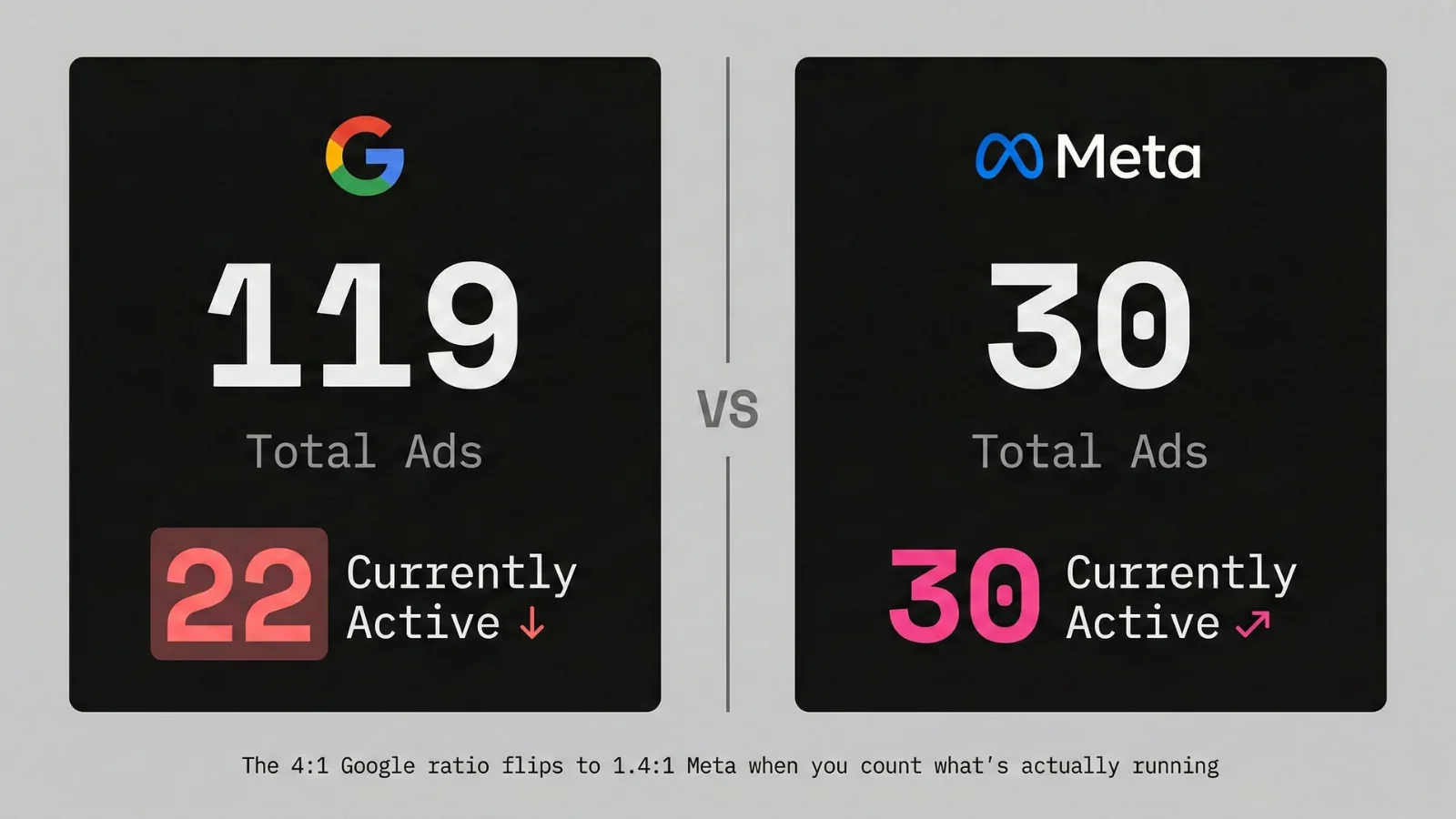
“A women’s collagen supplement company running 119 ads on Google and only 30 on Meta.”
…a 4:1 ratio and hence the conclusion - Obvi is a supplement company which leans more into search intent through Google Ads rather than other platforms.
But that number is misleading.
I scraped every ad Obvi is running across Meta, Google, TikTok, Snapchat, and LinkedIn - 149 ads total across two platforms.
Of those 149 ads -
- three platforms (Tiktok, Snapchat and Linkedin) have barely been touched.
- out of those 119 Google ads, only 22 are currently active. The other 97 haven’t been shown in over a month.
- on Meta, all 30 are live right now. Every single one.
So the actual ratio of active ads flips to 30 Meta vs 22 Google - 1.4:1 in Meta’s favor. The brand that looked like a Google-heavy operation is, in practice, running more creatives on Meta, and that too a totally different format.
That reversal is the first pattern. It won’t be the last.
Meta: 30 Ads Running a Two-Track Funnel
70% Video, 30% Image - and Zero of Everything Else
Obvi’s Meta strategy is video-first. 21 of 30 ads are video.
The remaining 9 are static images.
There are zero carousels, zero DCO (Dynamic Creative Optimization), and zero DPA (Dynamic Product Ads).
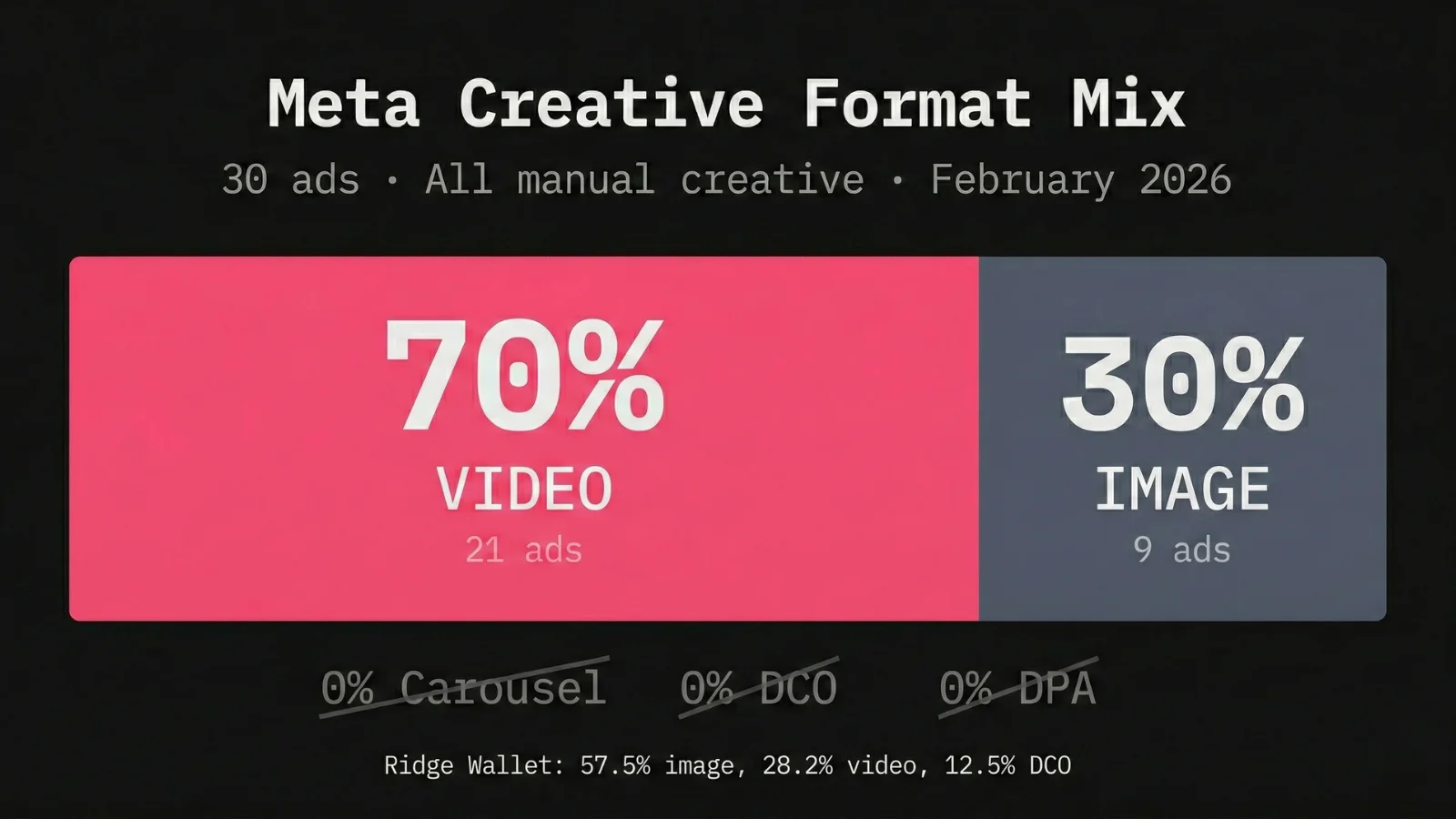
For context - when I analyzed Ridge Wallet’s 273 Meta ads, the split was the opposite - 57.5% image, 28.2% video, with 12.5% DCO and 1.8% DPA. Ridge used Meta as a visual catalog with automated creative testing layered on top.
Obvi uses Meta as a storytelling channel.
No DCO means Obvi isn’t letting Meta’s algorithm mix-and-match creative components. No DPA means they’re not running catalog-based retargeting through Meta.
Every ad you see was deliberately crafted - someone wrote the copy, chose the video or image, and paired it with a specific landing page. All 30 are manual creative.
Two CTAs, Two Completely Different Funnels
Here’s where it gets interesting. Ridge used “Shop Now” on 100% of its 273 ads. Every single one. Obvi splits it:
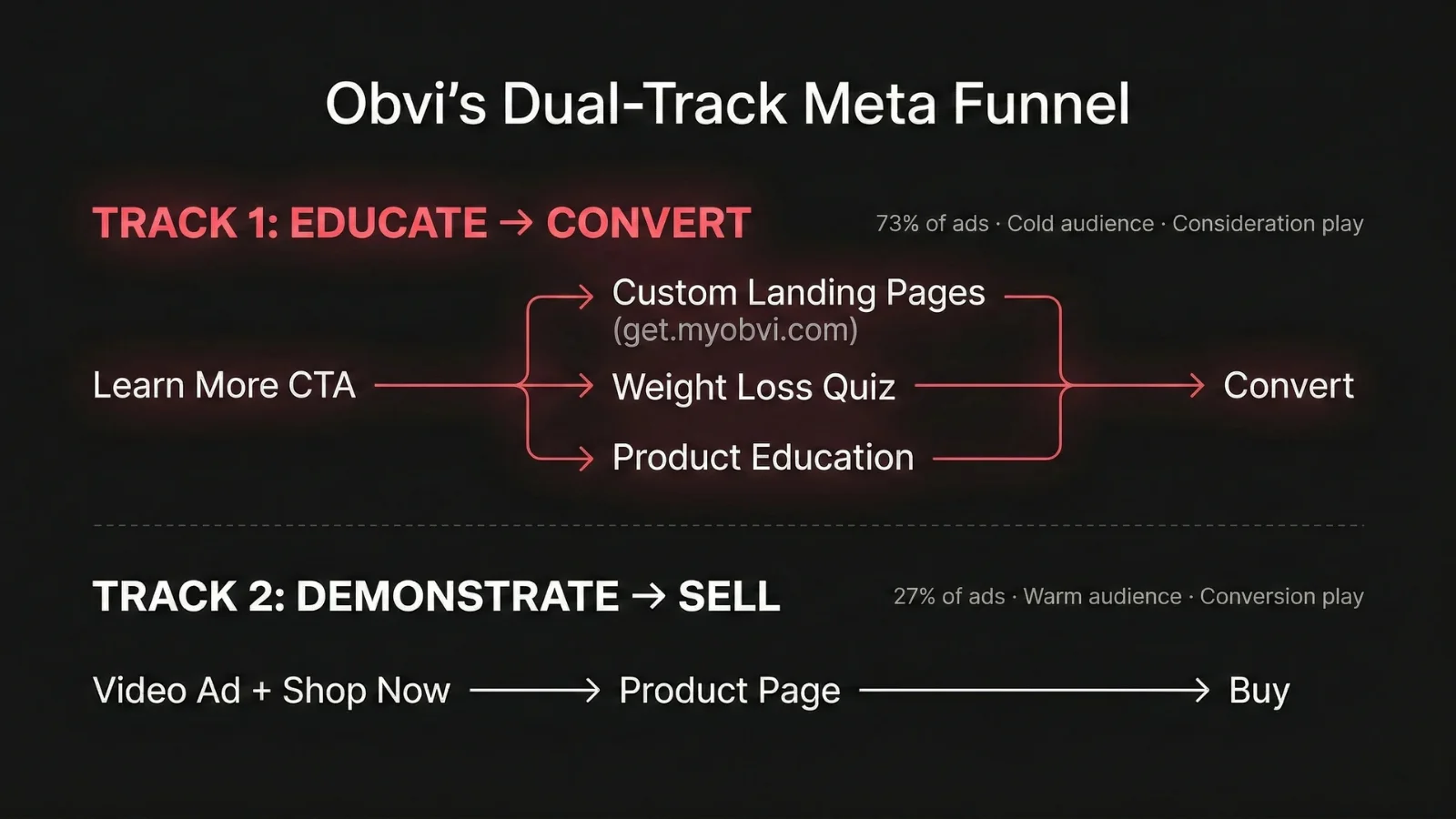
- “Learn more” -> 22 ads (73%)
- “Shop now” -> 8 ads (27%)
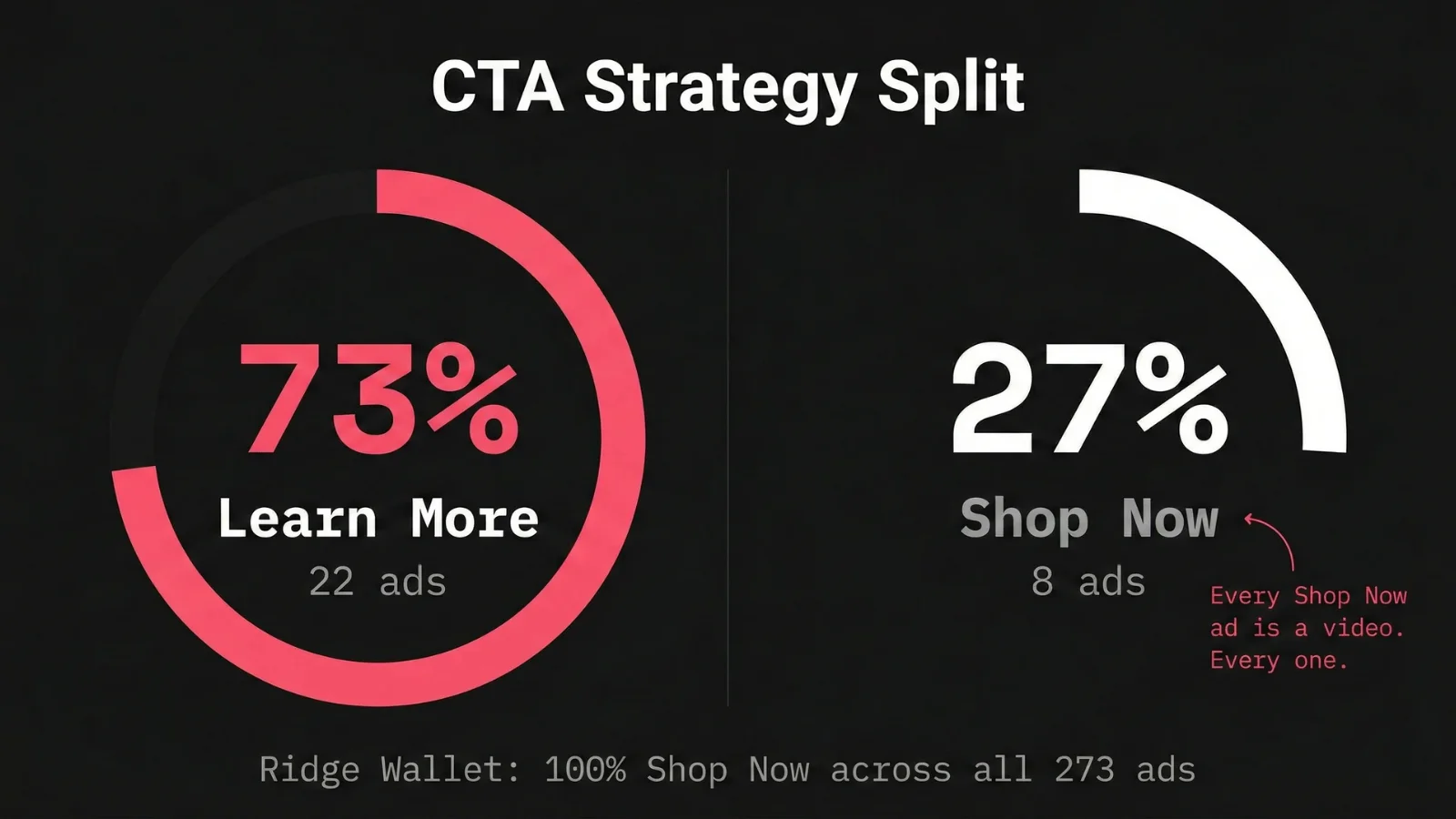
That split alone tells you these are different strategies. But the real pattern shows up when you cross-reference the CTA with the ad format and landing page.
Every “Shop now” ad is a video. All 8. And all 8 point to Obvi’s product pages (primarily the Burn Elite product page at myobvi.com/pages/burn-elite-a). Not a single image ad uses “Shop now.”
“Learn more” ads, on the other hand, go to three types of destinations:
- Custom landing page funnels (get.myobvi.com) -> 13 ads
- Product pages -> 5 ads
- A weight loss quiz (myobvi.com/pages/obvi-weight-loss-quiz) -> 3 ads
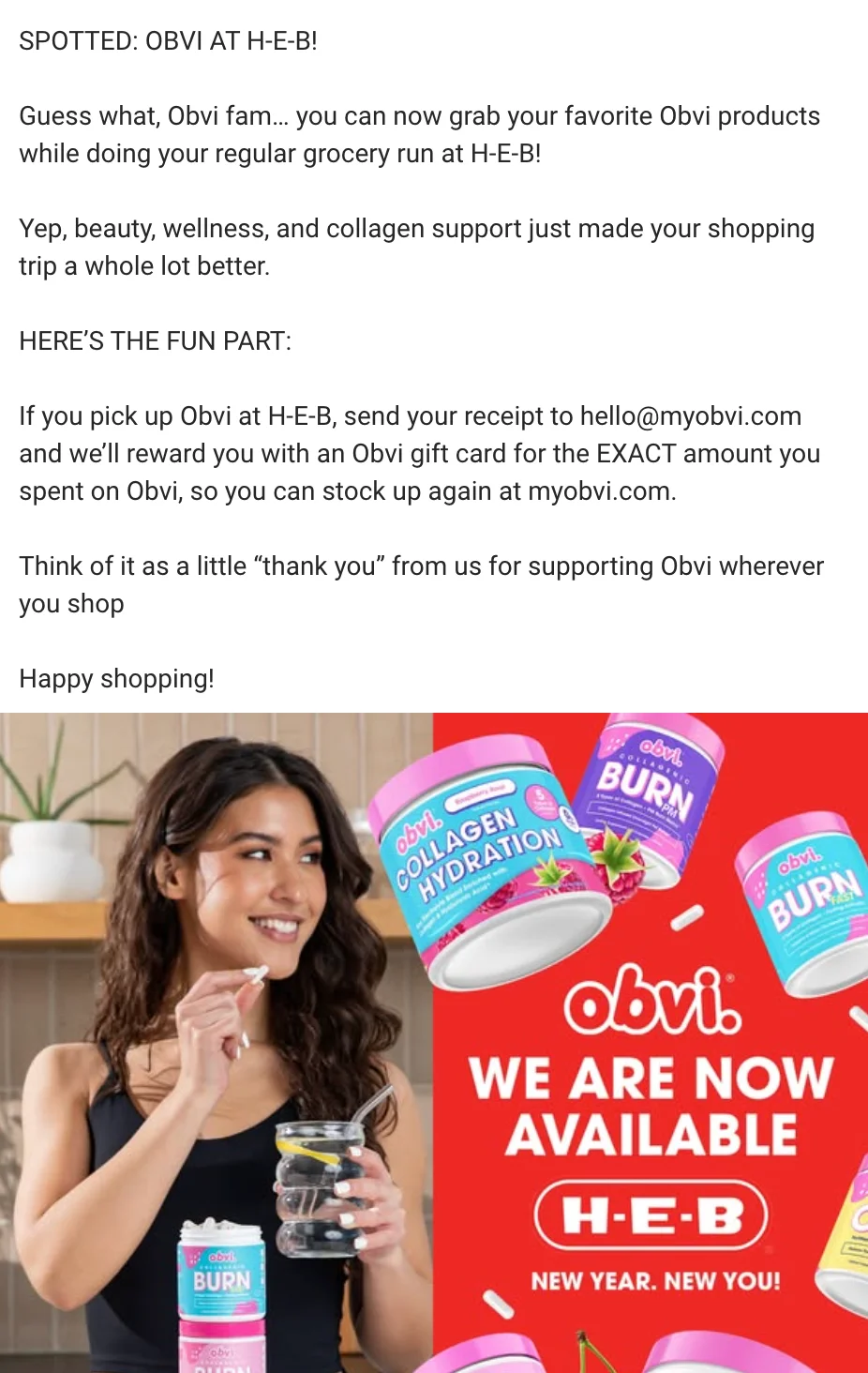
- H-E-B retail page -> 1 ad
So the pattern is:
Track 1 -
Educate, then convert. “Learn more” pushes people into custom landing pages or a quiz.
These aren’t product pages - they’re standalone funnels hosted on get.myobvi.com, each built around a specific pain point. The user reads, learns, maybe takes a quiz, and then gets directed to purchase. This is a consideration play.
Track 2 -
Demonstrate, then sell. Video ad shows the product in action (or a testimonial), paired with “Shop now” directly to the product page. This is a conversion play.
The two tracks likely serve different audiences - Track 1 for people who don’t know Obvi yet and need education, Track 2 for warmer audiences who just need a push.
Do note - The above analysis is a hypothesis. I can’t confirm this from the data alone, but the funnel architecture strongly suggests it.
8 Unique Copy Texts Across 30 Ads
Obvi runs 8 distinct ad copy texts across all 30 Meta ads. That means many ads share the same body copy but appear with different creative assets (different video or image, same words).
Every copy text follows the same structure:
- Open with a pain point the reader feels personally. Not generic health claims - specific, visceral descriptions.
“Your ponytail is half the thickness it used to be. You’re finding hair in the drain, on your pillow, wrapped around everything.” Or: “Now your knees ache when you stand up. Your hips are stiff in the morning. You feel 10 years older than you are.”
- Explain the science behind the problem.
“After 25, your body produces less collagen every year - and collagen is the protein that supports your hair follicles.” This positions Obvi as the educator, not the salesperson.
- Position the product as the solution other brands failed to deliver.
“Most collagen supplements only contain Type I (for skin). They skip Type II entirely, the type that actually supports cartilage and joint health.” Or: “Most supplements are built for gym bros, loaded with stimulants that spike your cortisol.”
- Social proof via testimonials. Quoted reviews, formatted with arrow bullets:
“My bald spots resemble a 5 o’clock shadow because the hair is coming back.”
-
Feature bullets. Checkmark format, listing clinical claims and ingredient highlights.
-
Risk reversal.
“90-day money-back guarantee” appears in 21 of 30 ads (70%), either in the body copy or the link description.
- CTA at the bottom.
“Tap below to learn more” or a direct URL to the product page.
This is long-form ad copy - 200 to 400+ words per ad. These are not punchy one-liners. They read more like advertorials or email sequences compressed into a single ad.
Three Pain Points, Three Landing Pages
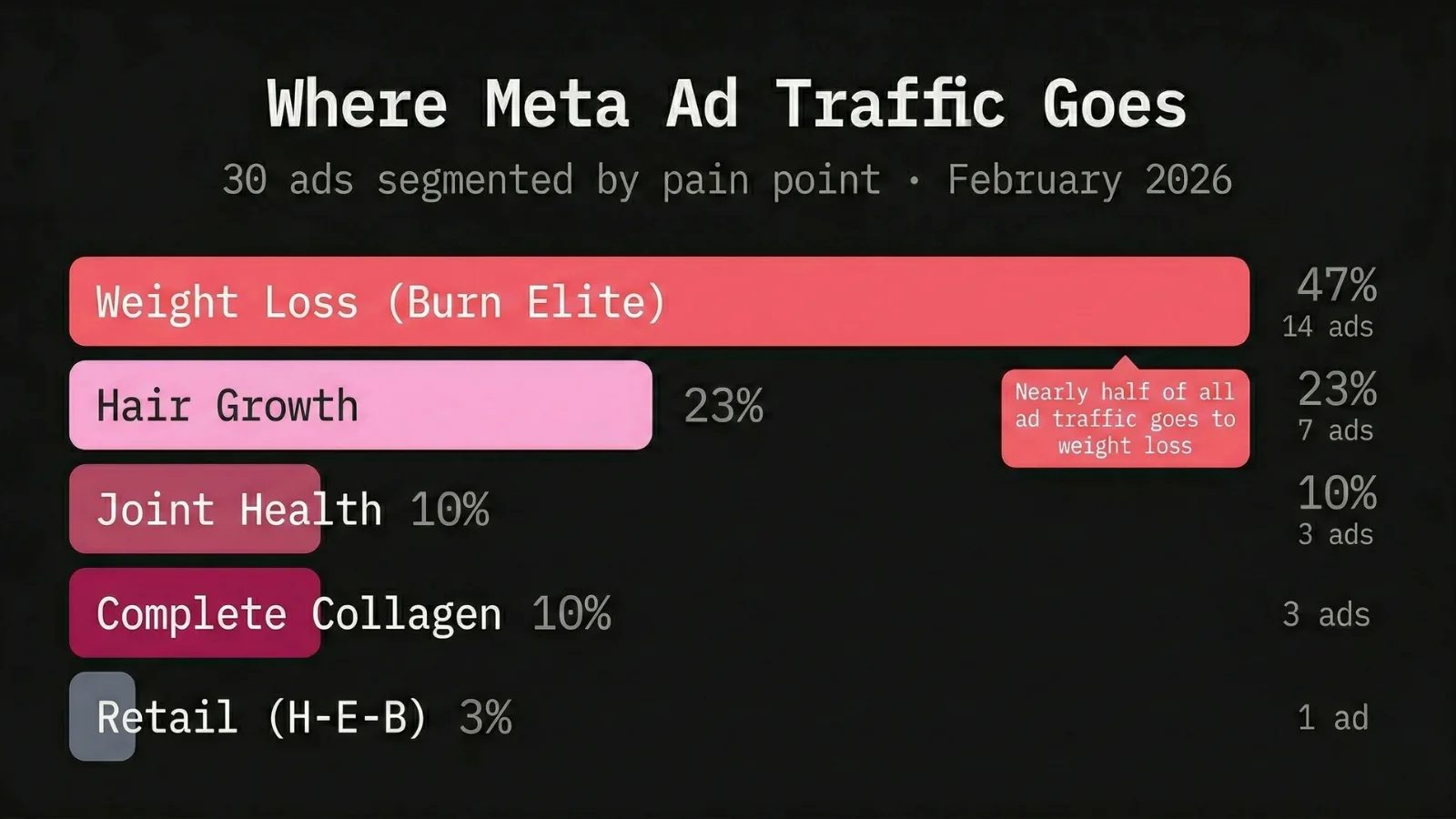
The 30 Meta ads aren’t just selling “collagen.” They’re selling three specific outcomes, and each one gets its own dedicated landing page:
| Pain Point | Landing Page | Ads | % of Total |
|---|---|---|---|
| Weight loss (Burn Elite) | myobvi.com/pages/burn-elite-a, a1, v2, + quiz | 14 | 47% |
| Hair growth | get.myobvi.com/f/D4QVX4YW | 7 | 23% |
| Joint health | get.myobvi.com/f/S32RA0Y3 | 3 | 10% |
| Complete collagen | get.myobvi.com/f/2M5YJ552 | 3 | 10% |
| Retail (H-E-B) | heb.com/brand/obvi | 1 | 3% |
Weight loss is nearly half of all Meta ad traffic. Hair growth is the second-biggest bet. Joint health and the “complete collagen” angle each get a smaller allocation.
The get.myobvi.com URLs are notable - these are separate from the main myobvi.com domain. They’re likely built on a landing page tool (Unbounce, Instapage, or similar) specifically for ad traffic.
Each one is tailored to a single pain point with copy that matches the ad that sent the user there. Hair ad -> hair landing page. Joint ad -> joint landing page. No mismatch.
This is a one-pain-point-per-funnel architecture. The goal is never to send everyone to the same product page and hope they find the benefit that matters to them. Instead, Obvi pre-segments at the ad level and delivers a landing page that speaks directly to what brought the user in.
Zero Discounts
0 out of 30 Meta ads mention any discount, sale, percentage off, coupon code, or price.
Zero.
Every ad is value-led - education, storytelling, social proof, and risk reversal (the 90-day guarantee). The closest thing to an “offer” is the title text “Special Offer Available Now!” on two Burn Elite ads, but the body copy contains no actual discount. The offer is the product itself plus the guarantee.
For comparison, Ridge Wallet ran 88% value-led ads with 12% mentioning discounts. Obvi takes it further - 100% value, 0% discount. In the supplement space, where aggressive discounting and “buy 2 get 1 free” offers are common, this is a deliberate choice.
A Note on Social Proof Numbers
One inconsistency in the data: some ads reference “over 500,000 units sold” while others say “800,000+ Customers Worldwide” - and both appear in ads running simultaneously in February 2026. These might be different metrics (units shipped vs unique customers), or the numbers may have been updated in newer ads without refreshing older ones. It’s a minor point, but worth noting.
Google: 119 Ads in Three Waves - With Two Blackout Periods
Now let’s look at the other side - Google, where the story is completely different.
The Format Mix Is the Opposite of Meta
Where Meta is 70% video, Google flips the script:
| Format | Count | % |
|---|---|---|
| Text (Search/Display) | 60 | 50.4% |
| Image (Display) | 41 | 34.5% |
| Video (YouTube/Display) | 18 | 15.1% |
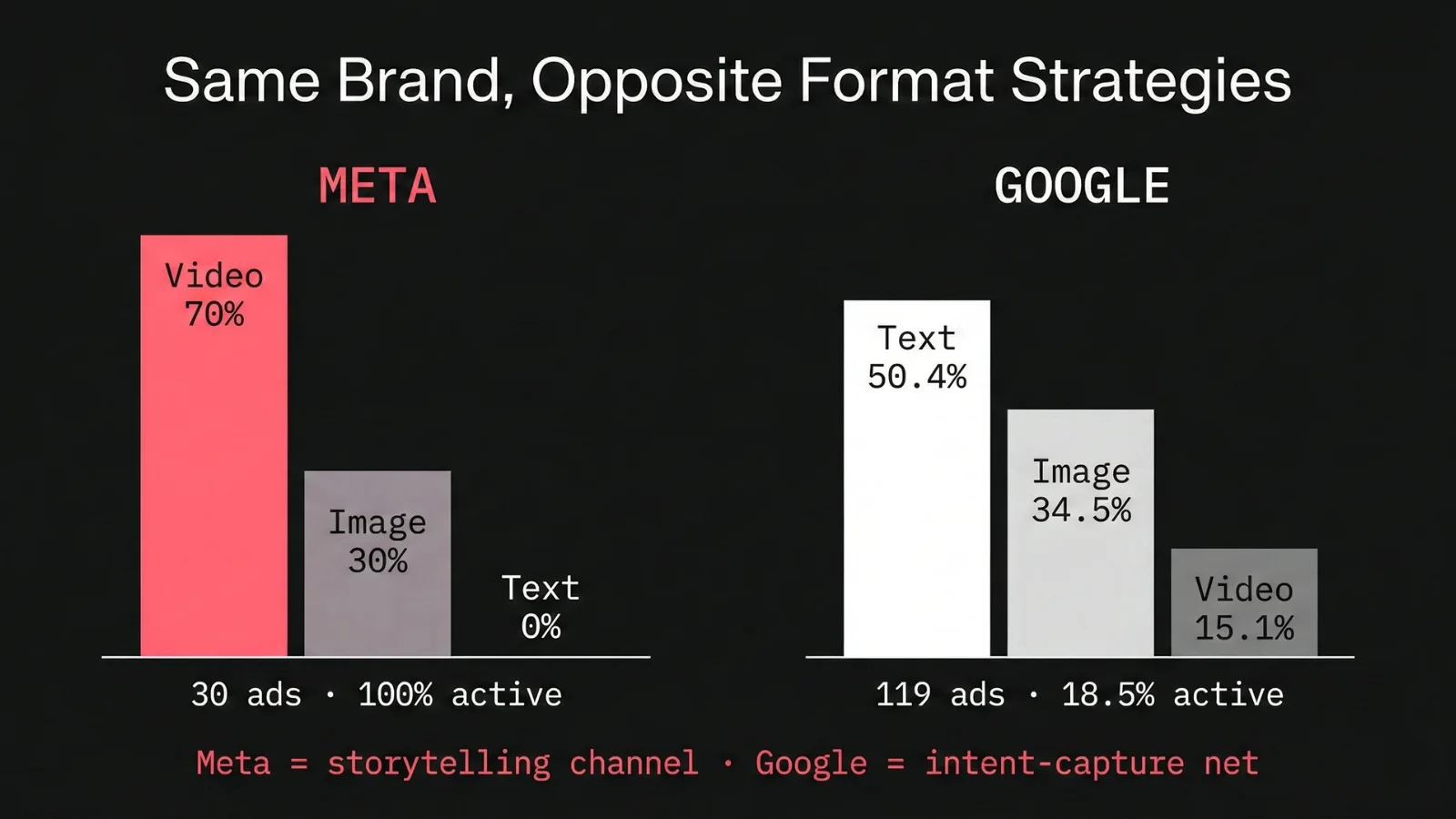
Text ads dominate. This makes sense - Google’s primary strength is capturing search intent with keyword-targeted text ads. When someone Googles “best collagen supplement for weight loss” or “collagen for hair growth,” a text ad appears. That’s the job of half of Obvi’s Google ads.
The 41 image ads are likely Google Display Network placements - banner ads that appear on partner websites. The 18 video ads are probably YouTube pre-rolls or in-feed video placements.
When we look at only the 22 currently active Google ads, the text-heavy lean is even more pronounced:
| Format | Active | % |
|---|---|---|
| Text | 13 | 59% |
| Image | 6 | 27% |
| Video | 3 | 14% |
Three Campaign Waves, Two Blackout Periods
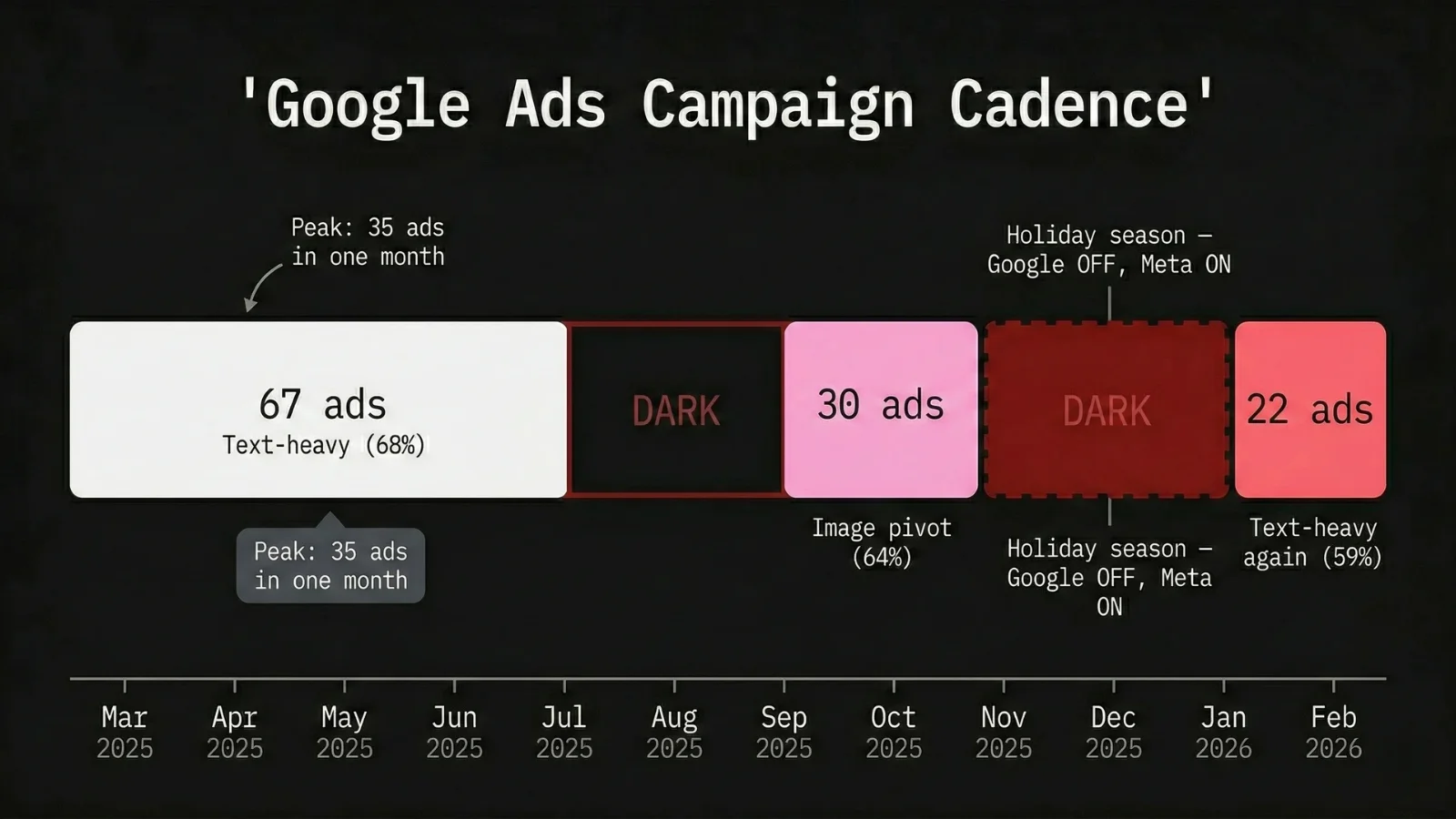
This is the most striking pattern in the Google data. Obvi doesn’t run Google ads continuously. They run in distinct waves:
| Period | Ads Active | Dominant Format |
|---|---|---|
| Mar-Jun 2025 | 67 | Text-heavy (68% text in peak month) |
| Jul-Aug 2025 | 0 | DARK |
| Sep-Oct 2025 | 30 | Image-heavy pivot (64% image in Sep) |
| Nov 2025 - Jan 2026 | 0 | DARK |
| Feb 2026 | 22 | Text-heavy again (59% text) |
Three observations here:
First -
The format changes between waves.
- Wave 1 was text-first (search-driven).
- Wave 2 pivoted to image-first (display-driven).
- Wave 3 is back to text-first.
This could mean they tested display ads in Wave 2 and found search ads more effective, or it could mean different campaigns serve different purposes. The data can’t distinguish between the two.
Second -
The holiday blackout. Obvi went completely dark on Google from November 2025 through January 2026.
For a supplement brand, Q4 is peak season - gift sets, New Year’s resolution buyers, holiday promotions. Every major D2C competitor ramps ad spend during this period. Obvi turned Google off entirely.
Meanwhile, on Meta, they launched 16 ads on December 15-16. Meta was the active platform during the holiday period. Google was not.
This might indicate a deliberate budget allocation decision - concentrate holiday spend on Meta where they have sophisticated funnels, and pause Google where the operation is simpler.
Third -
The peak month was April 2025 - 35 ads. That’s a heavy text-ad push (29 of 35 were text ads). Something drove a significant investment in search advertising that month, and then it scaled back.
Targeting: Almost Nothing
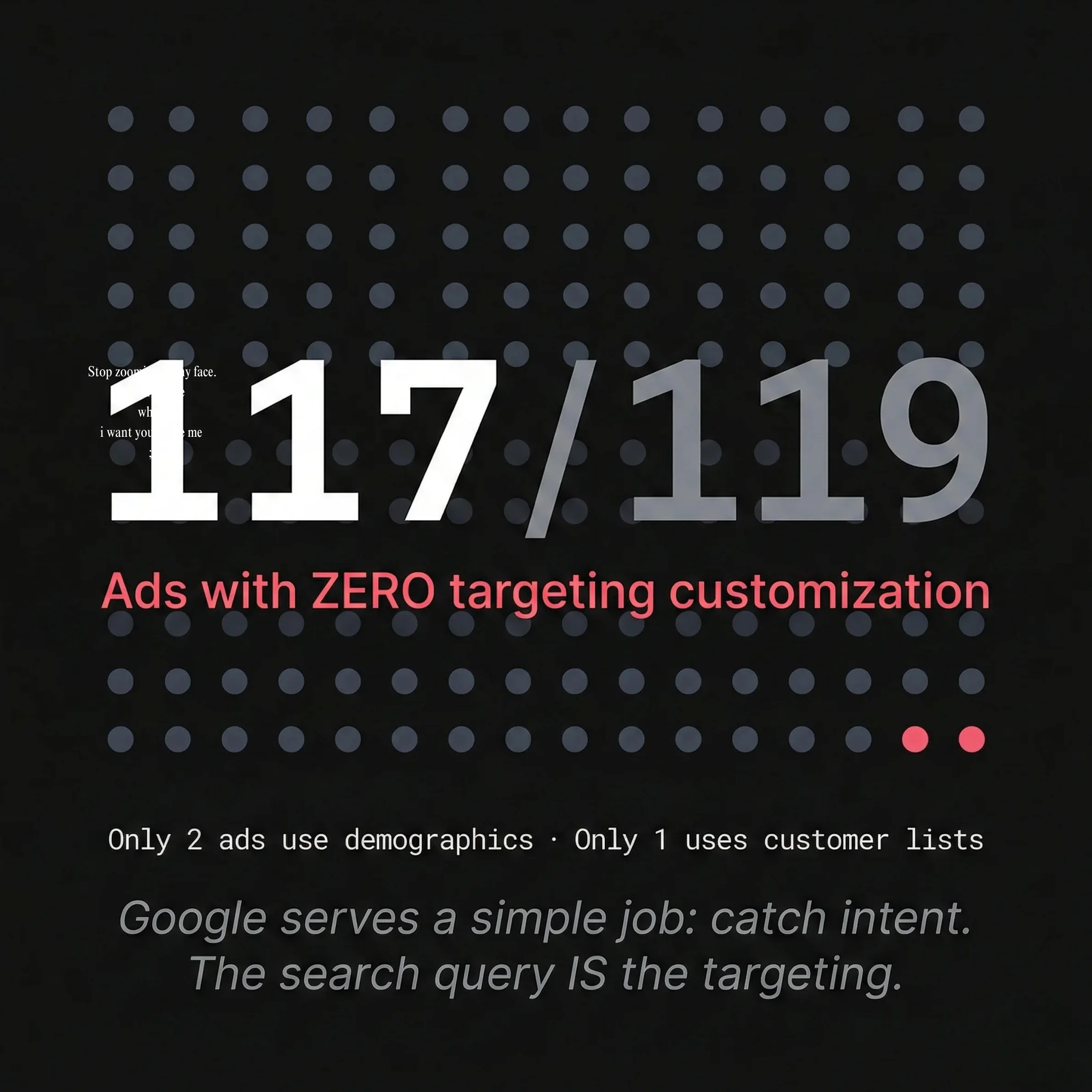
Of 119 Google ads, the targeting data tells an interesting story - mostly by what’s absent:
I hardly found any targeting data… hence please take this section with a pinch of salt.
| Targeting Feature | Ads Using It |
|---|---|
| Demographics | 2 |
| Location | 2 |
| Contextual Signals | 2 |
| Customer Lists | 1 |
| Topics of Interest | 1 |
| No targeting data | 117 |
117 out of 119 ads show no targeting customization beyond the default. Only 2 ads use demographic targeting. Only 1 uses customer list targeting (which means retargeting from an uploaded email list or website visitors).
This is a very different approach from what you’d expect. Meta’s strength is audience targeting - demographic, behavioral, lookalike audiences. Google’s strength can be similar with customer lists, in-market audiences, and detailed demographics. Obvi is barely using any of it on Google.
I think this suggests Google serves a simpler function for Obvi: cast a broad keyword net, capture intent-based searches, and let the search query itself do the targeting. The person who types “collagen supplement for weight loss” has already self-selected. No additional targeting needed.
US-Only, With One Exception
All 119 Google ads target the United States. Few creatives also appeared briefly in Canada, Germany and India (one with a small impression range of 0-1,000 on Google Search).
Combined with Meta (also US-only), Obvi’s majority of their paid ad operation is domestic.
The Cross-Platform Picture: Same Brand, Opposite Strategies
Talking about Meta and Google separately reveals patterns within each platform. But the real insight comes from laying them side by side.
When you do that, the contrast is sharp:
| Dimension | Meta | |
|---|---|---|
| Total ads | 30 | 119 |
| Currently active | 30 (100%) | 22 (18.5%) |
| Primary format | Video (70%) | Text (50.4%) |
| Ad copy visible? | Yes - 200-400 word narratives | No - previews only |
| CTA strategy | Split: 73% “Learn more”, 27% “Shop now” | Not available |
| Landing pages | Dedicated pain-point funnels + quiz | Not available |
| Discount mentions | 0% | Not available |
| Campaign continuity | Always-on (Dec + Feb waves) | Intermittent (3 waves, 2 blackouts) |
| Targeting sophistication | Not exposed by Meta | Near-zero (1 customer list ad) |
| Automation (DCO/DPA) | 0% | N/A |
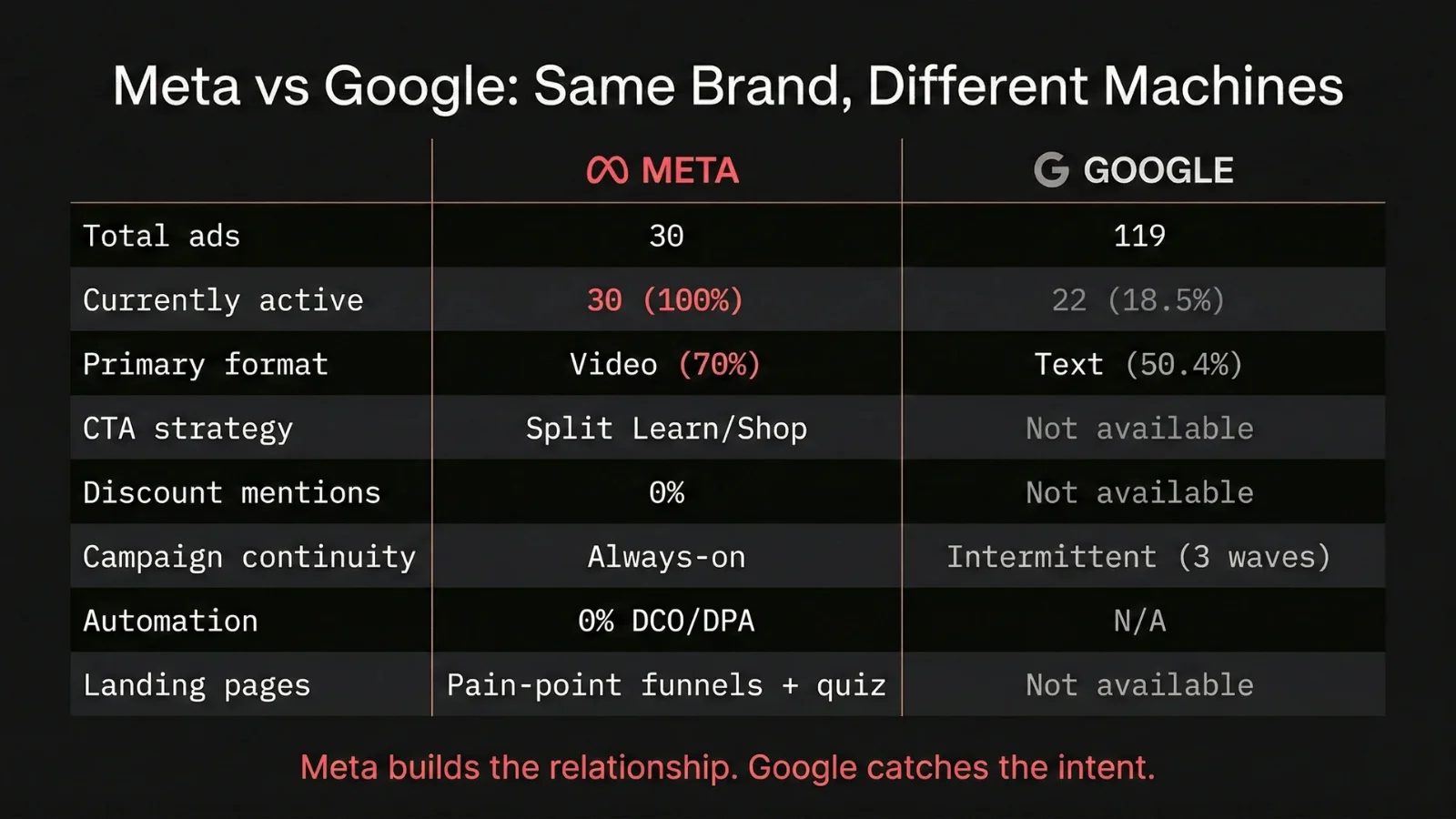
Meta is the storytelling and conversion engine. It runs 100% manual creative, uses long-form narrative copy, segments users by pain point, and routes them through dedicated funnels. It’s always on. Every ad is active. The creative is deliberate.
Google is the intent-capture net. It runs in waves, relies primarily on text ads, uses minimal targeting beyond keywords, and gets turned on and off seasonally. It has produced 4x more total creatives historically, but most of them are now inactive.
These platforms are doing different jobs for the same brand. Meta builds the relationship - educates, tells stories, pushes users through quizzes and landing pages. Google catches the people who are already looking - the ones typing “collagen supplement” or “weight loss pills for women” into search.
What’s notable is the investment gap in sophistication. Meta has custom funnels, three pain-point-specific landing pages, a quiz, video-first creative, and a two-track CTA strategy. Google has… text ads with almost no targeting customization. The same brand, operating at very different levels of maturity on each platform.
The Missing Platforms: No TikTok, No Snapchat, No LinkedIn
I checked TikTok’s Creative Center, Snapchat’s Ad Library, and LinkedIn’s Ad Library. Obvi has zero ads running on any of them.
The LinkedIn and Snapchat absence is expected - neither is a primary channel for D2C supplement brands. But the TikTok absence is worth pausing on.
TikTok’s wellness, supplement, and “that girl” health content ecosystem is enormous. Collagen, weight loss supplements, and hair growth products are some of the most-discussed categories on the platform. Competitor brands in the supplement space are running TikTok-native creator content, influencer partnerships, and TikTok Shop integrations.
Obvi - a brand that sells collagen specifically to women, positioned with the kind of personal storytelling that TikTok rewards - is running zero ads there. Maybe they’re active organically on TikTok and just not running paid. Maybe they tested it and the economics didn’t work. Maybe it’s on the roadmap. The data only tells us what’s in the ad libraries right now, and right now, TikTok is a gap.
How Obvi Compares to Ridge Wallet
This is the second brand teardown in this series. The first was Ridge Wallet - 273 Meta ads for a $100M+ men’s accessories brand. Comparing the two:
| Ridge Wallet | Obvi | |
|---|---|---|
| Meta ads | 273 | 30 |
| Google ads | Not analyzed | 119 |
| Meta format lean | Image-first (57.5%) | Video-first (70%) |
| Meta CTA | 100% “Shop now” | 73% “Learn more”, 27% “Shop now” |
| Discount ads on Meta | 12% | 0% |
| Unique ad copy | 24 texts | 8 texts |
| DCO/DPA | 14.3% | 0% |
| Advertised product categories | 5 | 2 (weight loss + collagen) |
| Platform coverage | Meta only (analyzed) | Meta + Google |
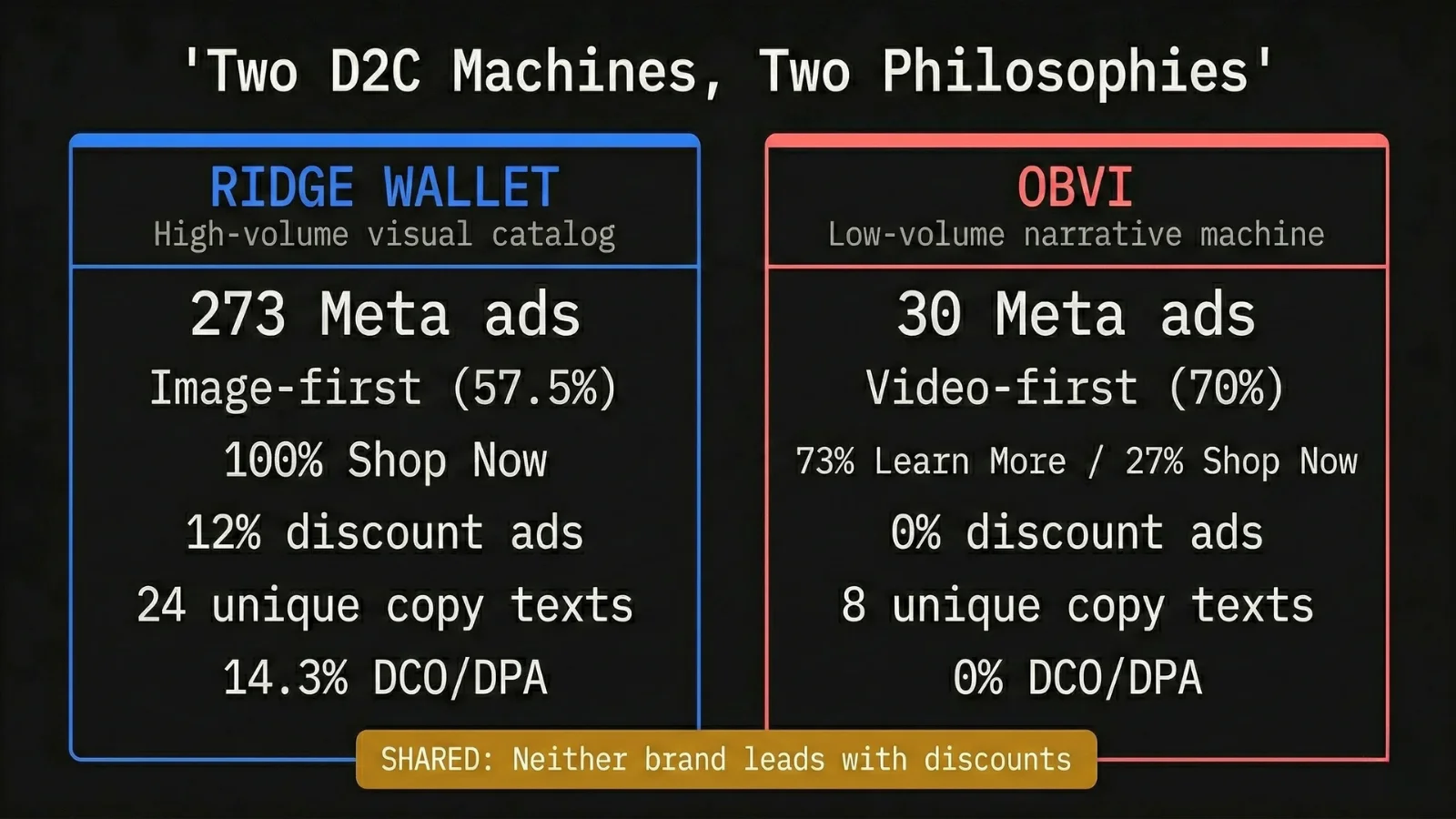
Ridge runs a high-volume visual catalog - hundreds of ads, image-first, heavy DCO testing, 100% “Shop now.” It’s a machine optimized for direct conversion at scale.
Obvi runs a low-volume narrative machine - fewer ads, video-first, long-form copy, dual CTA strategy, and dedicated funnels per pain point. It’s a machine optimized for education before conversion.
Both share one thing: neither leads with discounts. Ridge was 88% value-led. Obvi is 100%. In different product categories with different price points and different competitive dynamics, both chose to protect their pricing and lead with product value instead.
What All of This Means - Five Things Any Brand Can Take From This Playbook
1. Match the format to the platform’s job.
Video on Meta. Text on Google. Same brand, completely different creative strategies - because each platform serves a different function. Meta is where you tell the story. Google is where you catch the person already searching for the solution. Stop repurposing the same creative everywhere and start asking what each channel is actually doing for you.
2. One pain point, one landing page.
47% of Meta ads go to a weight loss page. 23% go to a hair growth page. Every ad speaks to a single problem and lands on a page built around that problem. If you’re sending three different customer segments to the same generic product page, you’re leaking conversions at the bottom of the funnel.
3. Guarantees beat discounts.
Zero coupons. Zero sales. Zero percentage-off callouts across 30 Meta ads. The only “offer” is a 90-day money-back guarantee - which does the same psychological work as a discount without training customers to wait for one. If your product actually works, a guarantee is the most underpriced conversion tool you have.
4. You don’t need to be everywhere. You need to be consistent somewhere.
No TikTok. No Snapchat. No LinkedIn. Just two platforms - and Meta is the one that never goes dark. Most brands spread thin across five channels and show up inconsistently on all of them. This brand picked two, committed to one, and treats the other as a burst channel. That’s a resource allocation decision, not a gap.
5. “Learn more” is a funnel. “Shop now” is a close.
73% of Meta ads push education - quizzes, landing pages, content. Only 27% go straight to product. And that 27%? All video. The brand earns attention before asking for the sale. If your entire ad account is “Shop now” pointing at a product page, you’re skipping the part where people decide to trust you.
This teardown was built from 149 ads across Google and Meta Ad Transparency libraries. All data is publicly available.
I’m tearing down a D2C brand every week. If there’s a brand you want me to break down, DM me on X.
Share this teardown
Read Next
543 Google Ads. 166 Went Dark on the Same Day. Here's What Survived.
A breakdown of Fresh Clean Threads' Google Ads strategy. Why 166 ads went dark in 3 days, why 78% of active ads are Shopping, and how their Google strategy diverges from Meta.
Fresh Clean Threads Runs 150 Meta Ads. Only 17 Pieces of Copy Power All of Them.
150 active ads, 87% algorithm-driven, 17 unique copy blocks, and three simultaneous promo codes. Inside a $60M basics brand that trusts Meta's machine more than its own creative team.
Graza Has 128 Google Ads Spanning a Full Year. The Meta Account Is 11 Days Old.
128 Google ads across 12 months - EVOO cans, Amazon Shopping, a 20.74% Black Friday sale, and a video-only glass bottle launch. The platform where Graza has been experimenting long before Meta.