Our Place Runs 502 Meta Ads. 472 of Them Share One Body Text. Seven Words.
Contents
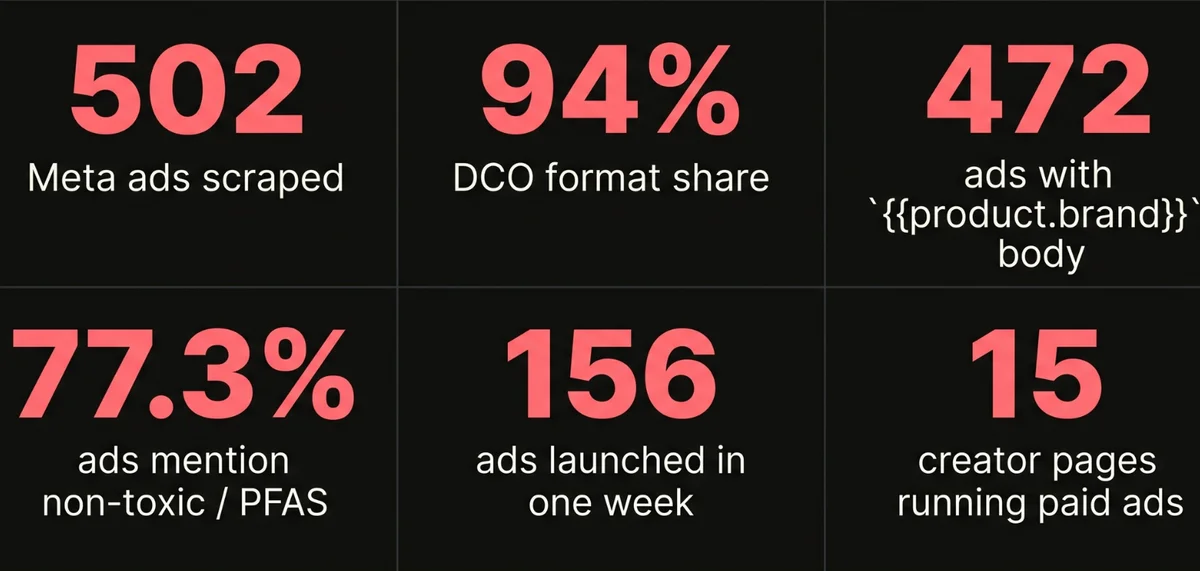
On March 21, 2026, I scraped Our Place’s entire active Meta ad library. 502 ads. All live. All running simultaneously.
Every single ad had the same body text - the literal {{product.brand}} variable.
472 of 502 ads (94%) used the Meta DCO variable that pulls the product name from their Shopify catalog at render time. Our Place has built the most template-driven Meta account I’ve seen in this series - more than Little Sleepies’ 350 DCO ads, more than Magic Spoon’s pastry bet, more than anything covered so far.
Some context before we dig in. Our Place was founded in 2019 by Shiza Shahid (co-founder of the Malala Fund) and Amir Tehrani. The brand is legally registered as “Lagom Kitchen Company” - Lagom being the Swedish word for “just enough.” The Always Pan famously launched with a 30,000-person waitlist. Revenue estimates put them between $50M and $100M annually, with $90.2M in venture funding raised. They’ve woven celebrity partnerships (Selena Gomez, Cameron Diaz, David Beckham) into mission-driven storytelling about multicultural home cooking.
But the ad account doesn’t look like a mission-driven brand. It looks like a machine.
Let me walk you through what I found.
1. The Entire Account Is DCO. 94% of It.
Here’s the format breakdown across all 502 ads:
- DCO (Dynamic Creative Optimization): 472 ads (94%)
- Video: 19 ads (3.8%)
- Image: 9 ads (1.8%)
- DPA (Dynamic Product Ads): 2 ads (0.4%)
DCO in Meta works like this: instead of writing one ad creative, you provide Meta with a catalog of products, a few copy variants, and a few image/video variants. Meta then assembles the ad on the fly for each viewer, picking the product that matches what they’ve browsed or what the algorithm thinks they’ll convert on. The body text at the ad level is typically a template variable - {{product.brand}}, {{product.name}}, {{product.price}} - and the actual selling happens inside the carousel cards.
Our Place’s SKU count makes this unavoidable. They sell cookware sets, individual pans, air fryers, cookware plus a broad range of appliances, dinnerware, tableware, bakeware, and limited-edition colorways. A traditional “one ad, one product, one copy variant” structure would require thousands of manual creative combinations. DCO collapses that into one creative template that adapts to every viewer.
But it comes at a cost: you can’t A/B test body copy. The body is a variable. All your testing - hook, objection handling, proof points - has to happen somewhere else.
Which brings us to the next pattern.
2. The Body Text Is Frozen. The Cards Are Where They Actually Test.
If 472 ads share the same body, where does the messaging live?
In the DCO cards. Each ad carries two or more carousel cards, and those cards carry the real copy.
Here’s what that looks like at scale:
- Total cards across all ads: 1,136
- Unique card body texts: 159
- Unique card titles: 91
- Unique link descriptions: 7
Seven unique link descriptions across 1,136 cards. I’ll repeat that - seven.
The top three link descriptions handle almost every ad:
- “Welcome to Our Place” - 35 cards
- “Kitchen essentials from Our Place, we believe in connections made across the kitchen table. Start today with our Heirloom…” - 12 cards
- “While Stocks Last, be quick!” - 4 cards
Card titles are a little more varied. The top five:
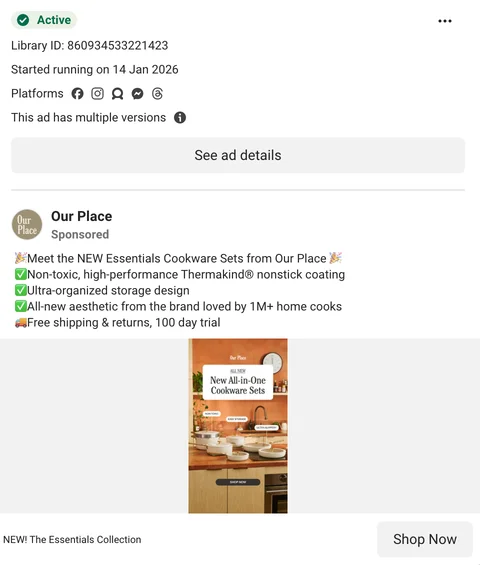
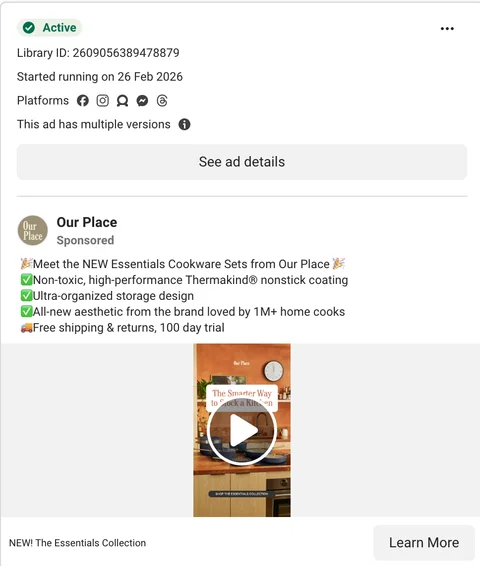
- “NEW! The Essentials Collection” - 101 cards
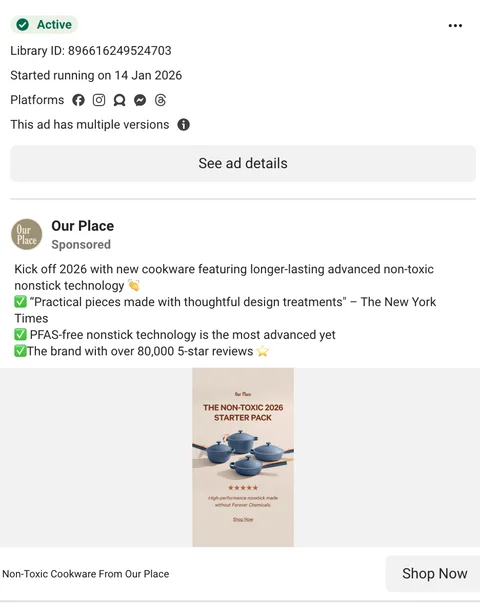
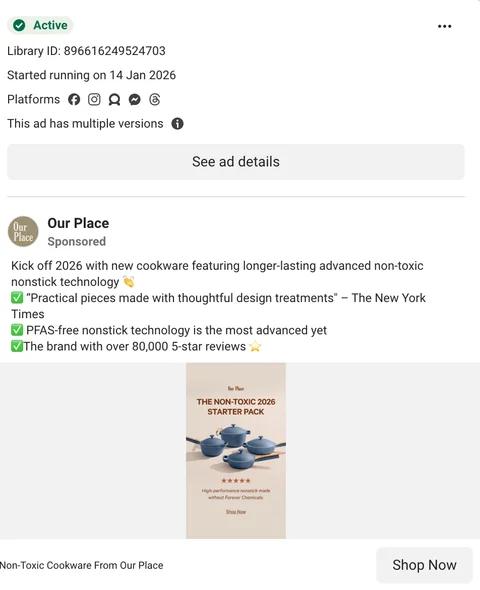
- “Non-Toxic Cookware From Our Place” - 94 cards
- “Toxin-Free Cookware from Our Place” - 59 cards
- “Non-toxic cookware used by pros” - 38 cards
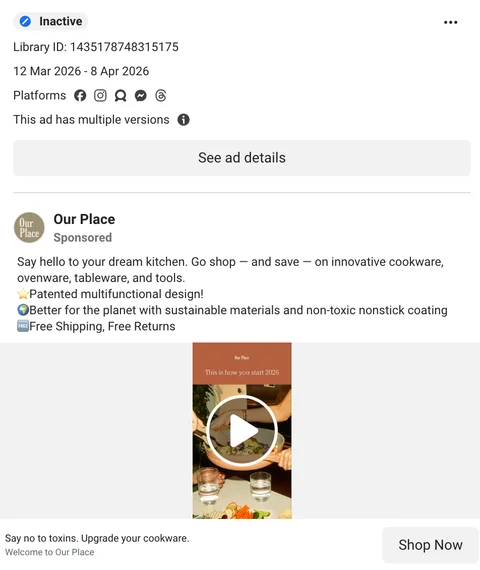
- “Say no to toxins. Upgrade your cookware.” - 35 cards
Four of the top five titles mention “non-toxic” or “toxin-free.” Which leads directly to the next pattern.
3. Non-Toxic Is Not a Message. It’s the Entire Identity.
I ran keyword analysis across all 1,136 cards looking for the dominant messaging pillars. Here’s what surfaced:
| Theme / Hook | Ad Count | Percentage |
|---|---|---|
| Non-toxic / PFAS-free / forever chemicals / Thermakind / NoCo | 388 | 77.3% |
| Multifunctional / “all-in-one” / “in 1” / “replaces” | 146 | 29.1% |
| Performance / pro chef / searing / indestructible / heat-safe | 134 | 26.7% |
| Press & validation (Vogue, NYT, “1M+ home cooks”) | 117 | 23.3% |
| Limited edition / exclusive / Forget-Me-Not | 58 | 11.6% |
| Sustainability / planet / eco | 40 | 8.0% |
Three out of every four ads mention non-toxic or PFAS. For comparison, Magic Spoon’s pastry pivot was 56% of their ad volume, and I called that out as the most dominant single-message bet I’d seen. Our Place’s non-toxic positioning is 21 points higher.
Let me show you what that actually looks like in a card:
“Our kitchenware is made without “Forever Chemicals” for safe and healthy cooking - always. ✅ “Practical pieces made with thoughtful design treatments” – The New York Times. ✅ PFAS-free nonstick technology…”
Or this one, which appeared in 34 different ads:
“Forget-Me-Not Blue: a limited-edition shade for stylish kitchens and thoughtful cooking. ✅ Same non-toxic ceramic cookware trusted by more than a million home-cooks. ✅ Made without PFAS, PTFE, or PFOA…”
Even their limited edition color drop leads with non-toxic.
I think the bet here is clear. The cookware category has been under fire for PFAS in the last few years - Teflon lawsuits, the “Dark Waters” movie effect, and a consumer shift toward ceramic and titanium alternatives. Our Place isn’t competing on design anymore. They’re competing on what’s not in the pan.
4. The Product They’re Famous for Is Now Their Fourth-Priority Ad Spend.
When you think of Our Place, you think Always Pan. That’s the product that had the 30,000-person waitlist. That’s the product in every celebrity’s kitchen. That’s the hero.
Here’s what their current ad spend says about what they’re really pushing:
| Product | Ad Count | Percentage |
|---|---|---|
| Wonder Oven (air fryer / toaster oven) | 127 | 25.3% |
| Titanium Pro (new cookware line) | 110 | 21.9% |
| Essentials Collection (new mid-tier cookware) | 97 | 19.3% |
| Always Pan | 68 | 13.5% |
The Always Pan - the product that built the brand - is fourth.
Wonder Oven is first by a wide margin. Looking at individual product pages:
/products/wonder-oven: 84 ads pointing here/products/wonder-oven-pro: 24 ads/products/large-wonder-oven: 8 ads
That’s 116 ads pointing directly to Wonder Oven product pages. The cookware company is becoming an appliance company in real time, and the ads are the paper trail.
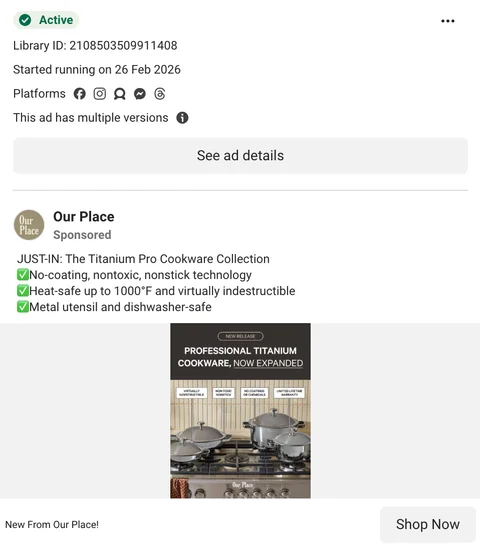
The Titanium Pro line is the second-priority push. This is a new no-coating nonstick technology Our Place launched in Q1 2026. The messaging is sharp - “300% stronger than stainless steel,” “virtually indestructible,” “heat-safe up to 1000°F,” “chef-approved.” Looking at launch dates, the Titanium Pro ad burst started around February 10, 2026 and peaked on February 26 when they launched 31 Titanium Pro ads in a single day.
The Essentials Collection is the third push. Different positioning - classic cookware sets, but reimagined with storage design and Thermakind coating. Again launched in waves: October 2025 (small test), January 2026 (ramp), February 26, 2026 (peak with 13 Essentials ads that day).
Always Pan, the original hero, shows up mostly as a secondary card inside DCO carousels or in the duo-and-combo landing pages. It’s not the star anymore. It’s the anchor.
5. They Launched 156 New Ads in a Single Week.
Here’s the weekly launch cadence for Q1 2026:
| Week | Date Range | New Ads |
|---|---|---|
| W03 | Jan 12-18 | 37 |
| W04 | Jan 19-25 | 9 |
| W05 | Jan 26- Feb 1 | 6 |
| W06 | Feb 2-8 | 20 |
| W07 | Feb 9-15 | 21 |
| W08 | Feb 16-22 | 30 |
| W09 | Feb 23- Mar 1 | 156 |
| W10 | Mar 2-8 | 68 |
| W11 | Mar 9-15 | 77 |
| W12 | Mar 16-22 | 42 |
February 26 alone saw 94 new ads launched. This was the coordinated Titanium Pro + Essentials Collection + Forget-Me-Not Blue launch day.
Wrt previous context - between July and December 2025, Our Place launched 36 ads in total. Between January and March 2026, they launched 466. That’s 93% of their current active library built in a 12-week window.
This is not a steady drip. This is a quarterly reset.
6. One Promo Code. One Secret Sale. One Fermat-Style Funnel.
I searched every card body and title for promo codes. Only one surfaced.
SaveSecretSale - 63 cards.
It points to a subdomain they built specifically for this: shop.fromourplace.com/secret-sale. The URL carries fermat_channel=facebook parameters, which tells me this is a Fermat-powered personalized landing page - a popular D2C tool for building one-to-one shopping experiences from ad clicks.
Here’s the copy in one Wonder Oven ad using this code:
“Did you know many air fryers contain toxic chemicals, and can release harmful fumes into the air and your body? Make the switch to the non-toxic, better-for-you Wonder Oven TODAY and get 20% off with code SaveSecretSale.”
The structure is consistent across the 63 cards: pose a health-based objection to competitor products, offer a 20-25% discount to switch, code delivered as social proof (“Used code: SaveSecretSale”). The framing of the card titles is notable - instead of “Use code: SaveSecretSale” (instructional), they use “Used code: SaveSecretSale” (past tense, implying others have already redeemed it).
Small thing. But deliberate.
The discount structure inside the copy itself:
- 25% off single products: 39 ads mention this
- 20% off: 8 ads
- 15% off: 4 ads
Compared to FCT running three promo codes simultaneously or Obvi’s rotating 40-60% discount structure, Our Place runs an exceptionally tight promo strategy. One code. One sale. One URL. Everything funnels through it.
7. The DCO Carousel Is Always Two Cards.
Most Meta DCO setups use 6-10 carousel cards - the more cards, the more surface area for Meta’s algorithm to find a winning combination. But Our Place does the opposite.
Cards-per-ad distribution:
| Cards per Ad | Ad Count | Percentage |
|---|---|---|
| 2 cards | 431 | 86% |
| 0 cards | 28 | 5.6% |
| 4 cards | 16 | 3.2% |
| 3 cards | 11 | 2.2% |
| 9 cards | 7 | 1.4% |
| 15 cards | 6 | 1.2% |
| 6 cards | 2 | 0.4% |
| 12 cards | 1 | 0.2% |
Almost nine out of every ten DCO ads are two-card carousels. My hunch is that they’ve tested longer carousels and found diminishing returns - viewer attention drops after card two, so why pay for card four through ten?
Note - The 15-card outliers all point to cookware-duo bundle landing pages, where the depth makes sense (many products, many angles).
8. Five Countries. Five Domains. Fully Localized.
Our Place runs ads across five country-specific domains on Meta:
| Domain | Ad Count | Percentage |
|---|---|---|
| fromourplace.com (US) | 151 | 30.1% |
| fromourplace.co.uk (UK) | 125 | 24.9% |
| fromourplace.ca (Canada) | 120 | 23.9% |
| fromourplace.au (Australia) | 54 | 10.8% |
| fromourplace.fr (France) | 26 | 5.2% |
| shop.fromourplace.com (secret sale) | 12 | 2.4% |
| go.shopmy.us (creator affiliate) | 14 | 2.8% |
What makes this interesting isn’t the number of countries - it’s the depth of the French localization. I scraped all the French ad cards and fed them through language detection. 32 of 50 French card body texts are written in French - not translated English, but native-written French copy.
Example from a Titanium Pro French ad:
Card title:
“La poêle adorée des chefs étoilés.” (The pan loved by Michelin-starred chefs.)
Card body:
“Ustensiles anti-adhésifs validés par les chefs 🔥R ésiste à 535°C 🫧Passe au lave-vaisselle ➕Garantie à vie limitée”
(Non-stick utensils validated by chefs 🔥Resists 535°C 🫧Dishwasher safe ➕Limited lifetime warranty)
The UK/CA/AU ads use the same English copy as the US with small spelling tweaks (colour/color, optimised/optimized). But France gets its own messaging entirely. My guess is French shoppers don’t respond to the same “forever chemicals” fear-based framing that works in English-speaking markets, so Our Place replaced it with the chef authority angle - Michelin stars and lifetime warranties instead of PFAS.
This is the deepest geo-localization I’ve seen in the series. Most D2C brands either run English-only globally or do shallow translations. Our Place is running a different campaign in French.
9. 15 Creator Pages Run Our Place Ads. 52 Ads Total.
This was the finding I didn’t expect.
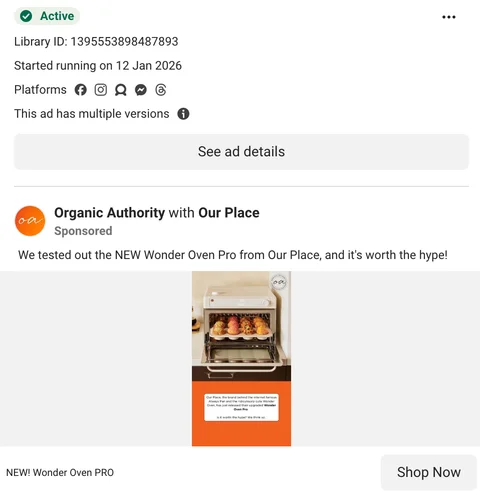
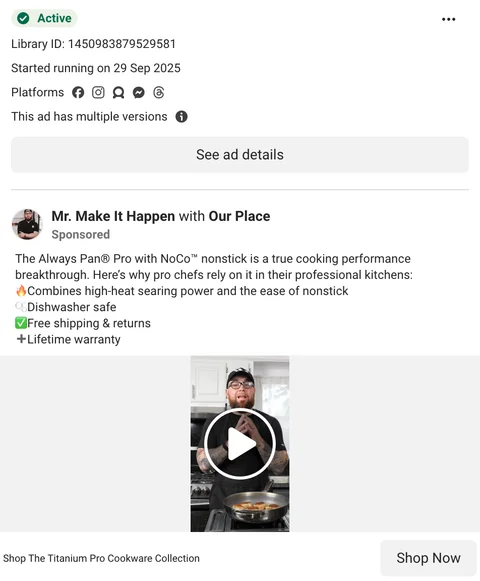
Of the 502 ads in the account, 52 (10.4%) are served from Meta pages that aren’t Our Place’s main page. They’re creator pages, influencer pages, and content site pages - running paid Meta ads that Our Place is funding.
Here’s the breakdown by page:
| Creator / Page | Category | Ads |
|---|---|---|
| Organic Authority | Health & wellness website | 12 |
| Mr. Make It Happen | Food & Drink | 8 |
| Daniella Monet | Artist / former Nickelodeon actress | 8 |
| Hailey polk | Health/beauty | 7 |
| Melissa | Personal blog | 3 |
| The Flint House | Home Design | 3 |
| The Hoppy Home | Personal blog | 2 |
| mycah_hunter | Personal blog | 2 |
Note - Seven more pages with 1 ad each: Madelyn May Jensen, Healthy Emmie, NORI, Minori Kawachi, arianestarceski, Saige Peterson, Alison Todd
The copy on these creator ads is different from the main brand ads. Instead of the DCO template, they read like personal endorsements:
“Obsessed with the Essentials Collection from Our Place! It is non-toxic, nonstick, and stores beautifully on my counter.” - Melissa
“WOW I am in love with this air fryer from Our Place! It is multifunctional (air fries, bakes, roasts, toasts, dehydrates and more), and it is non-toxic which is huge for me.” - Healthy Emmie
“This set is my new go-to. Simple, clean, and actually fun to cook with.” - Hailey polk, arianestarceski, Saige Peterson, Alison Todd (same copy, four different pages)
That last one is interesting. Four different creator pages running the exact same copy. Our Place wrote a standard testimonial script and asked the creators to post it from their pages.
And so the creators get paid, Our Place gets the authority transfer of an endorsement plus the algorithmic benefit of non-brand-page engagement.
10. 14 of Those Creator Ads Link to ShopMy. This Is Affiliate-Tracked Paid Spend.
Here’s the part that makes the creator ads more than just influencer marketing - they’re tracked.
Of the 52 creator ads, 14 use landing URLs like go.shopmy.us/p-36363971 or go.shopmy.us/p-43935100. ShopMy is an affiliate-tracking platform creators use to earn commission on conversions. The p- prefix is a ShopMy product link.
So the flow looks like this:
- Our Place pays Meta to run a paid ad from a creator’s page
- The ad clicks through to the creator’s ShopMy affiliate link
- ShopMy tracks the conversion and pays the creator a commission
- Our Place gets the sale, the creator gets the commission and the reach
This is the first time I’ve seen a D2C brand in this series use paid Meta ads to amplify creator affiliate links. Most brands either do organic creator partnerships (creator posts on their own feed, hopes it takes off) or run traditional UGC-style ads from the brand page. Our Place is doing both at once - paying for the distribution, while the creator gets paid on the outcome.
I don’t know if this is a widespread playbook or something Our Place pioneered. But 14 ads across 7 different creator pages all using ShopMy links tells me this is a programmatic partnership system, not a one-off.
11. Forget-Me-Not Blue Is a Limited Color, Not a Limited Product.
18 ads across all four English-speaking domains reference a limited-edition color called Forget-Me-Not Blue.
Here’s the breakdown:
- UK: 6 ads
- Canada: 5 ads
- US: 4 ads
- Australia: 3 ads
The launch dates cluster tightly between February 23 and March 18, 2026. Every ad points to /collections/forget-me-not-blue - which means this isn’t a new product, it’s the existing Always Pan / Essentials Collection / Wonder Oven lineup in a new color.
This is the Ridge Wallet capsule-drop playbook applied to cookware. Ridge runs 41% of their ad volume against limited collections - Oceanlight, Legends in Bloom, Year of the Fire Horse. Same SKUs, different colorways, scarcity framing. Our Place is doing 4% of their volume on Forget-Me-Not Blue, which is a lower bet, but the structure is identical.
The copy also carries a nod to the “over 1 million home cooks” social proof, so they’re using the limited color as a reason to retarget existing customers who already have their cookware in black or cream.
12. Press Validation Is Baked Into the Cards, Not the Body.
117 ads (23.3%) reference an external validation source. The common ones:
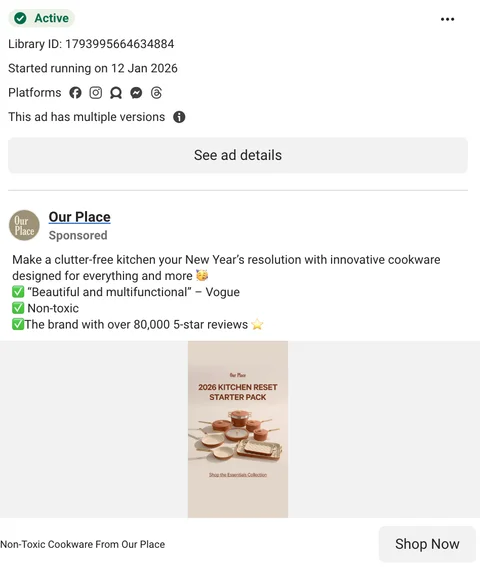
- Vogue - “Beautiful and multifunctional”
- New York Times - “Practical pieces made with thoughtful design treatments”
- “Chef-approved” / “1M+ home cooks” / “Used by pros”
These quotes appear inside the DCO cards, not in the ad-level copy. Again, because the ad-level body is frozen at {{product.brand}}, the cards have to carry all the trust-building work.
The most-repeated press validation is the “1M+ home cooks” language, which anchors the scale claim - a million people can’t all be wrong. Compare this to a brand like Magic Spoon which leans on celebrity endorsements - Our Place uses institutional validation (Vogue, NYT) rather than celebrity names in the ad copy.
My interpretation is that they’re targeting the “practical shopper” - someone who wants to know it’s good, not someone who wants to know who else bought it.
13. Every Ad Runs on Five Placements Simultaneously.
Here’s the Meta placement distribution:
| Placement | Ad Count | Coverage |
|---|---|---|
| 502 / 502 | 100% | |
| 502 / 502 | 100% | |
| Threads | 502 / 502 | 100% |
| Audience Network | 501 / 502 | 99.8% |
| Messenger | 499 / 502 | 99.4% |
Every single ad runs on Facebook, Instagram, and Threads. 501/502 also run on Audience Network and Messenger.
There’s no placement segmentation. No Instagram-only creative. No Facebook-specific targeting. Meta’s default is “run everywhere,” and Our Place accepts that default across their entire library. Which makes sense given the DCO structure - if the creative auto-adapts, why manually pick placements?
I noticed the Threads inclusion is near-universal. Threads is still a relatively new ad placement, and most of the brands I’ve analyzed have mixed placement - some Threads, some not. Our Place runs 100% coverage on Threads. Whether that’s intentional strategy or just default settings, I don’t know. But the ads are getting distributed there regardless.
14. The Ads Don’t Live Long. Zero of Them Cross 365 Days.
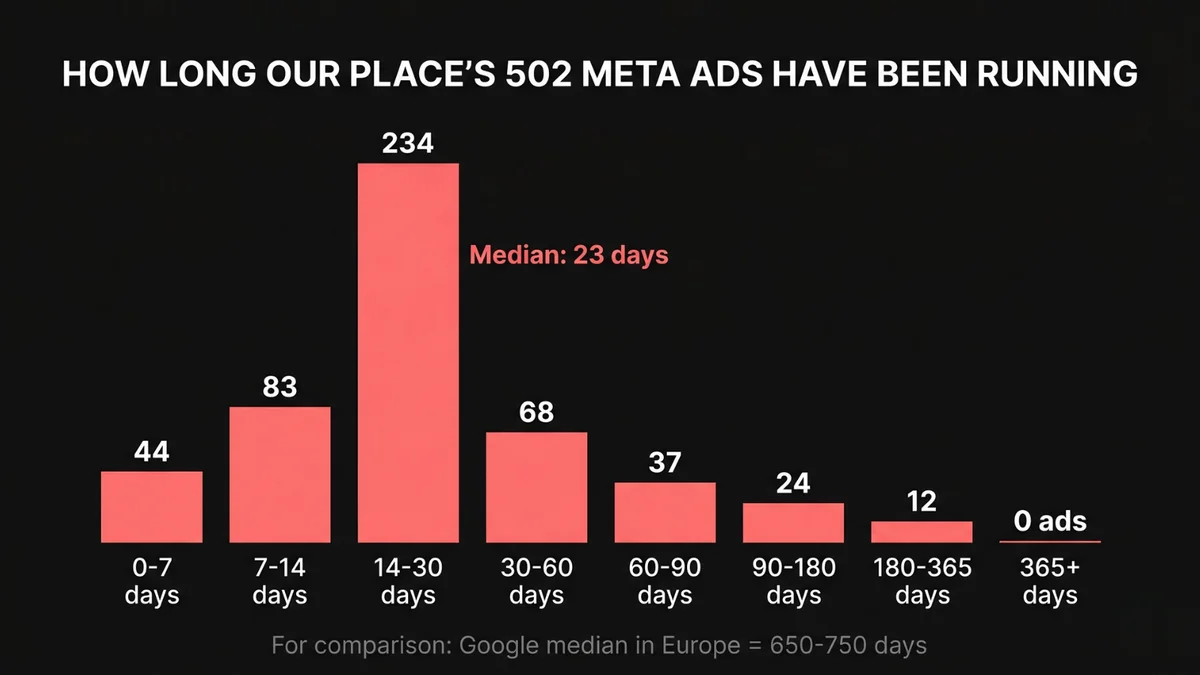
I pulled the start date for every ad and calculated how long each has been running. Here’s the distribution:
| Duration | Ad Count | Percentage |
|---|---|---|
| 0-7 days | 44 | 8.8% |
| 7-14 days | 83 | 16.5% |
| 14-30 days | 234 | 46.6% |
| 30-60 days | 68 | 13.5% |
| 60-90 days | 37 | 7.4% |
| 90-180 days | 24 | 4.8% |
| 180-365 days | 12 | 2.4% |
| Over 365 days | 0 | 0% |
Median ad age: 23 days. Average: 34 days.
This also aligns with the quarterly reset pattern. 93% of the account was rebuilt in Q1 2026. None of the old ads from 2025 survived into the current library because the strategy is to flood, test, kill, and reflood.
15. All 502 Ads Use the Same Call-to-Action. Almost.
| CTA | Ad Count | Percentage |
|---|---|---|
| ”Shop now” | 499 | 99.4% |
| “Learn more” | 3 | 0.6% |
The “Learn more” CTAs are on the longest-running ads in the account (90+ days), pointing to blog-style content pages. The rest of the account is pure conversion intent. “Shop now” - click, buy, done.
16. Body Text Isn’t Just a Variable. It’s a Signal.
Of the 502 ads, 472 use {{product.brand}} as body text. The remaining 30 use real body copy.
Here’s what those 30 look like:
- 5 ads use: “Our Place is the best place for cookware, appliances, dinnerware, and kitchen tools designed to make home cooking easier.” - brand anthem, homepage-adjacent positioning
- 4 ads use the Titanium Pro pitch: “Chef-approved for your kitchen: ALL-NEW Titanium Pro pots and pans. ✅No-coating, virtually indestructible nonstick technology…”
- 3 ads use: “Your dream kitchen is here. Shop non-toxic cookware, bakeware, appliances, and more designed to make home cooking easier.”
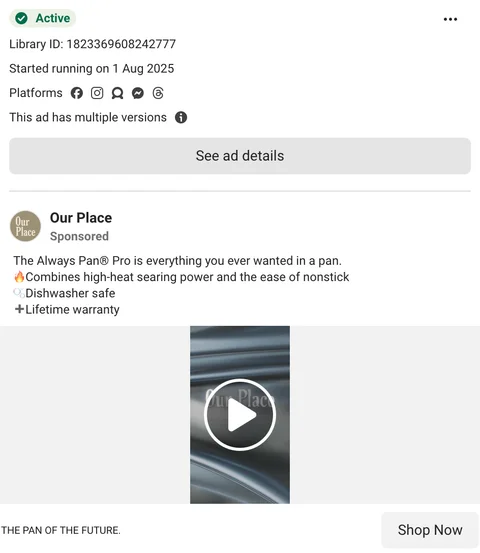
- 2 ads use the Always Pan Pro pitch: “The Always Pan® Pro is everything you ever wanted in a pan…”
- The remaining 16 are individual creator ads, French localized ads, and one Secret Sale ad
What this tells me is that when Our Place does write real body copy, it’s for high-priority product launches (Titanium Pro) or for ads that need to stand on their own (creator testimonials, French ads without DCO templates). Everything else defaults to the template variable.
Summary
If you skimmed to here, the patterns in one glance:
- 94% of 502 Meta ads are DCO. 472 of them share one body text - the literal
{{product.brand}}template variable. - 159 unique card body texts, 91 card titles, 7 link descriptions. All messaging lives in the DCO carousel cards.
- 77.3% of ads mention “non-toxic” or PFAS-free. This is the single dominant messaging pillar, 21 points ahead of the next contender (multifunctional at 29%).
- Wonder Oven is #1 by ad volume (127 ads, 25.3%). Always Pan - the product that built the brand - is #4 at 68 ads (13.5%).
- 156 new ads launched in a single week (Feb 23-Mar 1, 2026). 94 on Feb 26 alone. Q1 2026 built 93% of the current active library.
- One promo code: SaveSecretSale (63 ads). One dedicated subdomain:
shop.fromourplace.com/secret-salewith Fermat personalization parameters. - 86% of DCO ads use exactly 2 carousel cards. Constrained design, deliberate choice.
- Five country domains: US (151), UK (125), CA (120), AU (54), FR (26). French ads are fully localized - different messaging (chef authority instead of PFAS-free), not just translated copy.
- 52 ads run from 15 non-brand pages (Organic Authority, Daniella Monet, Hailey polk, and 12 others). 14 of those route through ShopMy affiliate tracking.
- Zero ads running over 365 days. Median ad age: 23 days. Fresh inventory every quarter.
- 99.4% of ads use “Shop Now” CTA. Bottom-funnel conversion intent.
- 502 ads, all active, all running on Facebook + Instagram + Threads + Audience Network + Messenger simultaneously.
I’m tearing down a D2C brand every week. If there’s a brand you want me to break down, DM me on X.
Share this teardown
Read Next
543 Google Ads. 166 Went Dark on the Same Day. Here's What Survived.
A breakdown of Fresh Clean Threads' Google Ads strategy. Why 166 ads went dark in 3 days, why 78% of active ads are Shopping, and how their Google strategy diverges from Meta.
Fresh Clean Threads Runs 150 Meta Ads. Only 17 Pieces of Copy Power All of Them.
150 active ads, 87% algorithm-driven, 17 unique copy blocks, and three simultaneous promo codes. Inside a $60M basics brand that trusts Meta's machine more than its own creative team.
Graza Has 128 Google Ads Spanning a Full Year. The Meta Account Is 11 Days Old.
128 Google ads across 12 months - EVOO cans, Amazon Shopping, a 20.74% Black Friday sale, and a video-only glass bottle launch. The platform where Graza has been experimenting long before Meta.