I Scraped 400 of RYZE's Meta Ads. Here's What a $50M Mushroom Coffee Brand's Ad Machine Actually Looks Like.
Contents
Every D2C brand tells you they “test creative at scale.” But what most of them mean is they swap a headline once a month and call it optimization.
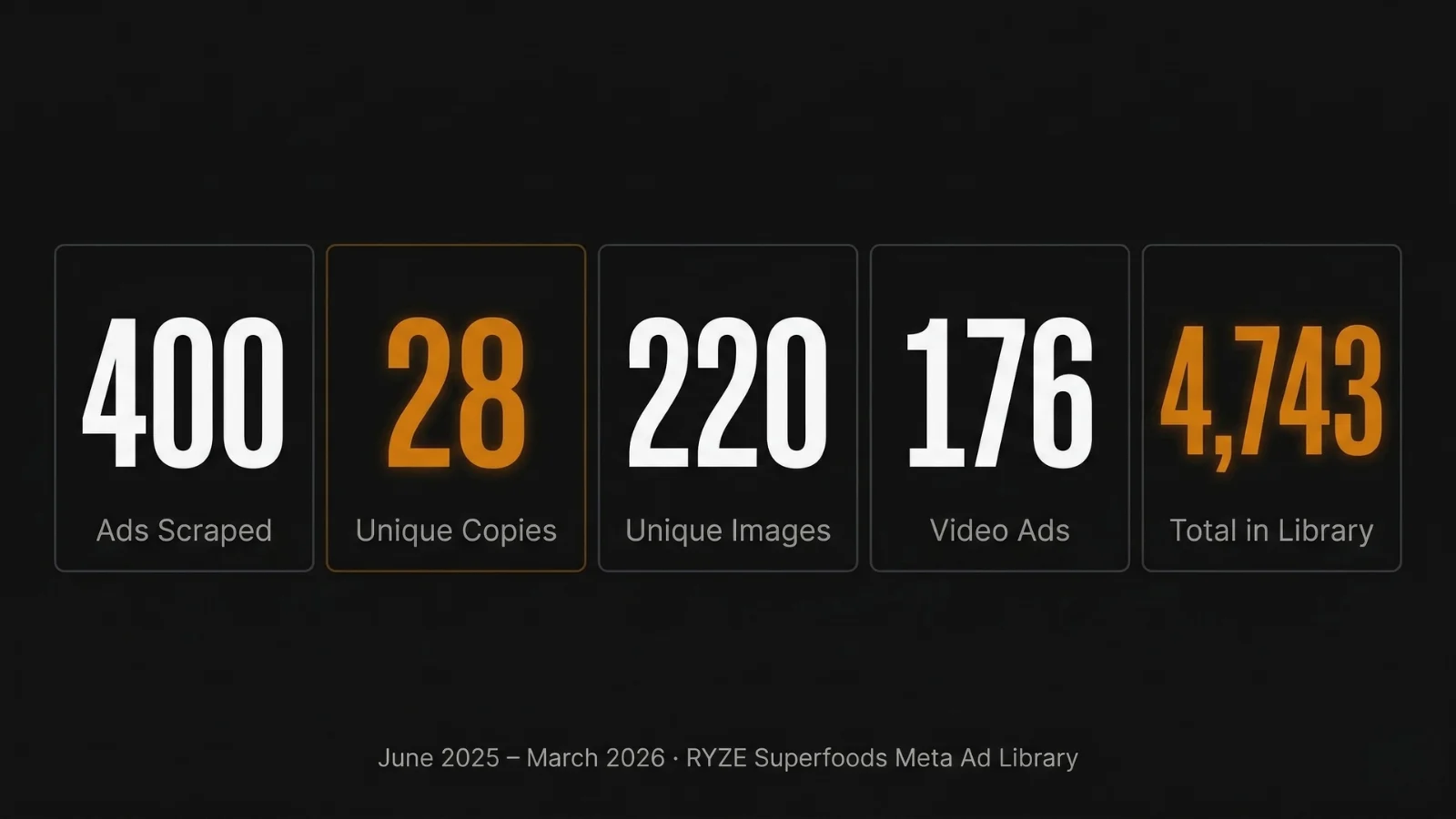
RYZE Superfoods - the mushroom coffee brand you’ve probably seen advertised at least twice this week - does something different. Their Meta Ad Library has 4,743 ads on record. I scraped 400 of them - the top 400 sorted by impressions, all currently active at the time of the scrape.
Across those 400 ads, there are only 28 unique pieces of body copy. And buried in the data, there’s evidence that they quietly changed something about their product - and their ads are the proof.
This is the third brand I’m tearing down. Ridge Wallet was accessories. Obvi was collagen supplements. RYZE is the biggest dataset yet - 800 ads across Meta and Google.
This is Part 1: the Meta side. 400 ads, spanning June 2025 through March 2026. Here’s what the data shows.
400 Ads. 9 Months. 28 Copy Variants. RYZE Isn’t Testing Words.
The 400 ads I scraped span from June 14, 2025 to March 5, 2026 - roughly 9 months of active creative. All 400 were live at the time of scraping on March 6, 2026. The total ad library shows 4,743 ads ever created, so this sample captures the currently running portion - the ads that survived whatever internal testing and pruning RYZE does.
Here’s when these 400 ads were originally launched:
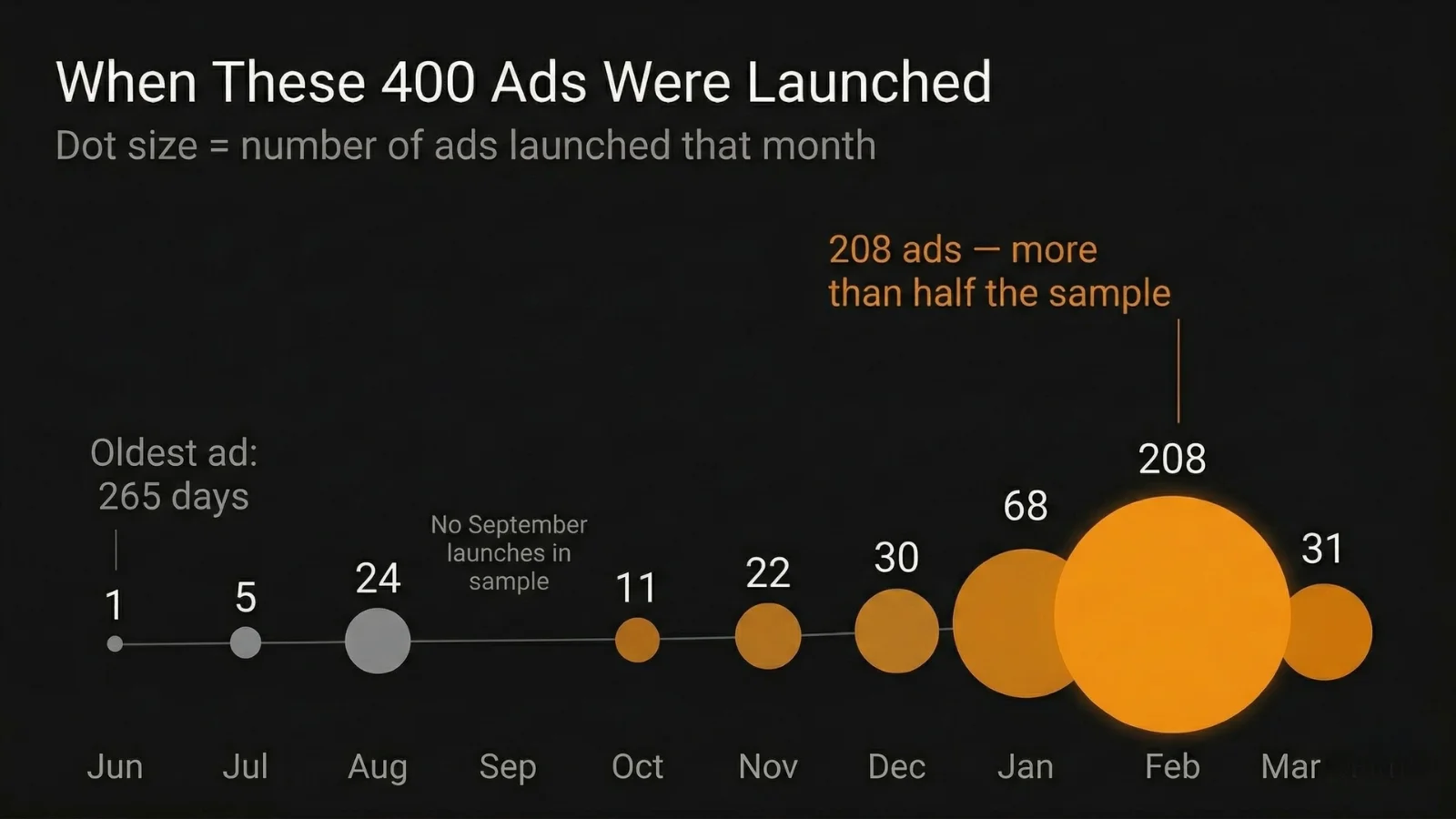
More than half the sample - 208 ads - was launched in February 2026 alone. The oldest ad still running was launched June 14, 2025, and has been live for 265 days. The median ad has been running for 26 days.
But the interesting part isn’t the volume or the dates. It’s what they’re testing versus what they’ve finalized.
Across the 400 ads, there are 220 static image creatives. Every single one uses a unique image - zero reuse. They’re pumping out visual after visual: different product shots, different layouts, different backgrounds, different lifestyle imagery. Then they hand it to Meta’s algorithm and let it find the winners.
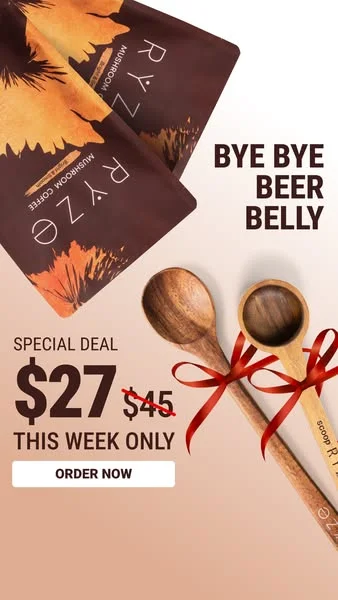
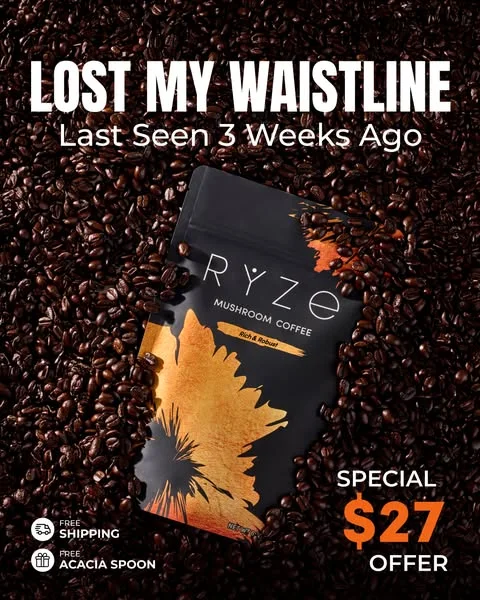
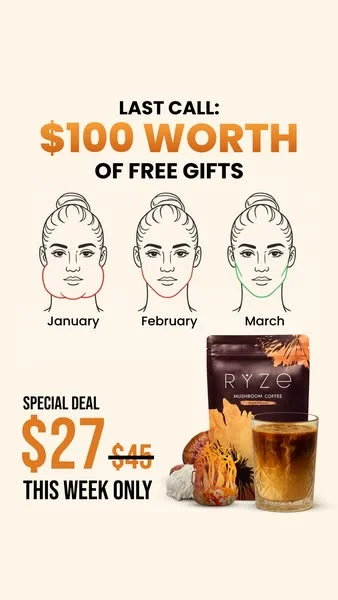
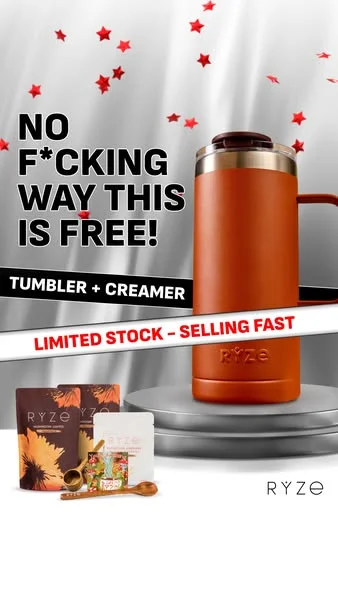
The copy, though? That’s frozen.
Only 28 unique body copy variants exist across all 400 ads. The top copy alone appears in 224 ads - 56% of the sample. The next most-used copy appears in 50 ads. After that, usage drops sharply.
RYZE found their words and stopped changing them. All the experimentation happens on the visual side.
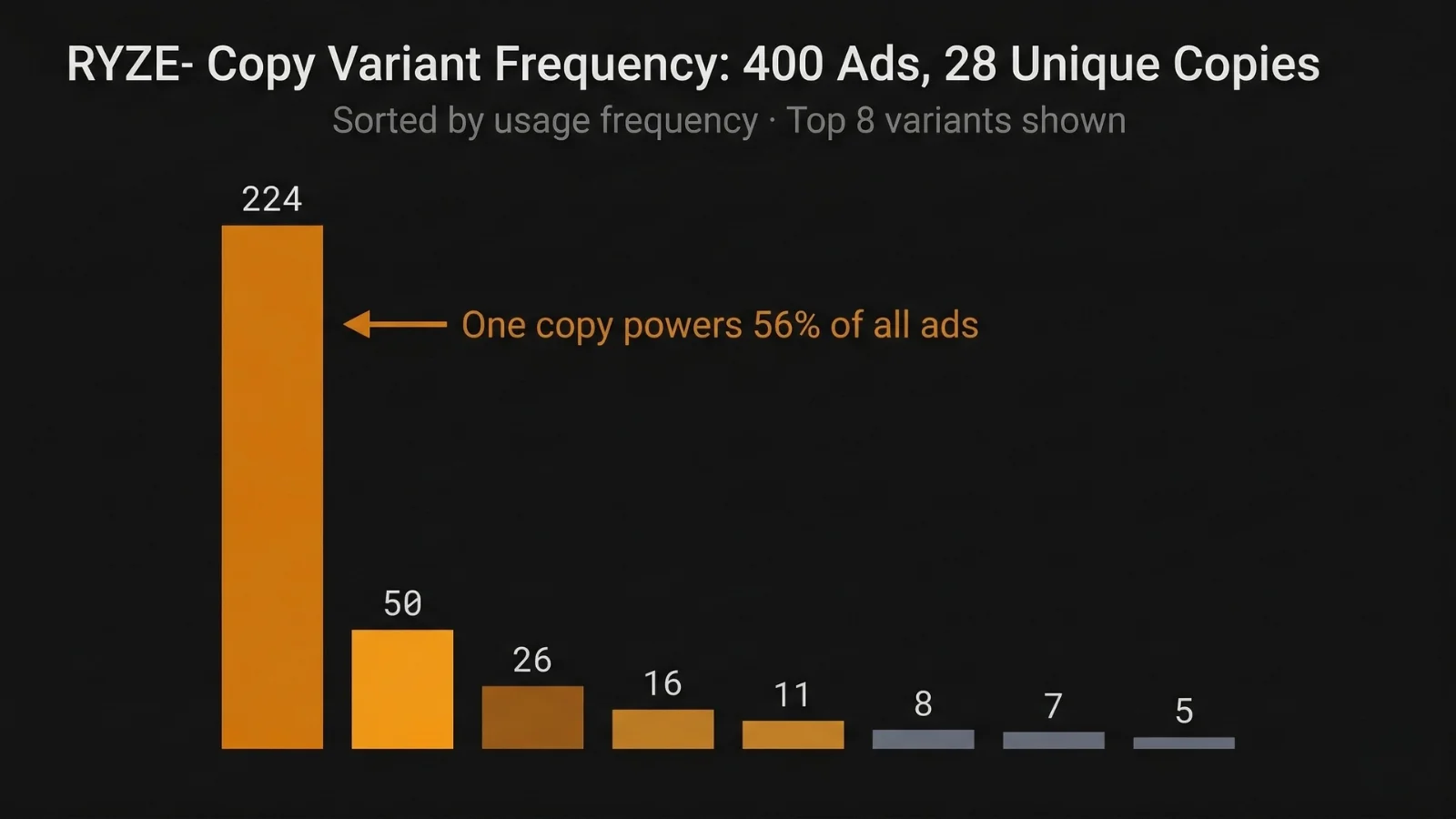
I saw a nearly identical pattern with Ridge Wallet - 273 ads with only 24 unique copy texts. This might be a broader D2C playbook: test the creative, lock the copy.
RYZE takes the testing infrastructure further than Ridge did, though. 140 of the 400 ads are grouped into collation groups. There are 107 unique test groups, with the largest ones running 4 variants each. Most of these test groups are video ads, and they’re concentrated on the newest campaigns (the Target retail push and the recent February blitz).
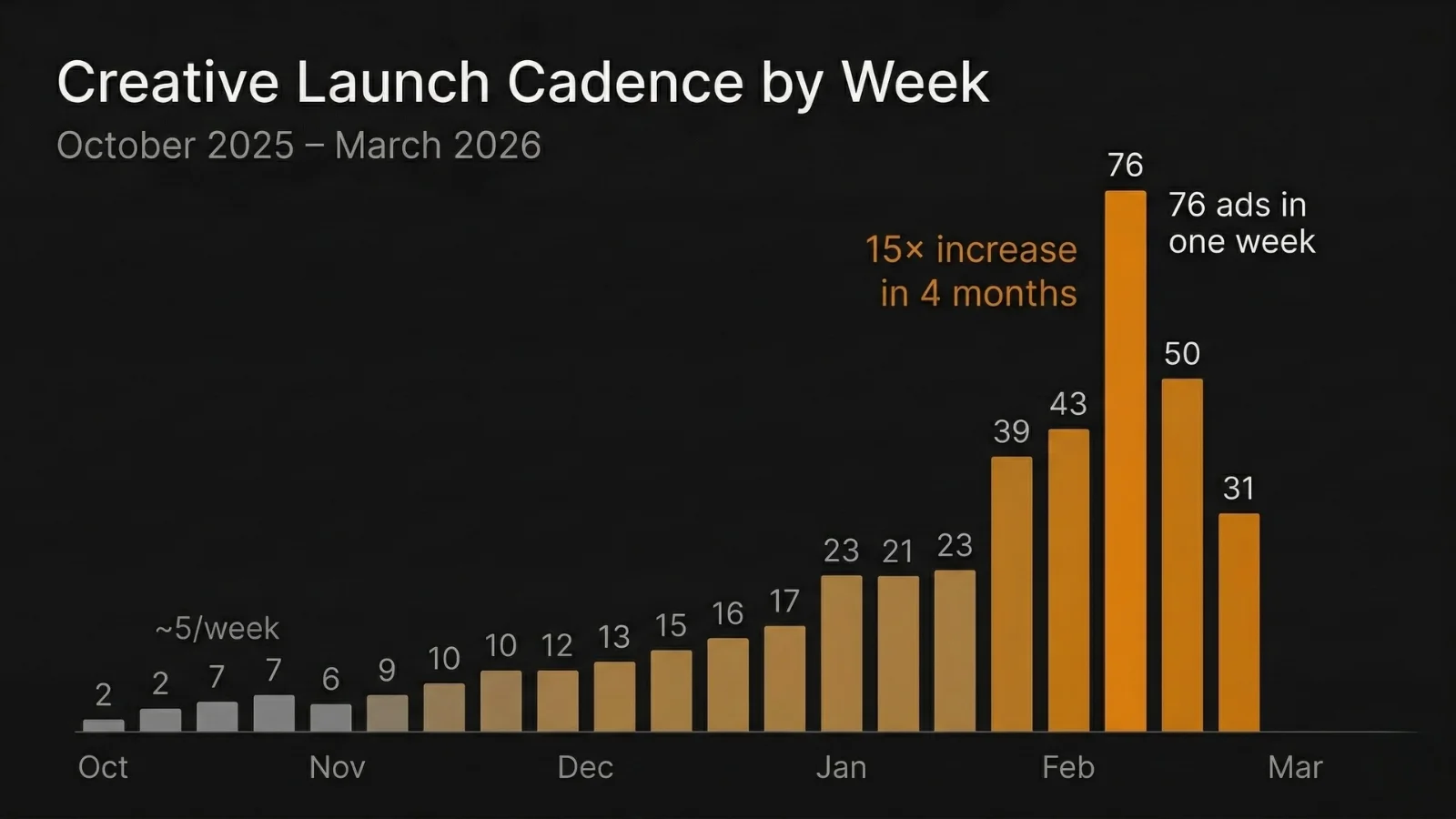
The velocity tells its own story. In October 2025, RYZE was launching roughly 5 new ads per week -
-
By the week of February 16, 2026, that number hit 76. A 15× increase in creative output over four months.
-
Every single ad launches at either 07:00 or 08:00 UTC - most probably an automated scheduling system pushing new creative on a predictable cadence.
-
73% of launches fall on weekdays, 27% on weekends.
None of these ads are flagged as Advantage+ eligible - RYZE is managing campaigns manually, not handing the keys to Meta’s broad automation. The testing is systematic and human-directed.
One Piece of Copy Powers 56% of the Sample.
Here’s the copy that appears in 224 of 400 ads - more than half of everything I scraped:
“RYZE is powered by functional mushrooms and adaptogens. Our creamy and delicious blend features six functional mushrooms, prebiotics, zero added sugar and 100% organic or non-GMO ingredients. These clean, no BS ingredients come to you sustainably from right here in the USA to provide game-changing daily immune support and long-lasting energy in every cup. Just add water for easy prep and on-the-go wellness.”
It ends with “Try now ➡️” and a link.
The structure follows a consistent formula-
what the product is → ingredient credibility → values and identity → benefits → ease of use → CTA.
Every element serves a purpose.
- “Six functional mushrooms” is the credibility anchor.
- “Zero added sugar” and “100% organic” handle the health-conscious objections.
- “No BS ingredients” is a personality signal - it tells you what kind of brand this is.
- “Just add water” eliminates the friction objection.
And it’s all packed into 68 words.
The average body copy length across all 400 ads is 68 words. The median is 67. They’ve found their word count sweet spot and they stick to it - 80% of all ad copy falls in the 400–500 character range.
The template extends beyond the body copy. 83% of ads include “Try now ➡️” as an in-body CTA before the link. 98% use paragraph breaks to separate the pitch from the call to action. 96% include a URL directly in the body text. Even the emojis are formulaic - ➡️ appears in 81% of ads (always as a CTA arrow), and ☕️ appears in 85% of titles. There’s no decorative emoji use. Every emoji has a job.
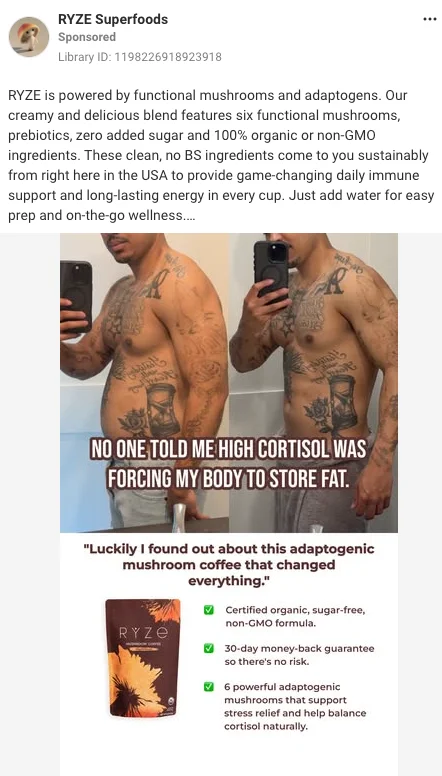
But the body copy is only half the conversion architecture. Below the ad, in the link description - the small text that appears under the headline - sits this line:
“Boost energy, focus, mood & gut health with 30 servings of delicious mushroom coffee. 25% off today-just $0.90 per cup. Free U.S. shipping. Cancel anytime.”
That’s 22 words. And it appears on 202 out of 400 ads. It handles -
- Benefits (energy, focus, etc.)
- Value framing ($0.90 per cup - cheaper than any coffee shop)
- Discount (25% off)
- Risk removal (free shipping)
- Subscription anxiety (cancel anytime)
Every major purchase objection addressed in a single line.
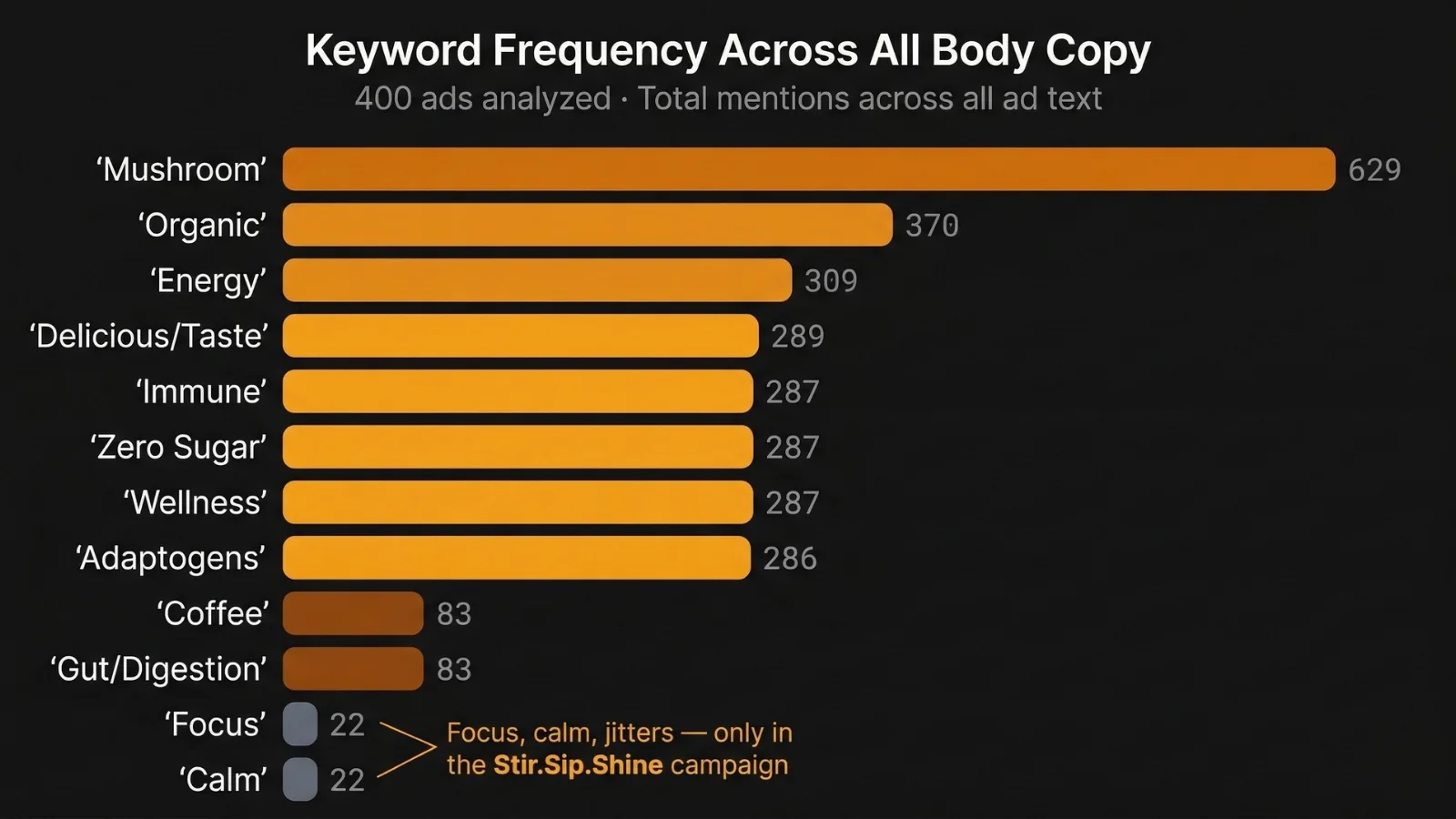
The keyword frequency across all body copy paints a clear picture of what RYZE considers their most important selling points:
- “mushroom” appears 629 times
- “organic” 370 times
- “energy” 309 times
- “delicious” and taste-related words 289 times
- “immune” 287 times
- “zero sugar” 287 times
- “wellness” 287 times
RYZE Quietly Changed Something in Their Product. Their Ads Gave It Away.
This is the finding I didn’t expect.
When I sorted the ad copy variants by launch date, a pattern emerged. From June through October 2025, RYZE’s ads described their blend as featuring “healthy fat from MCT oil.” Starting in November 2025, that phrase vanishes. In its place: “prebiotics.”
The switch is clean. There’s no overlap period where both appear. Within the 400 ads I scraped, MCT oil shows up in 18 ads - all launched between June and October 2025. Prebiotics shows up in 269 ads - all launched from November 2025 onward. Every new piece of copy that entered the account after October 2025 uses “prebiotics” instead of “MCT oil.”
The 4 MCT oil ads in February 2026 are older ads that were still running - they were launched in mid-2025 and never updated.
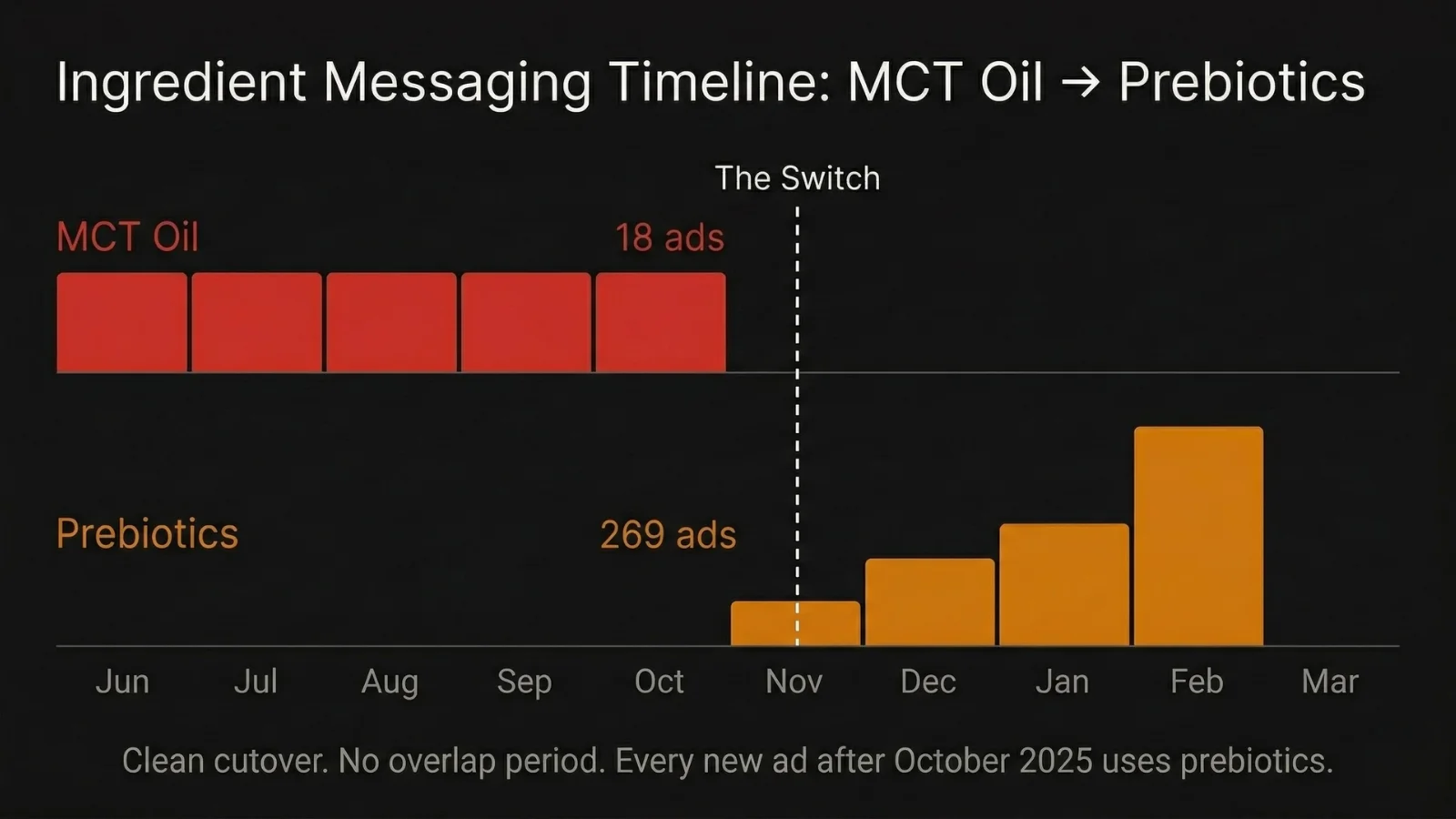
I think this is a product reformulation, not just a messaging change. When a brand swaps out a specific ingredient claim across every single new ad creative, while the rest of the copy remains nearly identical, that points to an actual change in what’s in the bag.
But it could also be a deliberate repositioning - “gut health” is a stronger marketing angle in 2026 than “healthy fat” was in 2025. Either way, the ads are the paper trail.
Two Ad Strategies Running Side by Side. Most People Only See One.
RYZE’s 400 ads look like one machine from the outside. They’re not. There are two distinct strategies running simultaneously, and they serve completely different purposes.
Workhorse Ads - Text + Image based
- 261 of the 400 ads run the “RYZE is powered by functional mushrooms and adaptogens” copy
- 94% use “Shop Now” as the CTA
- They link to shop.ryzesuperfoods.com/fb
- The title is “Pour Yourself a Better Cup of Coffee ☕️” - which appears on 276 of the 400 ads
- This is a conversion machine optimized for cold audiences. It’s ingredient-led, credibility-heavy, and drives directly to purchase.
Brand Ads - Video based
There are 22 ads - just 5.5% of the sample - running copy that reads completely differently-
“Stir. Sip. Shine. RYZE blends premium organic coffee with six functional mushrooms so you can feel calm energy, sharper focus, and a healthy gut-without the jitters or crash. One small step towards feeling your best.”
These 22 ads are 100% video. They use “Learn More” instead of “Shop Now.” They link to the main website (ryzesuperfoods.com and ryzesuperfoods.store) rather than the shop subdomain.
And they’ve been running since August 2025 - averaging 207 days each as of the scrape date. That makes them the longest-running campaign in the dataset by a wide margin.
The contrast is sharp-
The workhorse copy leads with ingredients. Ref Ad
The Stir.Sip.Shine copy leads with feelings. Ref Ad
Words like “focus,” “calm,” “jitters,” and “crash” - which barely appear in the main copy - are the backbone of this campaign.
The Target Retail Push, a Celebrity Collab, and One Influencer Ad.
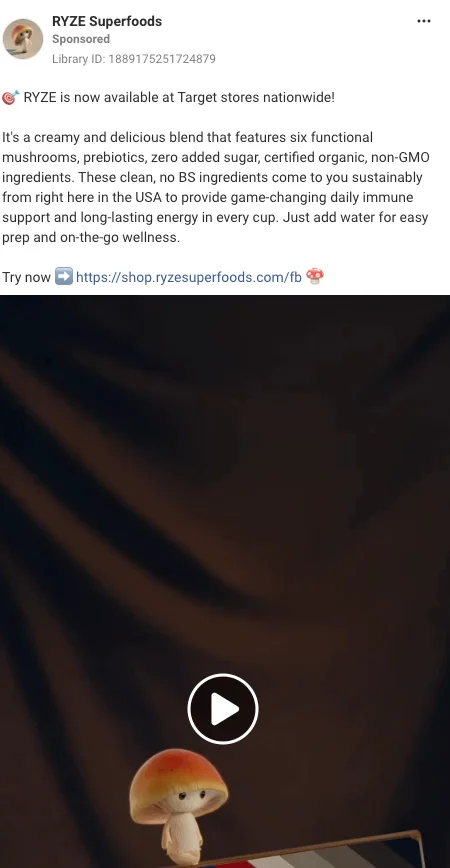
RYZE launched 22 new video ads on a single day - March 3, 2026. All of them carried the same message: RYZE is now available at Target stores nationwide.
The body copy opens with a 🎯 emoji and the announcement, then flows into the standard ingredient pitch. The title across most of them: “Your Target run just got a major upgrade.” Every single one links back to shop.ryzesuperfoods.com/fb - RYZE’s own DTC conversion page. Not Target.com. Not a Target product listing. Their own site.
My hunch is that - Target’s name and retail presence serve as a credibility signal - “if Target carries us, we’re legitimate” - but the actual transaction still happens on RYZE’s turf, where they control the experience, capture the email, and push the subscription.
Total Target-related ads in the sample: 27, all video, all launched in the first week of March 2026. At 1–5 days old at the time of scraping, these are the freshest ads in the dataset.
Sitting alongside the Target push, there’s a small but interesting set of other campaigns -
The Ritual Set upsell runs across 25 ads in the sample.
- The copy positions RYZE’s bundle - two bags of mushroom coffee, a probiotic creamer, and handcrafted acacia wood accessories - as “elevating coffee into a full experience.”
- These ads mention “FREE gifts available for limited time only!” and link to a dedicated /fbo/ritual-set landing page.
- They’ve tested both 25% and 40% discount levels across different variants.
The Neil Patrick Harris collab -
- Inside 2 DCO carousel ads that have been running since August 2025 (200 days old) - the copy references Neil Drips, a playful comparison where “RYZE Mushroom Coffee proudly holds a 100% win rate against ‘Neil Drips’” based on a super scientific comparison test led by Neil Patrick Harris.
- These link to “bio.site/ryzesuperfoodsFB”, a separate landing page from anything else in the account.
Out of 400 ads scraped, exactly one is a branded content video and it reads like a real person’s social post - “The list never stood a chance 😏 We find what we need as we go… including @ryzesuperfoods ☕️”. It’s the only ad in the entire sample that uses hashtags.
ref link - Neil Patrick Harris collab
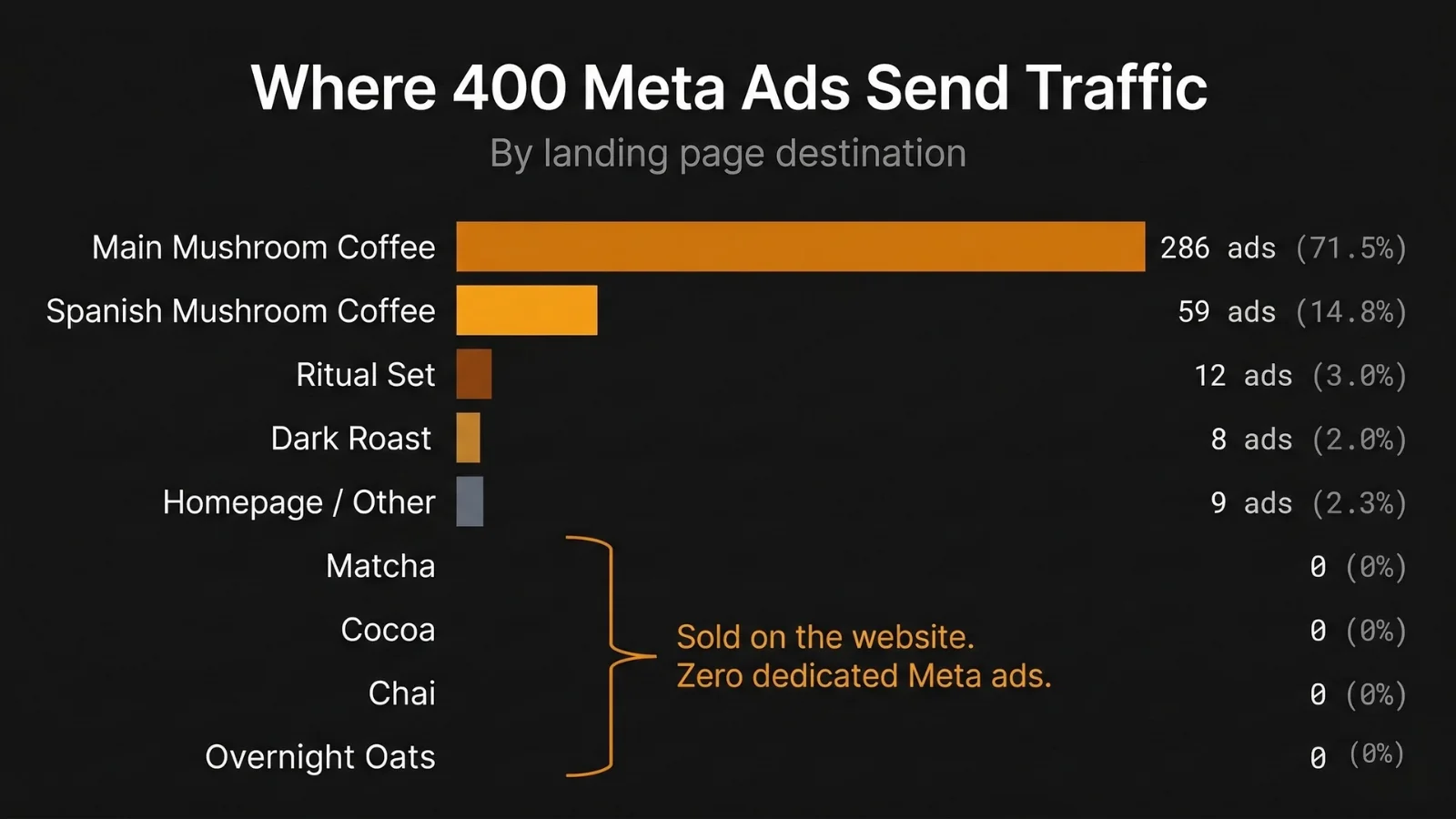
Another thing I noticed was that there are few products which are not in the 400 ads -
- matcha
- cocoa
- chai
- overnight oats
The hero mushroom coffee product carries the acquisition funnel - everything else lives in the post-purchase experience.
15% of Their Ads Are in Spanish. This Isn’t a Test.
61 of the 400 ads - 15.3% - target Spanish-speaking audiences.
And, importantly - they run a fully translated version of the standard copy (not auto-translated), with -
- A dedicated landing page and Spanish link description
- And the title “Pruebalo ahora! ☕️” (Try it now).
The Spanish ads lean heavier on video: 75% video versus 25% image, compared to the English standard at 26% video.
There’s even a Spanish Dark Roast variant (1 ad) and a Spanish Ritual Set ad (1 ad) - early signs of product diversification for this audience.
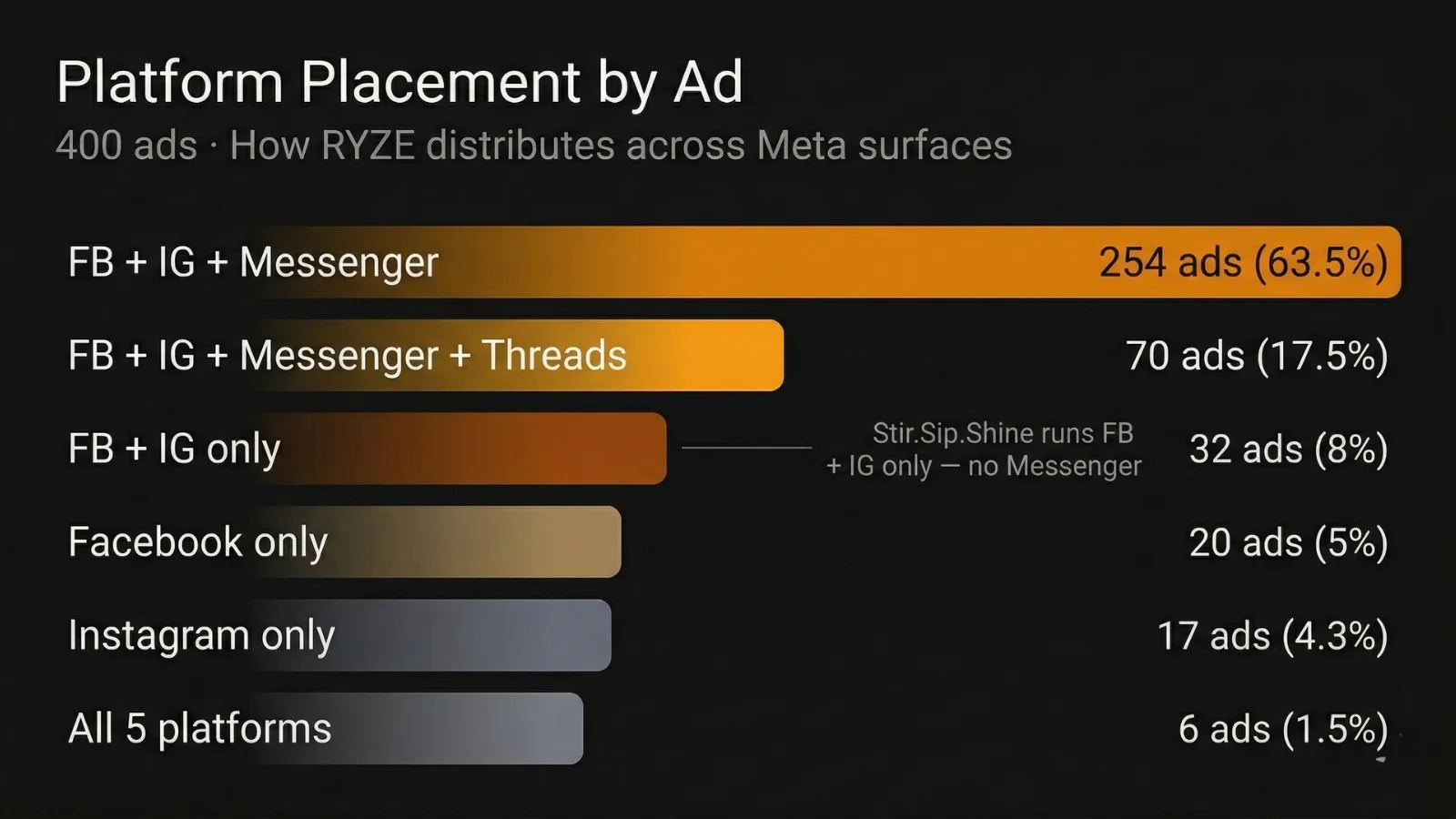
The Platform Distribution
Across the 400 ads shows -
- The dominant combo - Facebook + Instagram + Messenger - carries 254 ads (63.5%).
- Adding Threads brings it to 70 ads (17.5%).
- 32 ads run on just Facebook + Instagram,
- And a small number are single-platform (20 Facebook-only, 17 Instagram-only).
- The Stir.Sip.Shine brand ads specifically run only on Facebook and Instagram - no Messenger.
The landing page domain evolution is also worth noting.
- 91.5% of ads point to shop.ryzesuperfoods.com - the DTC shop subdomain.
- But the older ads from August 2025 (the Stir.Sip.Shine campaign and NPH collab) point to ryzesuperfoods.store and bio.site.
- The shift to shop.ryzesuperfoods.com as the primary domain happened between August and October 2025 - a deliberate consolidation of their conversion infrastructure.
And one more data point: the Facebook page like count visible in the ad data shows two distinct values - 489,656 on ads launched earlier in the timeframe and 1,215,418 on newer ads. That’s a 148% increase.
The ads themselves are a timestamp on RYZE’s audience growth curve.
The Ads Running the Longest Tell You What’s Actually Working.
Ad longevity isn’t a perfect proxy for performance - a brand might keep a low-performing ad running for reasons that don’t show up in public data. But when you see clear patterns across these 400 ads, the signal gets stronger.
Since all of the ads were active at the time of scraping (March 6, 2026), “longevity” here means how many days the ad has been live - from its launch date to the scrape date.
The distribution:
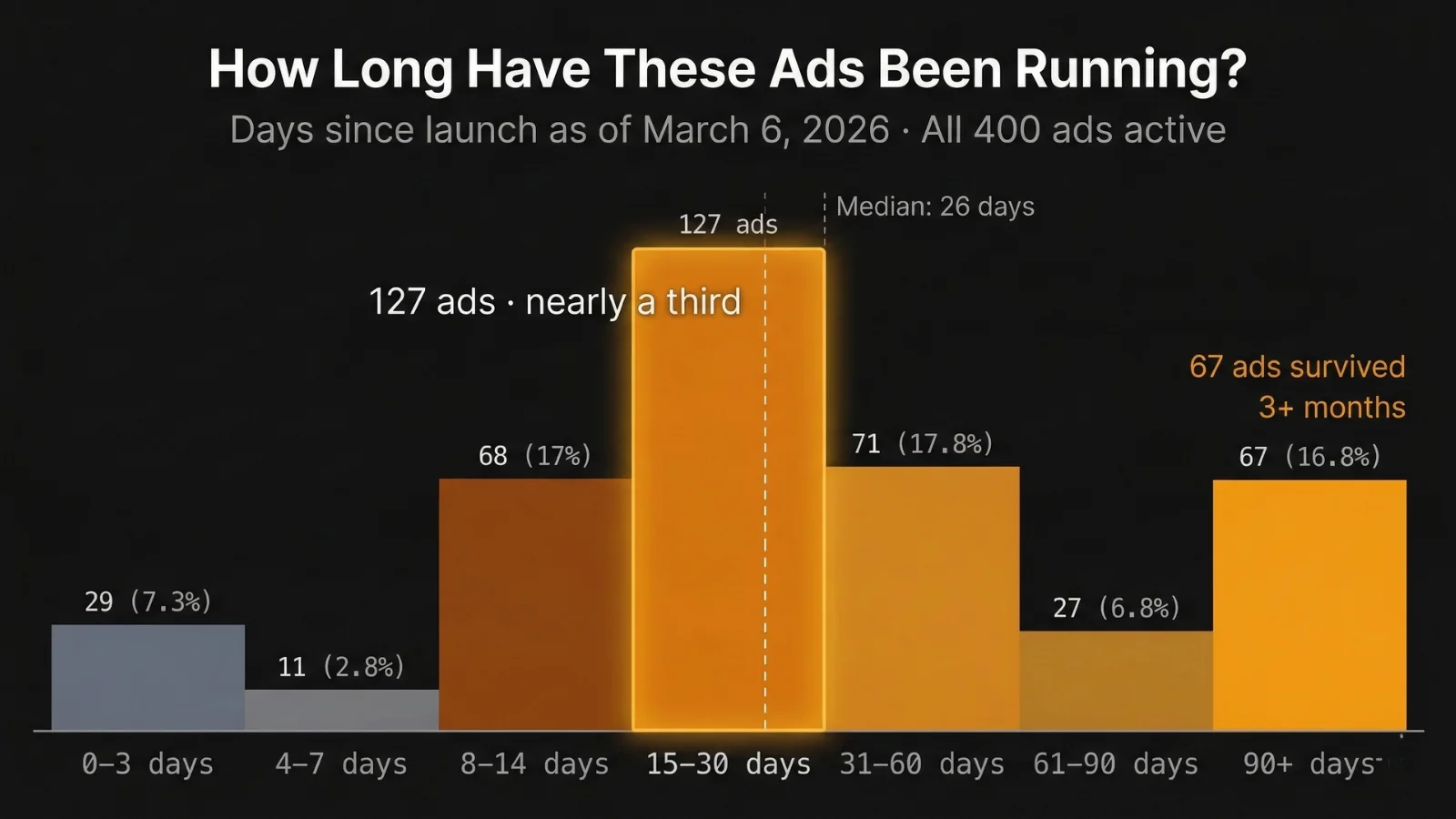
The average is 50 days.
The median is 26 - meaning half the ads in the sample have been running less than a month.
The longest-running ad has been live for 265 days: a video ad with the “Pour Yourself a Better Cup of Coffee” title, launched June 14, 2025.
Video ads have been running longer on average (55.7 days) than image ads (41.4 days).
The DCO ads average 134.8 days, though with only 4 in the dataset that’s a small sample.
The pattern holds across campaigns - the Stir.Sip.Shine videos averaging 207 days, the “RYZE and shine” brand videos at 206.9 days, compared to the workhorse “Pour Yourself a Better Cup of Coffee” at 39.5 days average.
The biggest batch launches in the data -
- February 18 saw 24 ads go live (20 image, 4 video - a standard copy creative blitz),
- March 3 saw 22 ads (all video - the Target launch),
- August 10, 2025 saw 12 ads (all video - the Stir.Sip.Shine debut).
The pricing architecture -
- $0.90 per cup, 25% off, 30 servings, free U.S. shipping, cancel anytime.
That value stack appears on 202 of 400 ads - it’s the foundation of the ads that last. And for what it’s worth, zero of the 400 scraped ads have been user-reported, and zero have violation flags.
What I Found: Summary
Here’s a skimmable version of the patterns from 400 RYZE Meta ads, spanning June 2025 through March 2026:
-
400 active ads scraped out of 4,743 in their ad library. The oldest ad in the sample has been running 265 days. More than half launched in February 2026 alone.
-
28 unique body copies across 400 ads. One single copy variant powers 56% of the sample. They test visuals relentlessly (220 unique images, zero reuse) while keeping messaging locked.
-
The dominant copy formula runs 68 words and follows a consistent structure: what it is → ingredients → values → benefits → ease → CTA. The link description handles pricing, discount, and risk removal in 22 words.
-
MCT oil disappeared from new ads in November 2025. Prebiotics replaced it. The switch is clean - no overlap in new creative. This likely signals a product reformulation or a deliberate repositioning toward gut health.
-
Two separate strategies run simultaneously. The workhorse (261 ads, Shop Now, ingredient-led, 39.7-day avg) and the Stir.Sip.Shine brand play (22 ads, Learn More, emotionally-led, 207-day avg).
-
The hero mushroom coffee carries the acquisition funnel. 86% of the sample drives to the main coffee page. Matcha, cocoa, chai, and overnight oats get zero dedicated Meta ads.
-
27 Target retail ads launched in early March 2026 - all video, all linking to RYZE’s own site, not Target.com. The Neil Patrick Harris collab has been running since August 2025. Only 1 out of 400 ads is UGC/influencer content.
-
15% of ads target Spanish speakers with dedicated translations, landing pages, and creative - running since late 2025.
-
Creative velocity increased 15× between October 2025 and February 2026 (5 ads/week → 76 ads/week). All ads launch at 07:00 or 08:00 UTC via automated scheduling.
-
Video ads have been running longer than image ads (55.7 days vs 41.4 days avg). The median ad in the sample has been live 26 days.
-
RYZE’s Facebook page grew 148% (489K → 1.2M likes) over the period visible in the data.
What’s next: I run the same analysis on RYZE’s Google ads. The strategy on the other side is completely different - a bigger discount, five products instead of one, and Halloween sale ads still running in March.
I’m tearing down few D2C brand every week. If there’s a brand you want me to break down, DM me on X.
Share this teardown
Read Next
Same Brand, Opposite Strategy. I Scraped 400 More RYZE Ads on Google.
RYZE runs a completely different playbook on Google - 5 products instead of 1, 40% off instead of 25%, 86% video, and Halloween sale ads still showing in March. 400 ads scraped from Google's Transparency Center.
543 Google Ads. 166 Went Dark on the Same Day. Here's What Survived.
A breakdown of Fresh Clean Threads' Google Ads strategy. Why 166 ads went dark in 3 days, why 78% of active ads are Shopping, and how their Google strategy diverges from Meta.
Fresh Clean Threads Runs 150 Meta Ads. Only 17 Pieces of Copy Power All of Them.
150 active ads, 87% algorithm-driven, 17 unique copy blocks, and three simultaneous promo codes. Inside a $60M basics brand that trusts Meta's machine more than its own creative team.