Little Sleepies Runs 524 Google Ads. On This Platform, They're a Completely Different Brand.
Contents
In Part 1, I broke down Little Sleepies’ 350 Meta ads. The story there was drops, Disney, and scarcity. One DCO template. 37 collections. “Limited” appeared 281 times. “Bamboo” appeared 9.
On Google, everything flips.
524 ads across the Google Ads Transparency Center. “Bamboo” appears 306 times. “Lunaluxe” - their proprietary fabric that showed up exactly once on Meta - appears 87 times. “Eczema” goes from zero to 37. “Grow With Me” goes from zero to 39. And discounts - up to 65% off - suddenly appear everywhere.
Same brand. Same products. A completely different vocabulary.
If Part 1 showed you how Little Sleepies sells to people who already want cute pajamas, Part 2 shows you how they sell to people actively searching for a solution - parents Googling “bamboo toddler pajamas eczema” or “best newborn sleepers sensitive skin” at 2 AM. These are different people with different intent, and Little Sleepies talks to them differently.
Let me walk through what I found.
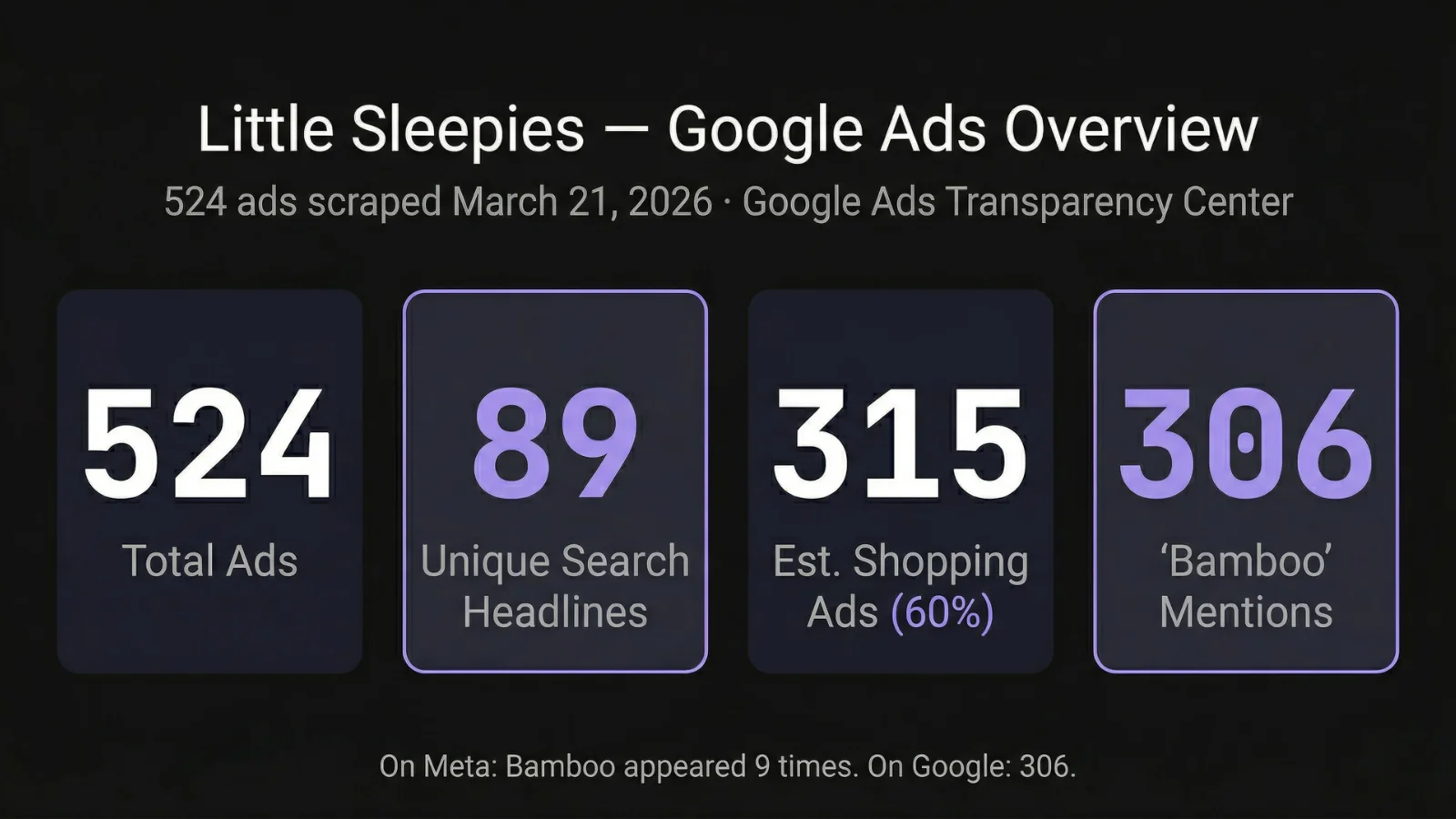
524 Ads, Three Layers Deep.
The Google account breaks into three distinct layers:
- Shopping ads: ~315 estimated (60%). 125 confirmed through OCR, plus 190 additional ads with Google Shopping image previews that strongly suggest they’re also Shopping. This is the product catalog feed - the largest chunk of the account by far
- Search ads: 89 (17%). Text ads triggered by keyword searches. Almost every headline is unique
- Display ads: 53 (10%). Banner-style ads on websites across Google’s Display Network
- Video ads: 27 (5%). YouTube and video placements. Most reference the Newborn Capsule collection
- Unclassified: ~40 (8%). Ads without preview data or OCR - I can’t determine their type
Nearly all of them are active. 500 ads were last shown between March 20-21, 2026 (the scrape dates). This isn’t an archive of old experiments - it’s a live, running machine.
For context, this is the largest Google account in the series. RYZE had around 400 Google ads. FCT had fewer. Little Sleepies runs more ads on Google than on Meta.
89 Search Headlines. Almost All Unique.
This is where the Google account gets interesting.
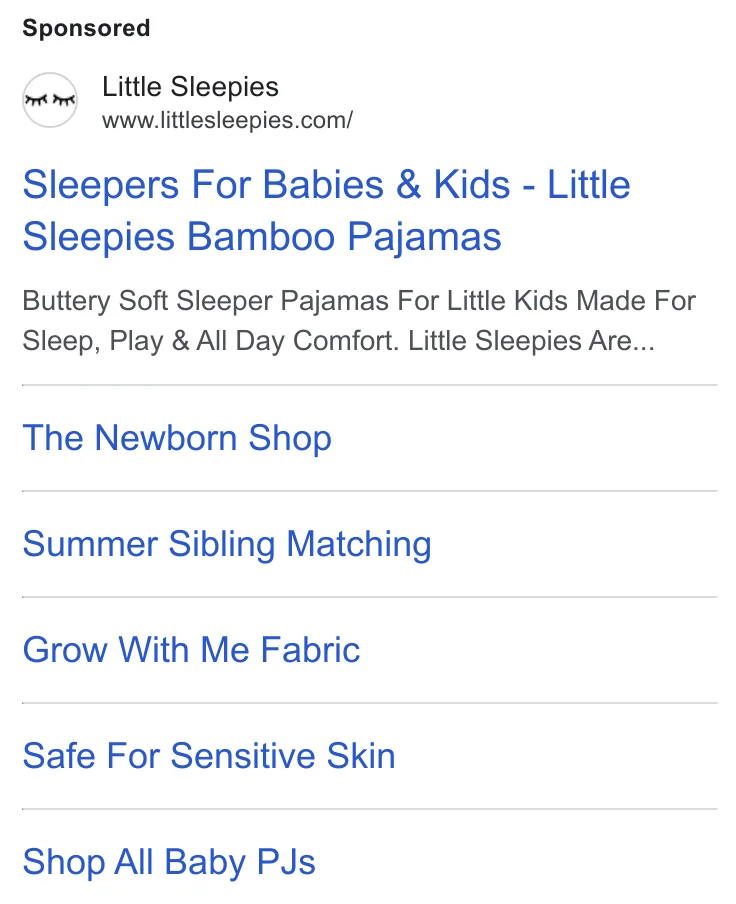
89 search ads. 86 unique headlines. Little Sleepies isn’t running 5 headlines and testing variations. They’re covering every conceivable search intent a parent could type into Google.
I categorized every headline and a clear segmentation grid emerged:
By age
They’re bidding across the entire child lifecycle:
- Baby (21 ads) - “Best Infant Pajamas,” “Bamboo Baby Pajamas No Zipper,” “Baby Convertible Footie Romper”
- Kids (16 ads) - “Kids Bamboo Pajamas,” “Cool Pajamas For Kids,” “Little Girl Bamboo Pajamas”
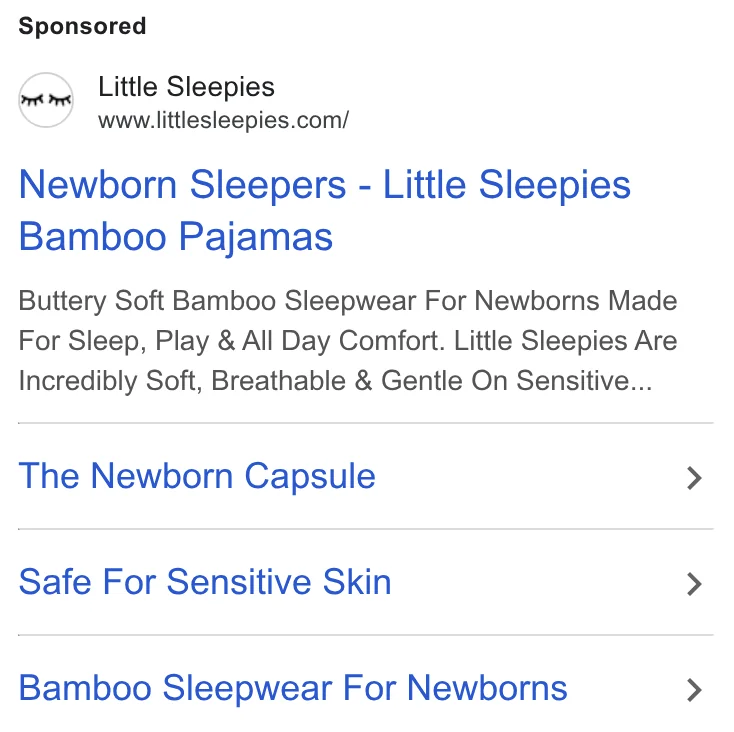
- Newborn/Infant (13 ads) - “Newborn Sleepers,” “Best Pajamas For Newborns,” “Newborn Footed Sleeper PJs”
- Toddler (9 ads) - “4T Pajamas For Toddlers,” “Construction PJs For Toddlers,” “Toddler Bamboo PJ”
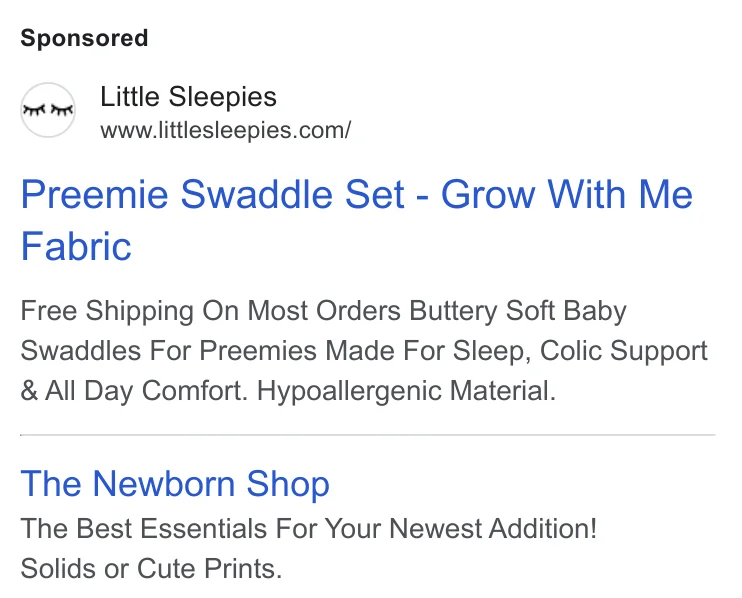
- Preemie (2 ads) - “Preemie Swaddle Set,” “Baby Preemie Clothing”
- Women/Adult (1 ad) - “Cute Pajamas For Women”
From preemie to adult. That’s a search funnel that catches parents at every stage - including before the baby is even born (coming-home outfits) all the way through to matching family sets.
By product type
- Pajamas (52 ads) - the core, covers two-piece sets, zippies, and general sleepwear
- Swaddles (16 ads) - “Bamboo Swaddle Blankets,” “Best Baby Swaddle Set,” “Stretchy Swaddle”
- Zippies/Sleepers (12 ads) - “Zipper Pajamas Baby,” “Sleepers With Foldover Feet,” “Baby Convertible Footie Romper”
- Accessories (2 ads) - “Little Sleepy Lovey,” “Baby Loveys”
- Daywear (2 ads) - “Twirling Dresses For Kids,” “Premium Bamboo Baby Clothes”
- Gifts (2 ads) - “New Baby Gifts,” “Best Newborn Baby Gifts”
- Nursery (1 ad) - “Bamboo Crib Sheets For Eczema”
By relationship
16 ads specifically target family matching searches - and they go granular:
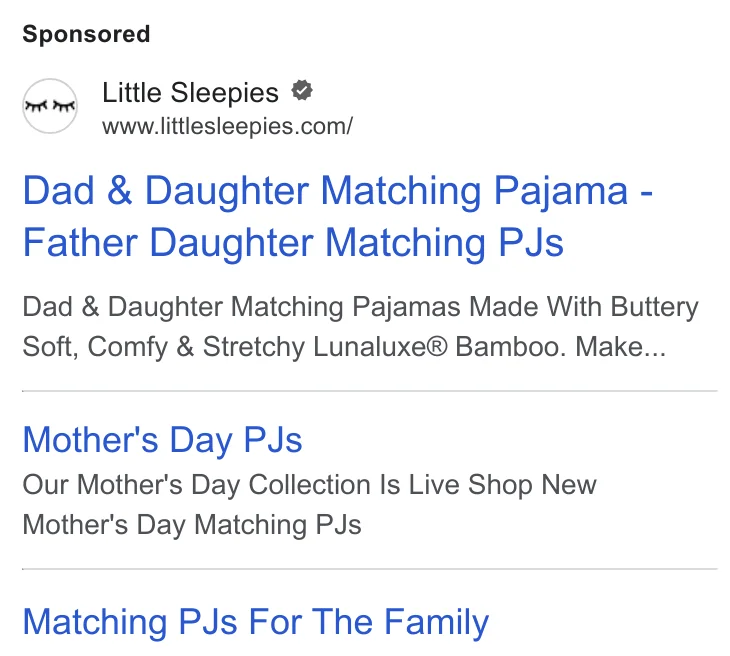
- “Dad & Daughter Matching Pajama”
- “Mommy And Son Matching Pajamas”
- “Mom And Son Matching Pajamas”
- “Mother & Daughter Matching PJs”
- “Dad And Son Matching Pajamas”
- “Family Pajamas - Matching Bamboo Family Pajamas”
- “Mommy And Me Bamboo Pajamas”
Every parent-child combination gets its own headline. This isn’t a generic “family matching” ad - it’s one ad for dad-daughter, another for mom-son, another for mother-daughter. That’s a level of long-tail coverage I haven’t seen from any other brand in this series.
By feature
- Bamboo: 42 of 89 headlines (47%) mention “bamboo.” On Meta, it appeared 9 times total
- “Grow With Me”: 11 headlines. Zero on Meta
- Eczema/Sensitive Skin: 5 headlines - “Toddler Pajamas For Eczema,” “Safe For Sensitive Skin.” Zero on Meta
- “Little Sleepies” brand name: 26 headlines
- “35K 5-Star Reviews”: 3 headlines
The feature language on Google is completely different from Meta. On Meta, the selling points were “limited edition,” “just dropped,” and “obsessed.” On Google, they’re “bamboo,” “grow with me,” “safe for sensitive skin,” and “35K 5-star reviews.” Two different vocabularies for two different buyer mindsets.
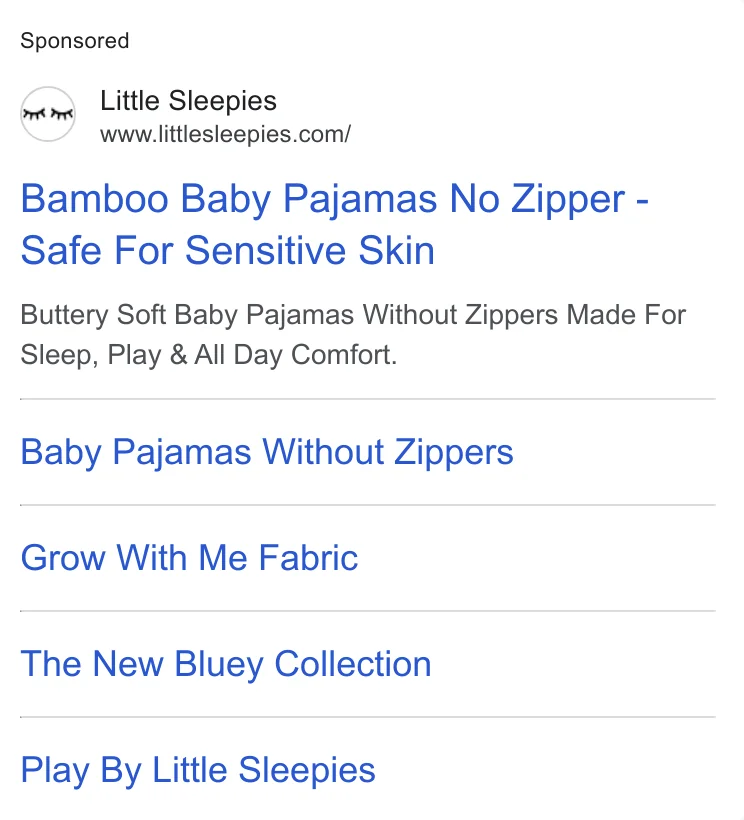
One Description Template Powers 38% of Search Ads.
The headlines are custom. The descriptions are templated.
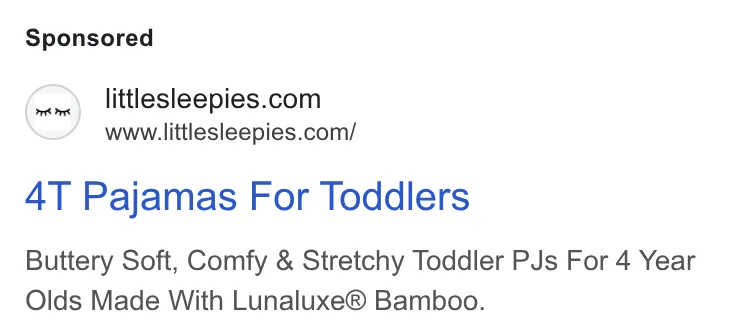
34 of 89 search ads (38%) follow the exact same description formula:
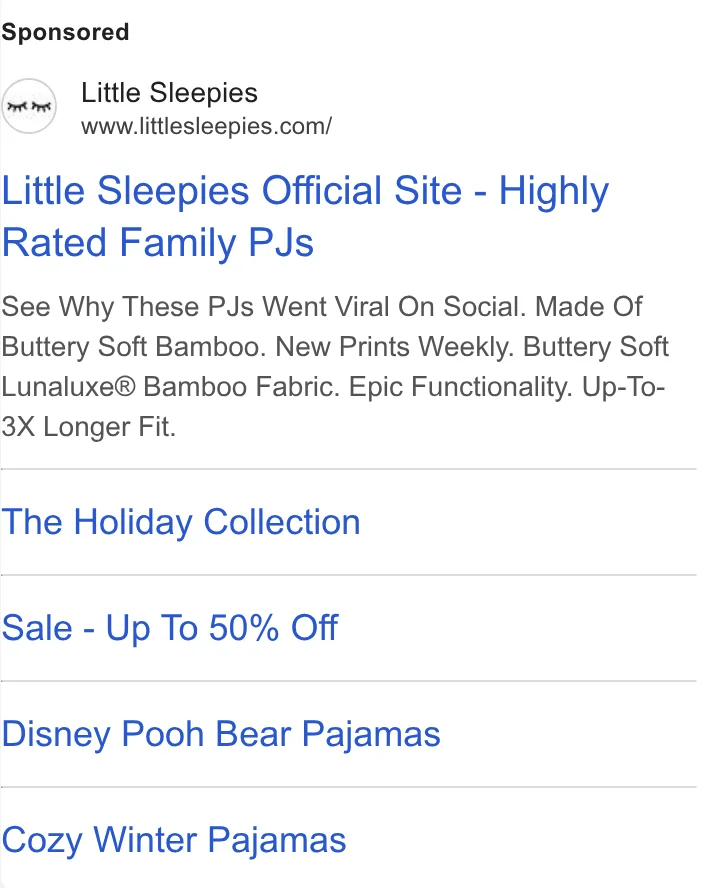
“Buttery Soft [product name] Made For Sleep, Play & All Day Comfort.”
Variations include adding “Little Sleepies Are Incredibly Soft, Breathable & Gentle On Sensitive Skin” at the end - which appears in 20 descriptions. “Lunaluxe” shows up in 38 descriptions. “See Why These PJs Went Viral On Social” appears in 6.
The pattern: the headlines do the targeting work (matching the exact search query), and the descriptions do the brand work (consistent messaging about softness, comfort, and gentle-on-skin). The headline changes for every keyword. The description stays recognizably Little Sleepies.
This is actually a smart division of labor. Google rewards headline relevance to the search query - the closer the match, the higher the Quality Score, the lower the cost-per-click. So the headlines need to be specific and varied. But the descriptions are where you reinforce what makes the brand different. “Buttery Soft [X] Made For Sleep, Play & All Day Comfort” is doing double duty: it sounds good to the parent reading it, and it’s consistent enough to build brand recognition across hundreds of search results.
Shopping Dominates. The Catalog Feed Does the Heavy Lifting.
125 confirmed Shopping ads from OCR data. But another 190 text-format ads have Google Shopping image (simgad) preview URLs - which strongly suggests they’re also Shopping ads that the scraper couldn’t fully classify. That puts the estimated Shopping total at ~315 of 524 ads. Roughly 60% of the account.
Shopping ads are different from search and display. You don’t write them - Google generates them automatically from your product feed (titles, descriptions, images, prices, availability from your Shopify catalog). The brand’s job is maintaining the feed, not crafting the ads.
The Shopping headlines I could read through OCR are mostly product-level:
- “Toddler Girls Unicorn Pajamas”
- “18 Months Footed Pajamas”
- “Baby Girl Newborn Clothes”
- “Disney Pooh Newborn Outfits”
- “Preemie Knotted Sleeper Gown”
- “Boys Birthday Pajamas”
These are catalog items, not marketing messages. The Shopping layer exists to catch every specific product search - a parent Googling “unicorn pajamas toddler girl” sees the exact product in Google’s Shopping carousel with an image, price, and a click-to-buy path.
21 Shopping ads have “LLC” as the headline - meaning the scraper caught the advertiser name rather than the product title. These are likely dynamically generated from the catalog and the actual headline the user sees is different from what the Transparency Center displays.
Google Runs Discounts That Meta Doesn’t.
On Meta, “sale” appeared 14 times out of 927 card bodies. On Google, discounts are everywhere.
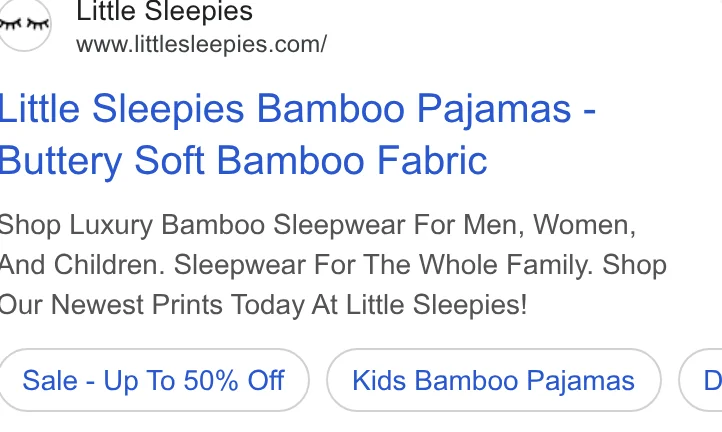
84 of 269 OCR’d ads (31%) carry a promotional offer. Here’s what they’re running:
- “Up To 50% Off” - 19 ads
- “Sale - Up To 50% Off” - 18 ads
- “Free Shipping On Most Orders” - 19 ads
- “100% Off Shipping - US Only” - 10 ads (free shipping, phrased aggressively)
- “Up To 65% Off” - 2 ads
- Various free shipping variants - 4 more ads
The promo rate varies by ad type:
- Display ads: 43% carry a promo
- Search ads: 38%
- Shopping ads: 22%
- Video ads: 0%
Display and search lean hardest into discounts. Shopping is lighter - maybe because the product price in the Shopping carousel already communicates value. Video carries zero promos, which is consistent with Meta where video is also promo-free.
This is a channel-level pricing strategy. Meta = zero discounts, scarcity-first. Google = up to 50-65% off, free shipping. The logic, I think, is about intent. On Meta, you’re interrupting someone’s scroll - you need to create desire, not negotiate price. On Google, someone is actively comparing options - they’re further down the funnel and price sensitivity is higher.
FCT did something similar - they ran discounts on Meta (35% of ads) but also ran them on Google. Little Sleepies draws a harder line. Discounts are a Google-only tool.
A Black Friday Ad Is Still Running in March.
This one stood out.
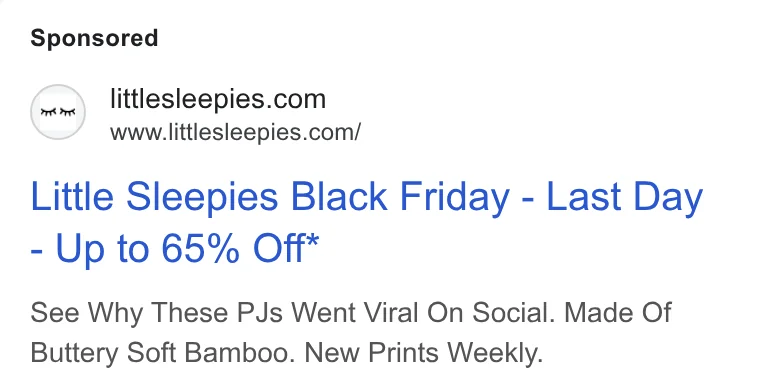
A display ad with the headline
“Little Sleepies Black Friday - Last Day - Up to 65% Off*”
was still showing as of March 20, 2026. That’s nearly four months after Black Friday.
And it’s not the only stale seasonal creative:
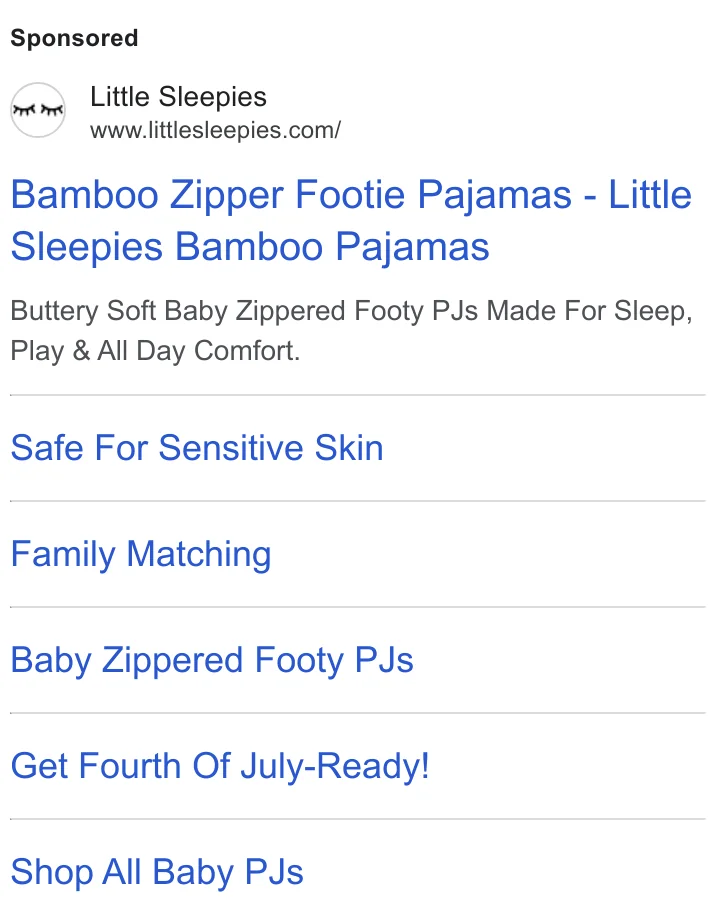
- “Get Fourth Of July-Ready!” - a Shopping ad for “Bamboo Zipper Footie Pajamas” was last shown March 20, 2026. That’s eight months after July 4th
- “Sunshine Footie Pajamas - Don’t Miss Up To 65% Off” - a search ad last shown March 21. The “65% off” pricing may have been a Black Friday holdover
I don’t know if these are deliberate or forgotten. “Last Day” running for four months is hard to interpret as intentional. But I also can’t confirm it’s an oversight - maybe the brand tested leaving them on and the performance held up. The data just shows that they’re live. I noticed a similar pattern with RYZE, where Halloween sale ads were still active months later.
What I can say: the 65% off ceiling only appears on Google, and it only appears in these seasonal holdover contexts. The standard Google discount is “Up to 50% Off.” The deepest discount in the dataset is tied to Black Friday and seasonal moments - not everyday pricing.
”Went Viral” as a Google Trust Signal.
On Meta, Little Sleepies uses “obsessed” as social proof - 88 mentions of parents being obsessed, everyone obsessing over the PJs. Peer validation as a verb.
On Google, they use a different kind of social proof: virality and review counts.
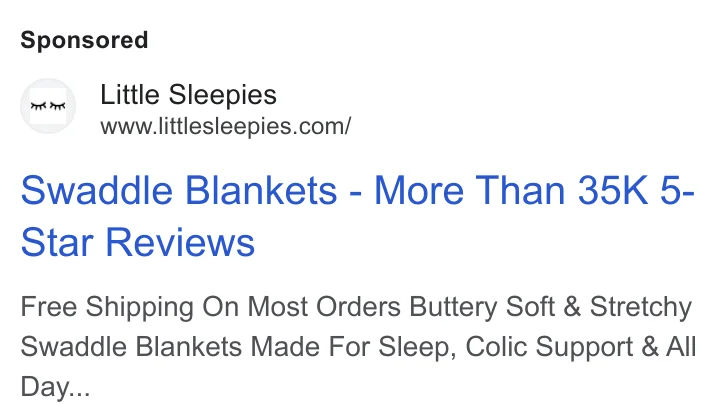
“See Why These PJs Went Viral On Social” appears in 9 search and display descriptions. “More Than 35K 5-Star Reviews” appears in 3 search headlines.
This is a cross-platform play. The brand’s community (400K+ VIP Facebook group members, the Instagram presence, the social buzz) becomes a Google conversion lever. On Meta, you can show the virality - the comments, the shares, the community engagement. On Google, you have to state it. So they do: “went viral on social” in text, “35K 5-star reviews” as a trust badge.
It’s the same social proof, reformatted for a platform that can’t show it natively.
Another thing I noticed: “Made Of Buttery Soft Bamboo. New Prints Weekly.” appears as a recurring description line. “New Prints Weekly” is doing the same job on Google that the drop calendar does on Meta - signaling freshness and constant newness. But on Google, it’s a text claim. On Meta, it’s literally visible through the burst of new collection ads.
Targeting Is Minimal. The Algorithm Decides.
Only 11 of 524 ads (2.1%) use any declared targeting through Google’s Transparency Center:
- Demographics: 11 ads
- Locations: 11 ads
- Customer lists: 2 ads
- Topics of interest: 1 ad
The other 513 ads? No declared targeting at all. They’re running broad and letting Google’s algorithm figure out who should see what.
This matches the Meta philosophy. On Meta, one DCO template handles everything - the algorithm decides which card combination works for which person. On Google, 89 unique search headlines handle the targeting through keyword specificity - the targeting IS the headline. “Bamboo Toddler Pajamas For Eczema” doesn’t need demographic targeting. The search query itself is the targeting signal.
The 11 ads with declared targeting are interesting though. 2 use customer lists (likely retargeting existing customers or lookalikes) and 1 uses topic-of-interest targeting. These might be display or video campaigns where the audience signal isn’t baked into the search query.
The brand’s overall philosophy across both platforms: build the creative framework, let the algorithm optimize delivery. They’re not micromanaging audience segments. They’re building ads that match intent, and trusting the platforms to find the right people.
524 Ads, Almost Entirely US-Focused.
500 of 501 region entries point to the United States. 3 mention Italy, 3 Germany, 1 Greece, 1 Ireland - but these are minor. The Google account is a US operation.
This aligns with the Meta data - free shipping on US orders $25+, no country targeting visible, the VIP group is English-language and US-centric. Little Sleepies has employees across 3 continents according to LinkedIn data, but their paid acquisition engine is US-first.
Only 4 ads show Google Search as a declared platform in the transparency data. The rest don’t declare a platform - which is normal for how Google’s Transparency Center reports. It doesn’t mean the ads aren’t on Search; it means the reporting is limited.
The Cross-Platform Picture.
Stepping back from the Google data and looking at both platforms together, here’s the split:
What Meta does
- Discovery and desire. Drops, Disney, scarcity. “Limited edition.” “Just landed.” “Won’t find anywhere else”
- Emotional language. “Buttery soft.” “Obsessed.” “Dream.” “Magic”
- Zero discounts (1.7% of card bodies mention any promo)
- One DCO template. The algorithm tests creative variants within single-collection pushes
- The fabric is invisible. Lunaluxe: 1 mention. Bamboo: 9
What Google does
- Capture and convert. Long-tail keywords, product feeds, every search intent covered
- Functional language. “Bamboo.” “Grow With Me.” “Eczema.” “Safe For Sensitive Skin”
- Discounts up to 65%. 31% of OCR’d ads carry a promo offer
- 89 unique search headlines. Targeting through keyword specificity, not audience segments
- The fabric is the story. Lunaluxe: 87 mentions. Bamboo: 306
The bridge between them
Some elements cross both:
- “Buttery soft” appears on both platforms - 53 times on Meta, 174 times on Google. It’s the one piece of brand language that works everywhere
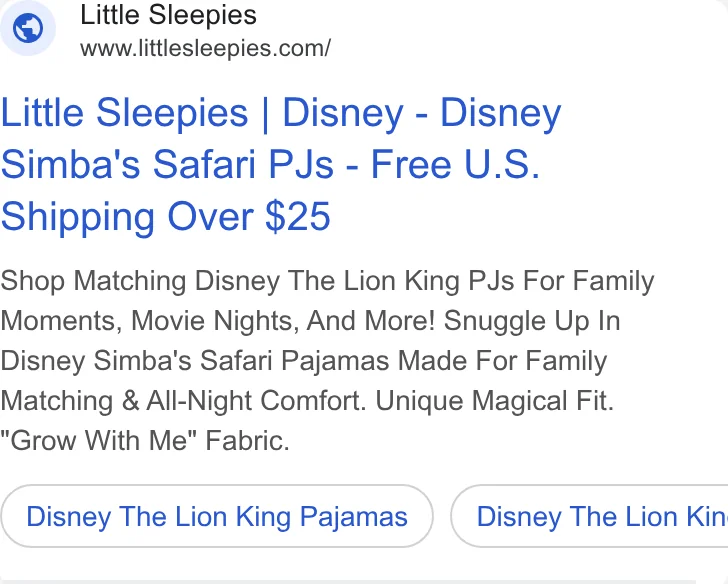
- Disney shows up on both - 188 Meta mentions, 22 on Google. But on Google it’s in Shopping product titles (“Disney Simba’s Safari PJs”), not in the emotional drop framing
- “Free shipping” exists on both - 48 Meta mentions, 27+ on Google
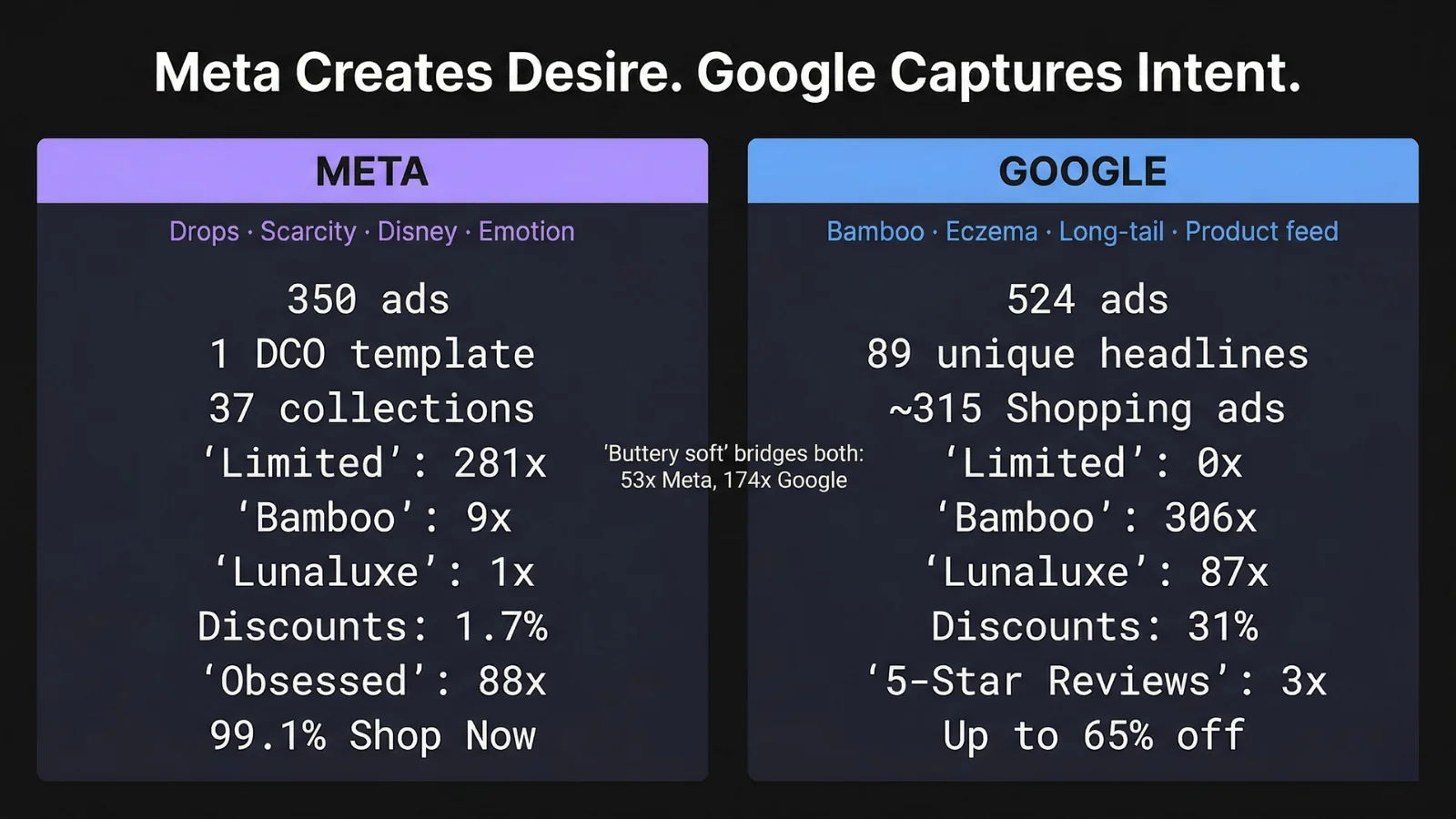
The mental model is this: Meta creates the want. Google captures the search. The person sees a Bluey pajama drop on Instagram, thinks about it, later Googles “bluey pajamas toddler,” and hits a Shopping ad. The Meta ad didn’t need to mention bamboo or Lunaluxe. The Google ad didn’t need to say “limited edition.” Each platform does its job.
Summary
Here’s what I found across Little Sleepies’ 524 Google ads:
- Shopping dominates. ~315 estimated Shopping ads (60% of account). The product catalog feed does the heavy lifting - Google generates ads automatically from the Shopify product feed
- 89 search ads with 86 unique headlines. Every search intent covered - by age (preemie to adult), by product (pajamas, swaddles, zippies, loveys, crib sheets), by relationship (every parent-child combo gets its own ad), by feature (bamboo, eczema, grow with me)
- “Bamboo” mentioned in 47% of search headlines. On Meta, bamboo appeared 9 times total. Google is the material science platform. Lunaluxe appears 87 times here vs once on Meta
- One description template - “Buttery Soft [X] Made For Sleep, Play & All Day Comfort” - powers 38% of search ads. Headlines are custom for keyword relevance. Descriptions are templated for brand consistency
- 31% of OCR’d ads carry promotional offers. “Up to 50% Off” is the standard. Display ads run promos hardest (43%), search next (38%), Shopping lighter (22%), video zero
- A Black Friday ad was still running in March. “Last Day - Up to 65% Off”* showing four months after Black Friday. A Fourth of July ad was also live. Stale seasonal creatives - deliberate or forgotten, the data doesn’t say
- “Went Viral On Social” appears 9 times as a Google trust signal - taking Meta’s community proof and converting it to text for a platform that can’t show it natively
- Targeting is minimal. Only 11 of 524 ads (2.1%) use declared targeting. The keyword IS the targeting. Same algorithm-first philosophy as Meta
- Almost entirely US-focused. 500 of 501 region entries are United States
- The cross-platform split is clean: Meta creates desire (drops, scarcity, Disney). Google captures intent (bamboo, eczema, product feed, discounts). “Buttery soft” is the one piece of language that bridges both
The full picture: Across both platforms, Little Sleepies is running 874 active ads - 350 on Meta, 524 on Google. One DCO template on Meta. 89 unique search headlines on Google. Near-zero discounts on Meta. Up to 65% off on Google. The proprietary fabric invisible on one platform. The entire selling point on the other.
This is a $200M brand that speaks two completely different languages depending on where it finds you.
I’m tearing down a D2C brand every week. If there’s a brand you want me to break down, DM me on X.
Share this teardown
Read Next
Little Sleepies Runs 350 Meta Ads With One Template. One.
350 active Meta ads. 288 of them - 82.3% - are DCO. And every single one uses the exact same template. Inside how a $200M children's apparel brand runs its entire paid operation through one dynamic template and 927 cards.
543 Google Ads. 166 Went Dark on the Same Day. Here's What Survived.
A breakdown of Fresh Clean Threads' Google Ads strategy. Why 166 ads went dark in 3 days, why 78% of active ads are Shopping, and how their Google strategy diverges from Meta.
Fresh Clean Threads Runs 150 Meta Ads. Only 17 Pieces of Copy Power All of Them.
150 active ads, 87% algorithm-driven, 17 unique copy blocks, and three simultaneous promo codes. Inside a $60M basics brand that trusts Meta's machine more than its own creative team.