Little Sleepies Runs 350 Meta Ads With One Template. One.
Contents
Every brand in this series has had a creative philosophy you could read in the data.
Ridge Wallet hand-crafted 82% of its 273 ads - they trusted their creative team over the algorithm. RYZE Superfoods found one copy formula and ran it across 56% of 400 ads, letting the visuals do the testing. Fresh Clean Threads handed 82% to DCO but still had 17 unique copy blocks rotating through the machine.
Little Sleepies makes all of them look complicated.
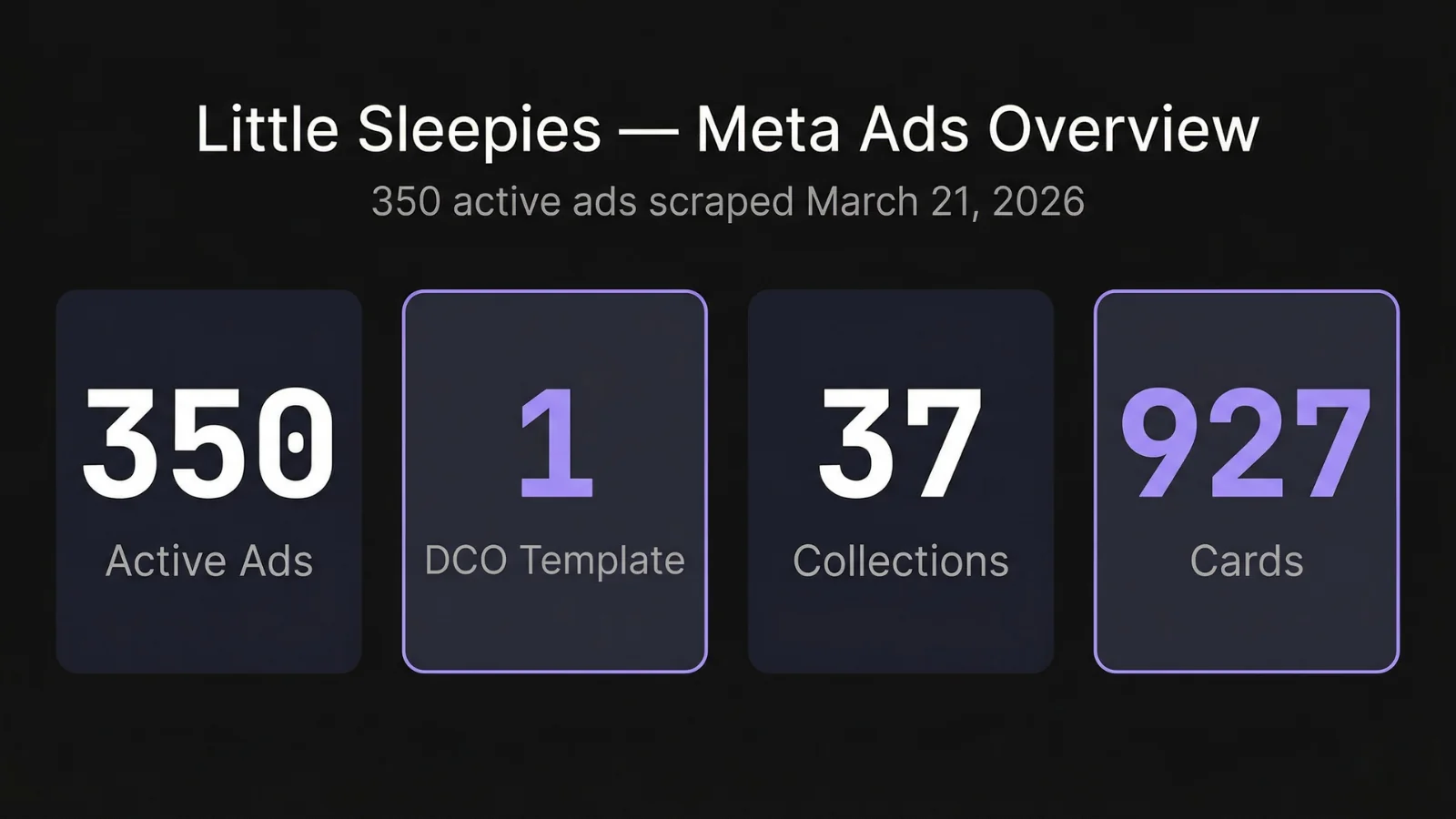
350 active Meta ads. 288 of them - 82.3% - are DCO. And every single one of those 288 ads uses the exact same template: {{product.brand}} for the body, {{product.name}} for the title, {{product.description}} for the link description. One template. Not two. Not five. One.
If you’re not familiar with DCO - Dynamic Creative Optimization - here’s the short version: the brand uploads a bunch of images, videos, and copy blocks as “cards” inside an ad, and Meta’s algorithm mixes and matches them to find the combination that converts best for each audience. Instead of crafting 288 individual ads, Little Sleepies built one machine and feeds it content.
The real messaging doesn’t live in the ads at all. It lives inside 927 cards, spread across 37 distinct collections, powering what is essentially a drop calendar fed into Meta’s algorithm.
Some quick context on the brand. Little Sleepies is a $200M company. Inc. 5000 #74 overall, #1 in retail, with 6,354% three-year revenue growth. Founded in 2018 by Maradith Frenkel - a mom who left a Hollywood film career after her second son’s eczema sent her searching for softer fabrics. She started from her garage with zero eCommerce experience. Cortec Group (a PE firm managing a $2.1B fund) invested in 2021. By 2023, revenue hit $200M with nearly 400,000 new customers acquired that year alone.
This is the biggest brand I’ve covered in the series. And on Meta, their entire paid operation runs through a single DCO template.
82% of These Ads Have No Real Copy. The Cards Do All the Talking.
Let me show you what 288 of 350 Little Sleepies ads actually look like at the ad level:
- Body text:
{{product.brand}} - Title:
{{product.name}} - Link description:
{{product.description}} - CTA: Shop Now
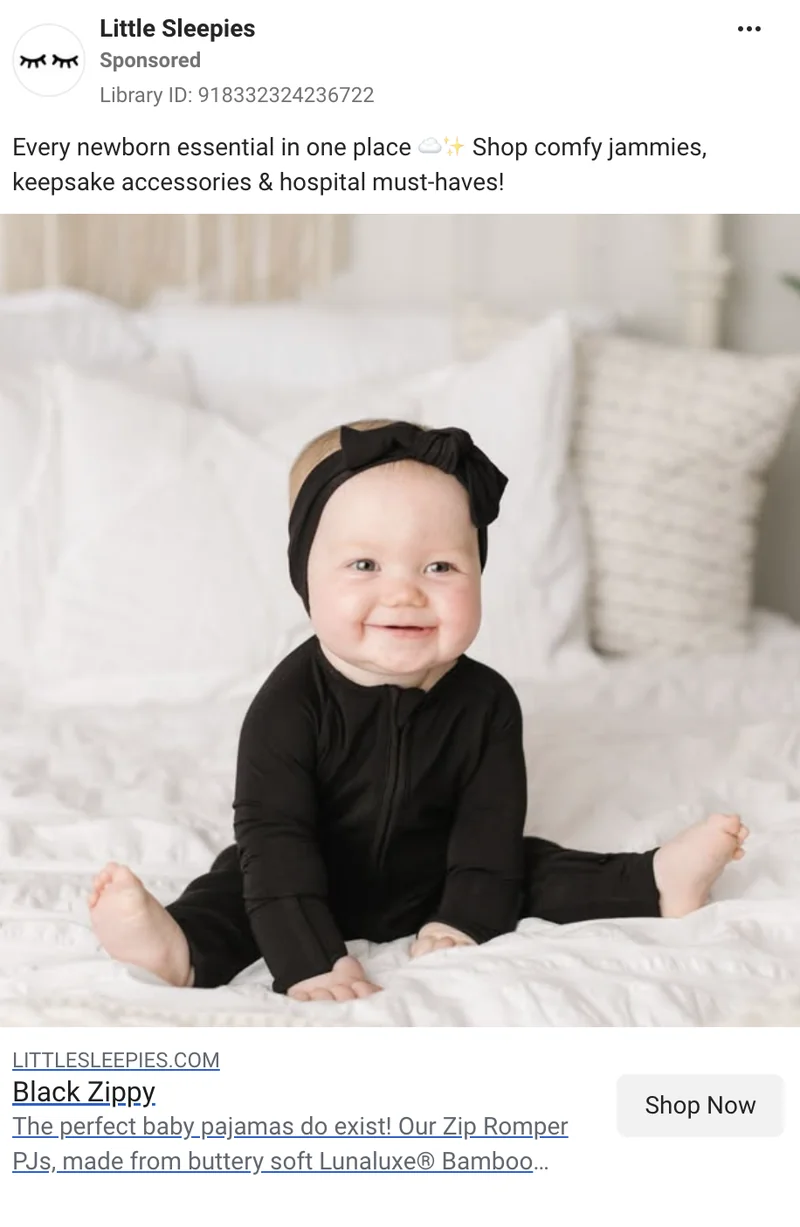
That’s the entire ad. No copywriting. No hook. No value proposition. The ad itself is an empty shell - a dynamic template that Meta fills in automatically from the product catalog. The brand doesn’t write the ad. They write the cards inside it.
What are cards? Think of them as slides within a carousel. Each card has its own image or video, its own headline, its own body text, and its own landing page URL. When you see a Little Sleepies ad on Instagram, what you’re actually looking at is the cards - the template wrapper is invisible to you.
927 cards across 288 DCO ads. That’s an average of about 3.2 cards per ad.
The remaining 62 ads split into two clean buckets:
- 40 video ads (11.4%) - each with its own hand-written body copy. 26 unique copy variants across 40 videos. These are the only ads where someone at Little Sleepies actually wrote the text you see
- 22 DPA ads (6.3%) - dynamic product ads for retargeting. More on these later
Here’s what’s interesting about that split: there are zero static image ads in the entire account. Not one. Every non-DCO ad is either a video or a retargeting unit. If you’re seeing a still image from Little Sleepies on Meta, it’s coming through a DCO card - not a standalone ad.
Every Ad Pushes One Collection. No Exceptions.
This is the finding I didn’t expect.
Across all 288 DCO ads, I checked whether the cards within each ad point to the same collection or different ones. The answer: 100% uniformity. Every single ad sends all its cards to the same collection URL.
When an ad is pushing Bluey, all 2-4 cards inside it go to /collections/bluey-collection. When it’s pushing Mini Builders, every card goes to /collections/mini-builders. When it’s Easter, every card goes to /collections/easter.
Zero mixed-collection carousels. Zero ads where one card goes to Easter and another goes to Best-Sellers. Each ad is a self-contained campaign for one drop.
Why does this matter? It means the algorithm isn’t choosing which collection to show you. Little Sleepies already made that decision before the ad went live. The algorithm’s job is narrower - it tests which creative variant works best within that single collection. Should this person see the image card or the video card? Copy version A or copy version B? But it’s always the same collection.
This is an unusually disciplined setup. Most brands I’ve looked at will throw multiple product categories into a single carousel and let Meta figure out which product resonates. Little Sleepies doesn’t do that. Every ad is one collection, one message, one landing page.
How many cards per ad?
- 2 cards: 133 ads (46.2%)
- 3 cards: 91 ads (31.6%)
- 4 cards: 64 ads (22.2%)
The DPA retargeting ads are different - they carry 6 cards each, all pointing to /products_preview for dynamic product feeds.
Across all cards, the media split is 78% image and 22% video. Image-heavy, even at the card level.
The Drop Calendar IS the Ad Strategy.
I mapped 37 distinct collections across the DCO ads. Thirty-seven. That’s not a product catalog - that’s a content calendar.
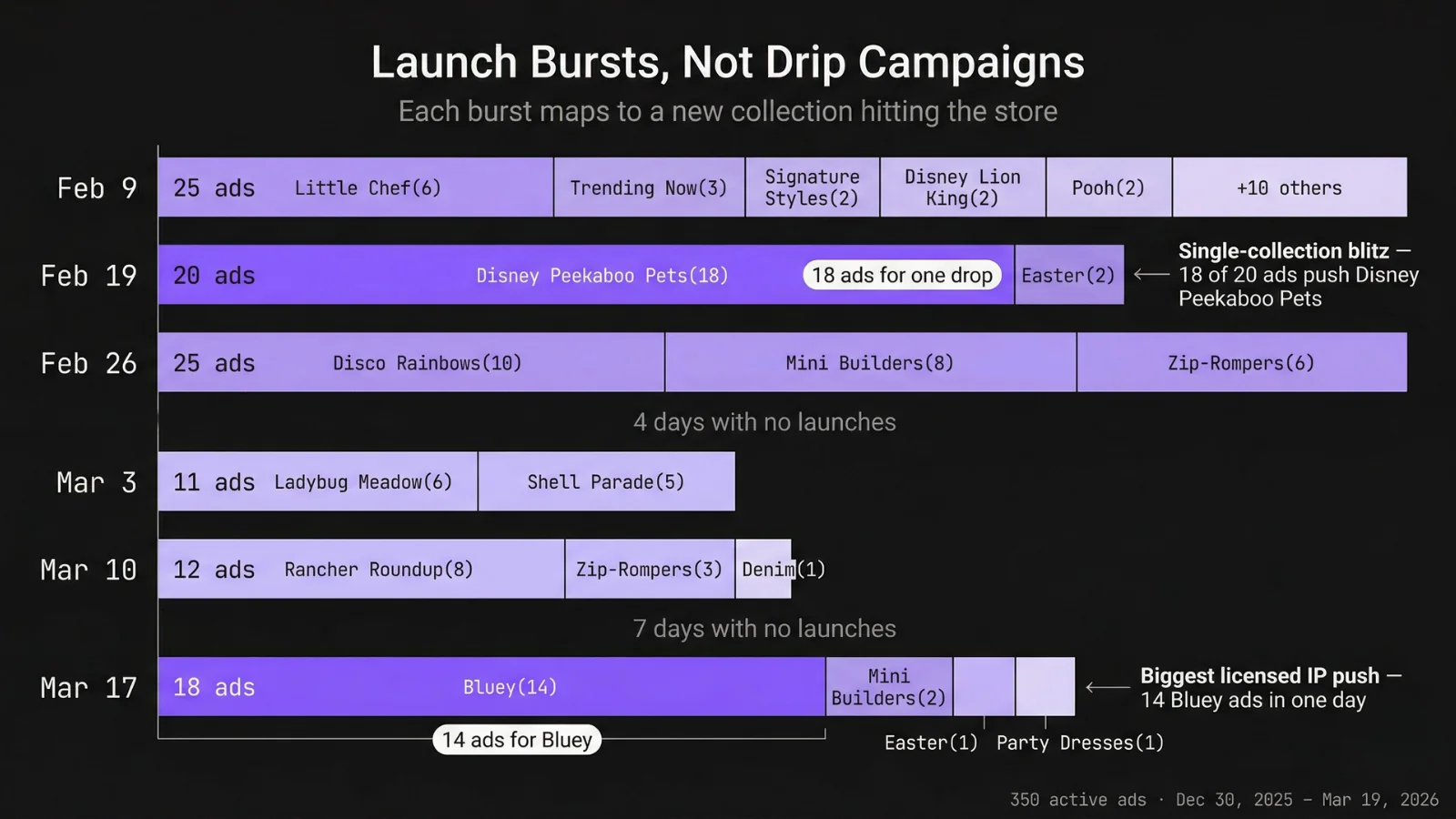
And the way they launch is telling. Little Sleepies doesn’t drip ads steadily over time. They launch in bursts:
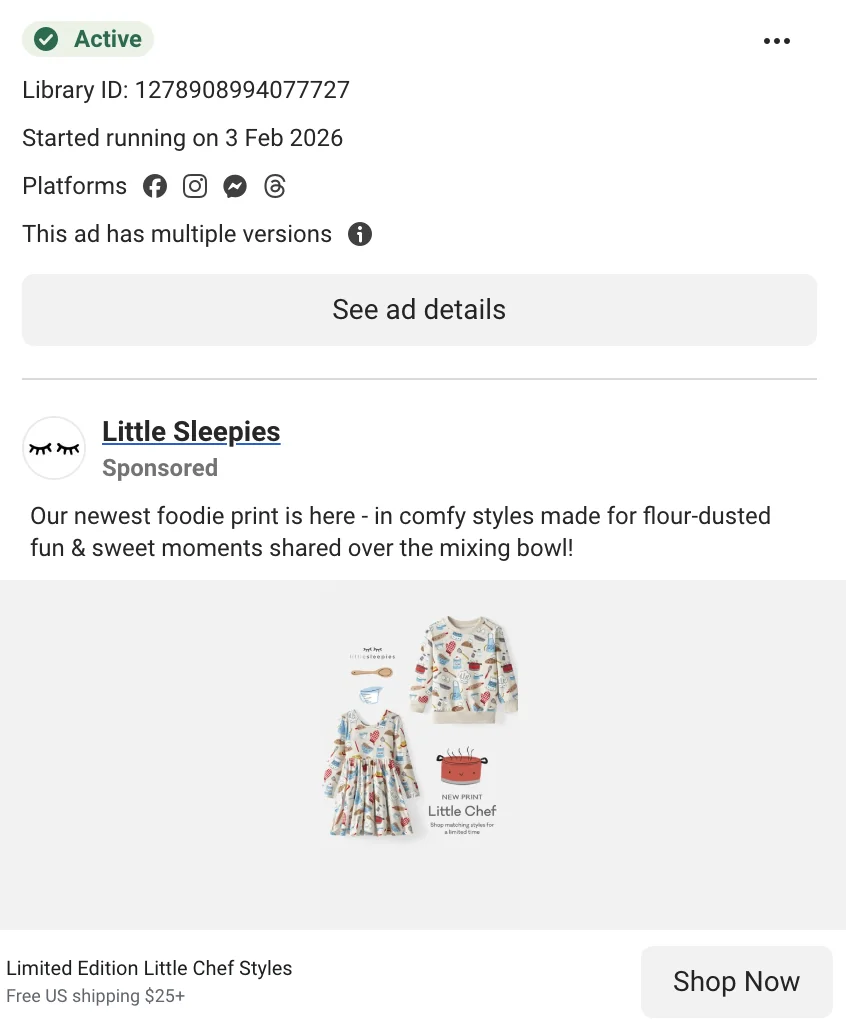
- Feb 9: 25 ads dropped. Little Chef (6), Trending Now (3), Signature Styles (2), Disney Lion King (2), Playtime with Pooh (2), and 10 more across smaller collections. This was a multi-collection refresh - almost like a store reset
- Feb 19: 20 ads. Disney Peekaboo Pets (18) and Easter (2). A single-collection blitz - 18 ads for one drop in one day
- Feb 26: 25 ads. Disco Rainbows (10), Mini Builders (8), Zip-Rompers (6). Three collections launching together
- Mar 3: 11 ads. Ladybug Meadow (6) and Shell Parade (5). Two spring prints at once
- Mar 10: 12 ads. Rancher Roundup (8), Zip-Rompers (3), Denim Shop (1). The Frontier Collection hitting the store
- Mar 17: 18 ads. Bluey (14), Mini Builders (2), Easter (1), Party Dresses (1). The biggest licensed IP push in the dataset
Each burst maps directly to a new collection hitting the store. The ad account is a mirror of the product launch calendar. When something drops on littlesleepies.com, the Meta ads fire the same day.
If you look at the weekly ad launch volume as a histogram, you can see the rhythm clearly:
- Week 7 (mid-Feb): 46 ads
- Week 9 (late Feb): 60 ads
- Week 10 (early Mar): 82 ads - the peak
- Week 12 (mid-Mar): 34 ads
This is a brand that ramps ad volume as it approaches spring and Easter - their biggest seasonal window for children’s apparel.
Two Engines: Licensed IP and Original Drops.
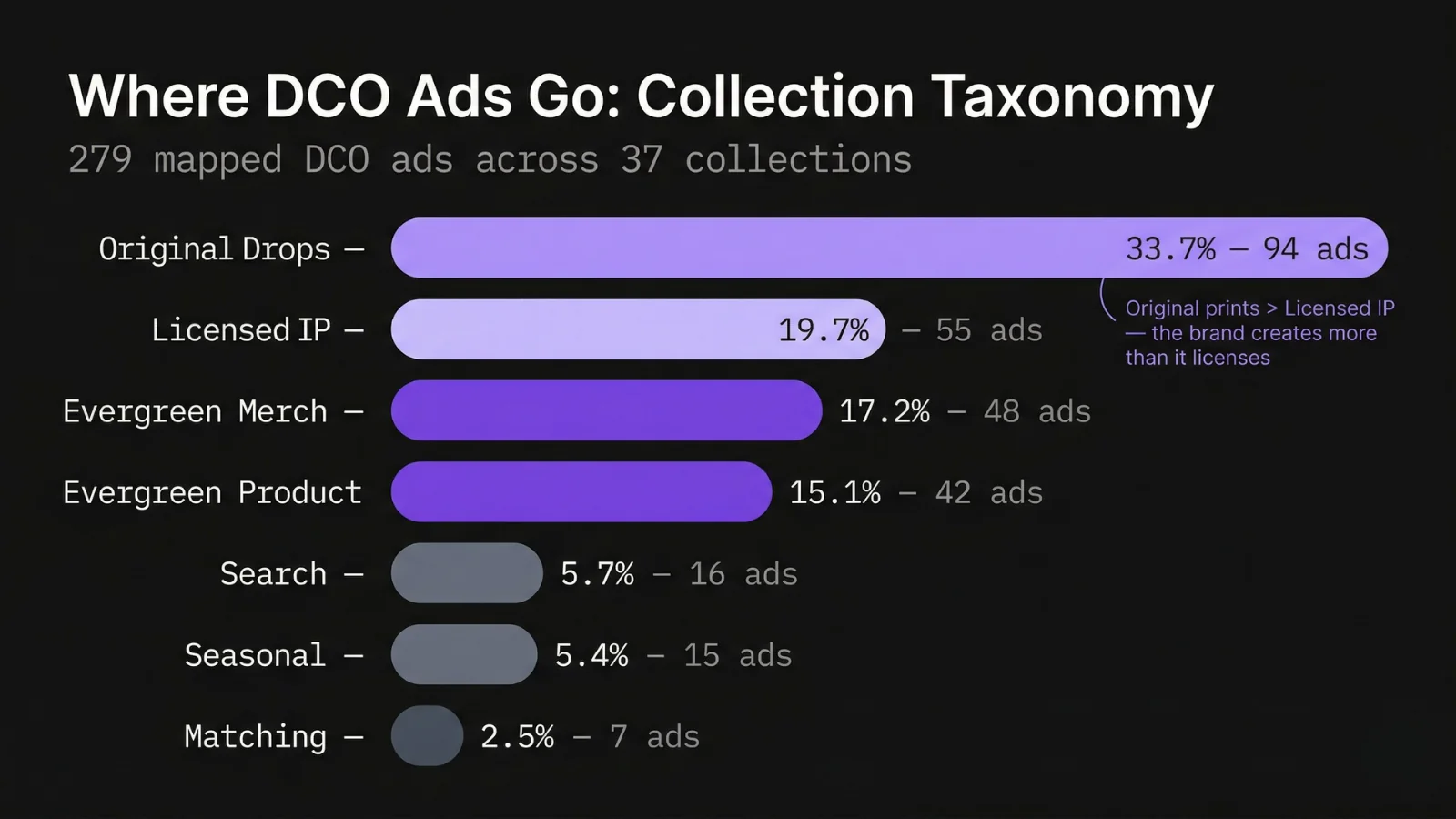
I grouped all 37 collections into categories to see where the ad spend is actually going. Here’s the breakdown across the 279 DCO ads I could map:
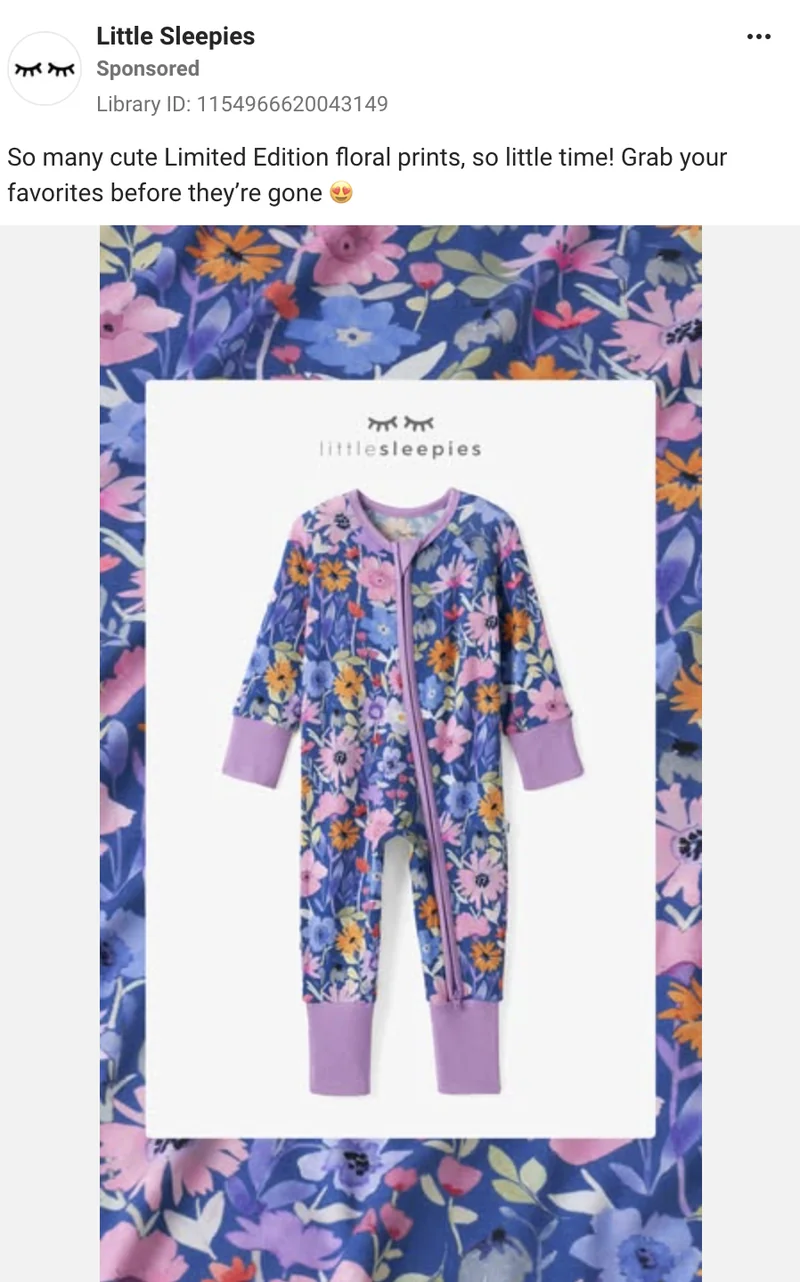
- Original print drops: 94 ads (33.7%) - Little Chef, Mini Builders, Disco Rainbows, Rancher Roundup, Shell Parade, Ladybug Meadow, Desert Sunrise, Florals, Purrfect Pals. These are in-house designed prints, launched as limited runs
- Licensed IP: 55 ads (19.7%) - Disney Peekaboo Pets, Bluey, Pixar Cars, Lion King, Finding Nemo, Winnie the Pooh. Six Disney and entertainment partnerships
- Evergreen merch pages: 48 ads (17.2%) - Best-Sellers, Trending Now, New Arrivals, Signature Styles. The always-on catalogue
- Evergreen product categories: 42 ads (15.1%) - Zip-Rompers & Sleepers, Two-Piece Sets, Shorty Zippies, Party Dresses. Product format pages, not print-specific
- Search catch-all: 16 ads (5.7%) - Ads pointing to the site search page. Likely running broad targeting and letting the user find their own product
- Seasonal: 15 ads (5.4%) - Easter, Spring Pajamas
- Relationship/Matching: 7 ads (2.5%) - Family Matching, Mommy-and-Me Hospital Outfits
The biggest takeaway: original drops are the largest single bucket. Licensed IP gets the cultural gravity - Disney, Bluey - but it’s not the majority of the ad account. The brand creates more of its own prints than it licenses. One-third of the DCO account is in-house creative.
This is a two-engine system. Licensed IP brings the recognition (your kid sees Bluey and wants it). Original drops bring the exclusivity (you can’t get Disco Rainbows anywhere else). Both run through the same DCO template. Both use the same scarcity language. But the balance leans toward original - the brand is building its own gravity, not just borrowing Disney’s.
The Ridge parallel is worth noting here. Ridge runs limited edition capsule drops - Oceanlight, Legends in Bloom, Chinese New Year. Little Sleepies does the exact same thing, just with bamboo pajamas instead of titanium wallets. Both brands avoid discounts. Both use scarcity to drive urgency. The difference: Little Sleepies also has licensed IP as a structural advantage. Ridge creates all their own drops. Little Sleepies can plug into Disney’s cultural gravity whenever they want.
Bluey Gets 23 Ads and Zero Copy Testing.
Another thing I noticed was the relationship between how many ads a collection gets and how many copy variants it runs.
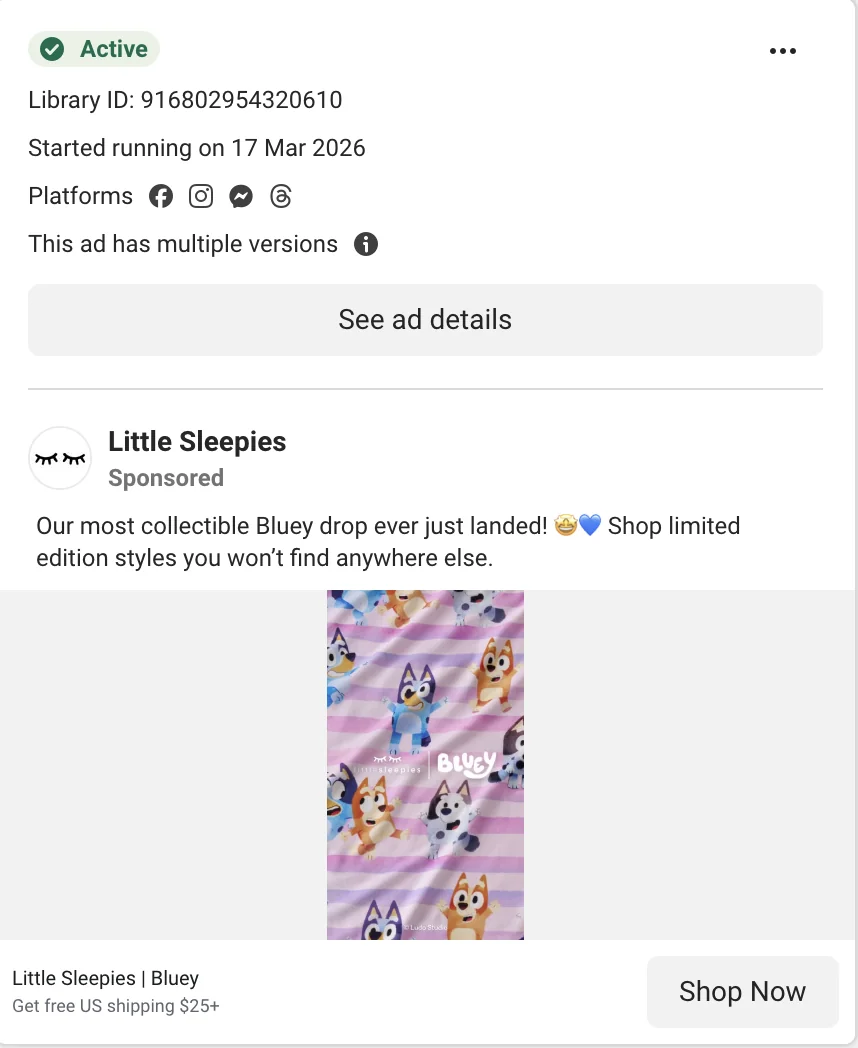
The Bluey collection has 23 DCO ads. All of them use the exact same card body - the same sentence, repeated 58 times across all cards:
“Our most collectible Bluey drop ever just landed! 🤩💙 Shop limited edition styles you won’t find anywhere else.”
One piece of copy. 23 ads. Zero testing.
Compare that to other collections:
- Zip-Rompers & Sleepers: 27 ads, 15 unique copies (ratio: 0.56)
- The Newborn Shop: 17 ads, 9 unique copies (ratio: 0.53)
- Best-Sellers: 11 ads, 6 unique copies (ratio: 0.55)
- Bluey: 23 ads, 1 unique copy (ratio: 0.04)
- Disney Peekaboo Pets: 21 ads, 2 unique copies (ratio: 0.10)
- Play by Little Sleepies: 10 ads, 1 unique copy (ratio: 0.10)
The pattern: licensed IP collections get volume but not copy variation. Evergreen product categories get fewer ads but significantly more copy testing. My hunch is that the IP itself is the creative - Bluey doesn’t need a clever headline. The character does the selling. You show a toddler in Bluey pajamas and the parent’s decision is already half-made.
But a generic product category like “zip rompers” doesn’t have that built-in pull. So the brand needs to test multiple angles to find what resonates. Is it “the one-and-done PJ every mom needs”? Or “our best-selling Zippies make diaper changes a total breeze”? Or “see why thousands of parents are obsessed”? They need the data to know.
Copy stays inside its collection
Most card bodies stick to one collection - 69 unique copy blocks appear in exactly one collection. Only 9 copy blocks cross over into multiple collections. One of those: “Gentle on delicate new skin, our first-ever Newborn Capsule is packed with features new parents need” appears across three collections (Gowns, Newborn Separates, Zip-Rompers).
The takeaway: copy is collection-specific. The brand writes for the drop, not for the account. When a new collection launches, it gets its own messaging. That messaging rarely leaks into other parts of the account.
”Limited” Appears 281 Times. “Sale” Appears 14.
I ran a word frequency analysis across all 927 card bodies. The messaging hierarchy is clear:
- “Limited” - 281 mentions. Broken into “limited edition” (167) and “limited time” (112)
- “Disney” - 188
- “Dropped” / “just landed” - 158 combined
- “Matching” - 151
- “Newborn” - 107
- “Parent” - 109
- “Mama” - 54
- “Buttery soft” - 53
- “Free shipping” - 48
- “Tagless” - 23
And at the bottom:
- “Sale” - 14
- ”% off” - 4
- “Discount” - 0
Only 1.7% of card bodies mention any sale or discount. Free shipping shows up in 4.6%. The rest is scarcity, newness, and emotional social proof.
This is Ridge’s playbook applied to children’s apparel. Ridge ran zero discounts across 273 Meta ads and used limited collection drops to create urgency instead of price cuts. Little Sleepies does the same - but with Disney characters and pastel prints instead of titanium wallets. FCT was the first brand in this series to run discounts on Meta (35% of ads contained promo language). Little Sleepies swings back the other way, hard.
99.1% of ads use “Shop Now” as the CTA (347 of 350). Three use “Learn More.” There’s no consideration funnel here. The assumption is that by the time someone sees the ad, they’ve either been primed by the drop announcement in the VIP group (400K+ members) or by the scarcity language in the card itself. The ad’s job is to get you to the collection page. That’s it.
”Obsessed” Is Their Word.
This one is worth its own section because it shows up everywhere.
The word “obsessed” - or its variations like “obsessing over” - appears 88 times across the entire account. It shows up in video copy, DPA copy, card copy. It’s not just frequent - it’s structural. It does the same job across every format: social proof as a verb, not a statistic.
Here’s what I mean. On their Google search ads (which I’ll cover in Part 2), Little Sleepies uses “More Than 35K 5-Star Reviews” as social proof. That’s a number. A statistic.
On Meta, they never do that. Instead, it’s always the crowd saying “obsessed”:
“See why thousands of parents are obsessed with LS”
“Discover the PJs everyone’s obsessing over!”
“One snuggle, and you’ll see why parents are obsessed!”
“Our best-selling Zippies make diaper changes a total breeze! See why thousands of parents are obsessed”
Every time, the framing is the same: other parents already love this, and you’re about to find out why. It’s peer validation disguised as a call to action. And it works differently than a review count because it implies a feeling, not just a rating. You can argue with 4.7 stars. You can’t argue with “thousands of parents are obsessed.”
The Fabric That Built the Brand Is Invisible on Meta.
This might be the most surprising pattern in the data.
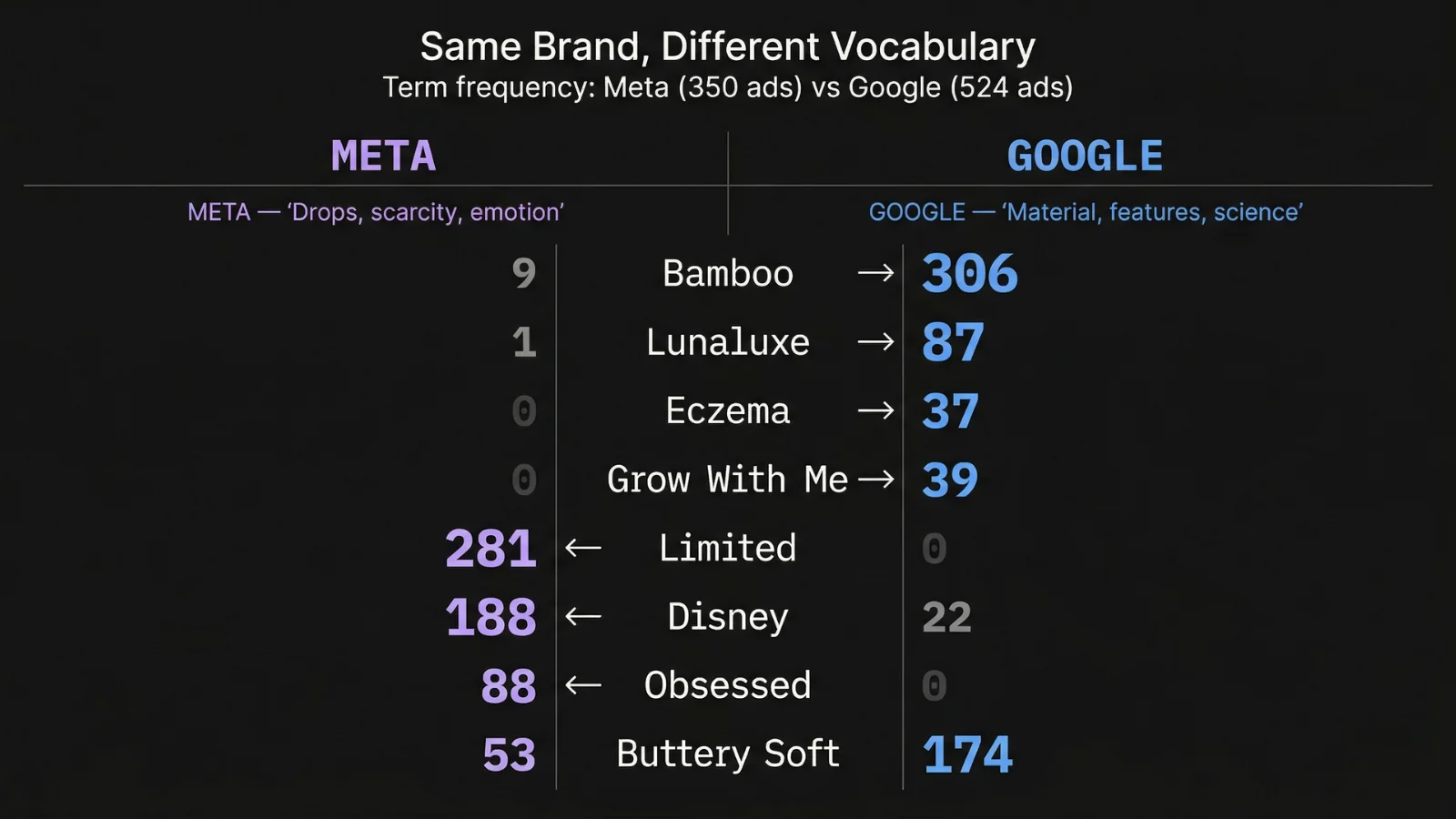
Lunaluxe® - the proprietary bamboo fabric that started the entire company, the fabric Maradith Frenkel spent years developing for her son’s eczema - appears exactly once across all 927 card bodies and all ad copy combined.
Once. In a single ad mentioning “buttery soft Lunaluxe® Bamboo Crescent Zippies.”
Let me put that in context with other terms:
- “Bamboo” - 9 mentions
- “Eczema” - 0 mentions
- “Grow With Me” (their signature fabric feature that fits 3x longer) - 0 mentions
- “Lunaluxe” - 1 mention
- “Hypoallergenic” - 0 mentions
The fabric innovation story that built a $200M brand from a garage is almost completely absent from their largest paid channel. Instead, what you see:
- “Buttery soft” - 53 mentions
- “Tagless” - 23
- “Obsessed” - 88
- “Double zips” - 6
They sell the feeling, not the fabric. The outcome, not the input. “Buttery soft” does the job that “Lunaluxe® Bamboo Viscose” does on a product page - but it’s simpler, more emotional, and doesn’t require the reader to know what bamboo viscose even means.
This is a deliberate channel split. On their Google search ads - which I’ll cover in Part 2 - “bamboo” appears 306 times and “Lunaluxe” appears 87 times. “Eczema” appears 37 times. “Grow With Me” appears 39 times. The people searching for “bamboo toddler pajamas eczema” on Google get the material science story. The people scrolling Meta get “buttery soft PJs that grow with your little ones 💕✨.”
Same brand. Same products. Completely different vocabulary depending on where they’re talking to you.
Video Is a Thin Layer. Creators Get Folded Into the Machine.
40 video ads make up 11.4% of the account. Not a lot - but they’re the only ads with hand-written copy (26 unique variants across 40 videos), so they tell you something about what the brand thinks needs a human touch.
Where video points
Video landing pages lean toward evergreen product and relationship categories:
- Little Chef - 6 ads
- Mommy-and-Me - 4 ads
- Matching Sibling Sets - 4 ads
- Two-Piece Sets - 4 ads
- Best-Sellers - 4 ads
- The Newborn Shop - 4 ads
Notice what’s missing: the drop collections. Bluey doesn’t get video ads. Disco Rainbows doesn’t get video ads. Mini Builders doesn’t. Drop collections get DCO with image and video cards. Standalone video ads are reserved for categories where you need to show the product in motion - a mom doing a diaper change with the double-zip, siblings matching at a photoshoot, a newborn being wrapped in a Crescent Zippy.
The oldest video has been running for 81 days. Median age is 40 days. These aren’t throwaway tests - the ones that work keep running.
Creator content
Only 4 video ads carry explicit creator credits in the body text:
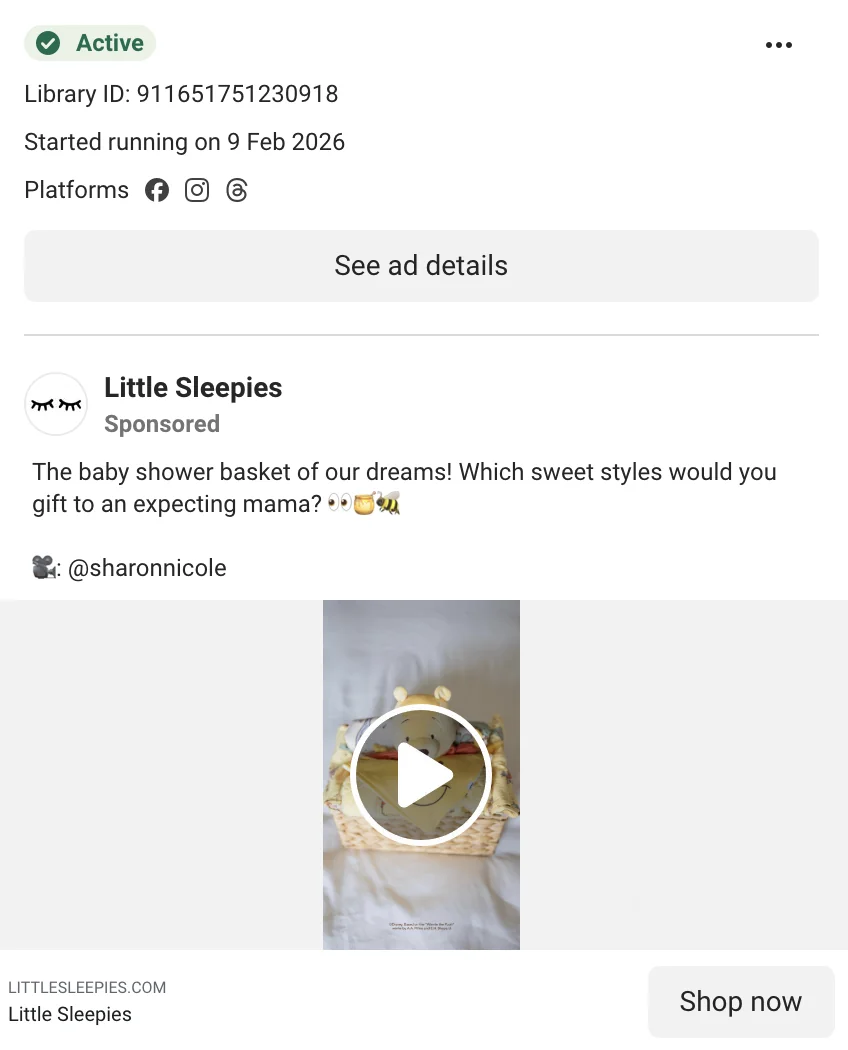
- @sharonnicole - baby shower basket content (2 ads)
- @kaylasheakoch - sibling matching content (1 ad)
- @rachel.betka - Little Chef baking content (1 ad)
But another 8 creator handles appear embedded in card-level text across the DCO system - @sweeeeeet_caroline, @josielinmullins, @julia, @lo, @_hannahh_n, @katherinelenora, @courtney_n_miller, @jamn0619. Their photos and videos become cards inside the DCO machine. The creator’s content is there, but it’s absorbed into the template - not showcased as a standalone UGC piece.
This is a different approach from FCT, where UGC was clearly separated (12 of 150 ads, tagged #cleanfreshthreadspartner, with individual creator handles visible). Little Sleepies integrates creators more quietly.
DPA: Two Waves, 13 Copy Variants.
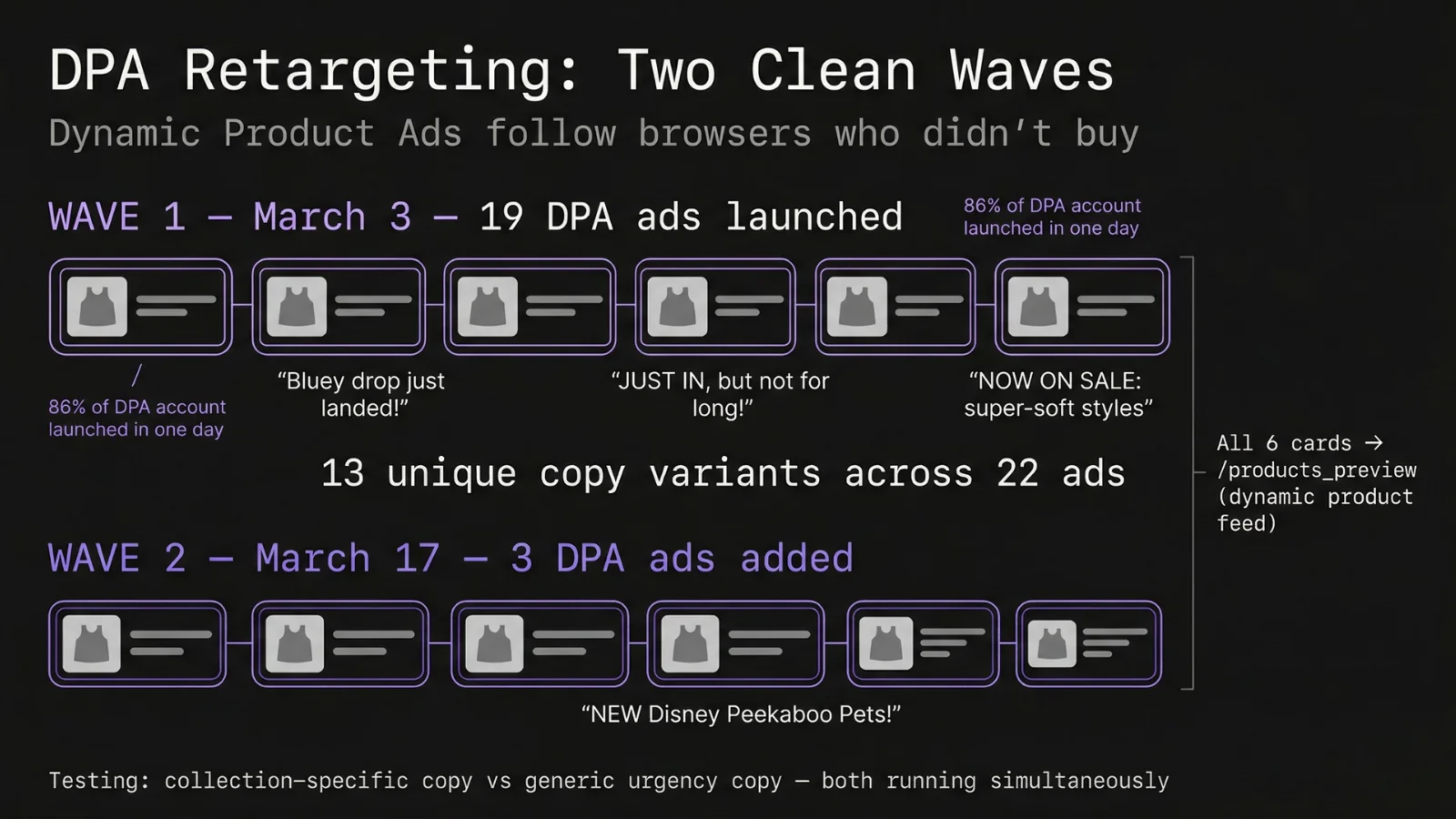
The 22 DPA (Dynamic Product Ads) are the retargeting layer. If someone browsed littlesleepies.com and didn’t buy, these ads follow them across Meta with products they looked at.
What caught my attention was the timing. They didn’t launch DPA gradually - they dropped them in two clean waves:
- March 3: 19 DPA ads launched
- March 17: 3 more DPA ads added
The March 3 wave alone is 86% of the DPA account. This looks like a strategic decision - maybe tied to a retargeting window after a February surge in new traffic from the Disney Peekaboo Pets and Disco Rainbows drops.
The 22 DPA ads rotate 13 unique copy variants. Some are collection-specific:
“Our most collectible Bluey drop ever just landed!”
“NEW Disney Peekaboo Pets just hatched for Easter!”
“Limited Edition Little Chef Styles!”
Others are generic urgency:
“JUST IN, but not for long! ⏰ Fill your cart with the cutest NEW arrivals before they’re gone.”
“NOW ON SALE: Snag the super-soft styles everyone’s obsessing over, for less!”
I think they’re testing whether collection-specific retargeting copy outperforms generic. The fact that both exist simultaneously suggests they haven’t found a clear winner yet - or they’re deliberately running both for different audience segments.
Also worth noting: the DPA ads carry 6 cards each (vs 2-4 in DCO), all pointing to /products_preview - a dynamic product feed. These are the broadest ads in the account in terms of product coverage.
A Few More Things I Found.
No Audience Network
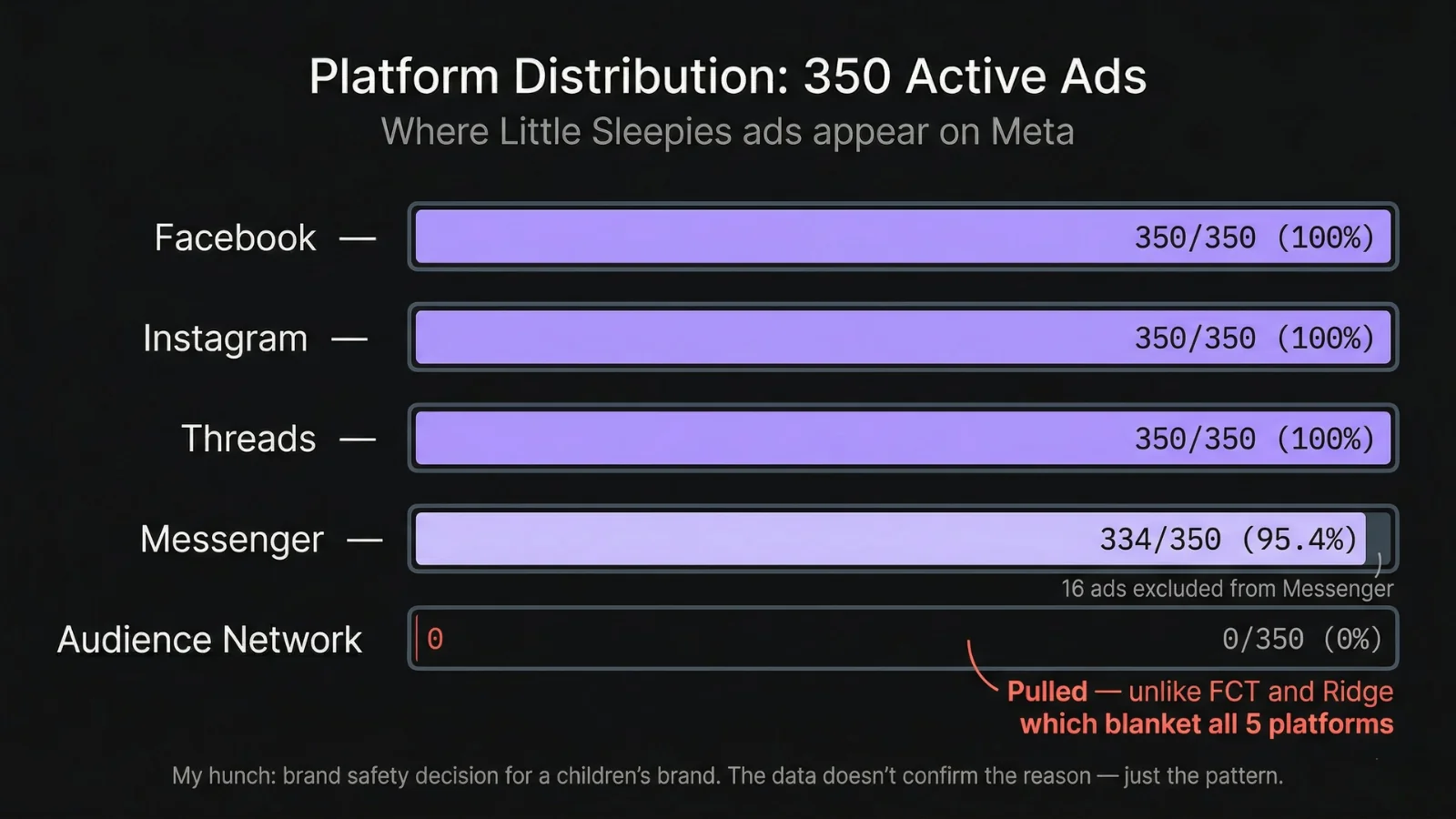
All 350 ads run on Facebook, Instagram, and Threads. 334 also run on Messenger. Zero on Audience Network.
This is different from FCT and Ridge, which blanket all five Meta platforms including Audience Network. I think this is a brand safety decision - Audience Network places ads on third-party apps and websites, and for a children’s brand, controlling where your ads appear matters more than squeezing out extra impressions. But the data doesn’t confirm the reason - just the pattern.
Zero AI-generated content
All 350 ads show false for Meta’s digital created media flag. Everything is photographed, filmed, or designed by humans. Same as every other brand in this series. I haven’t found a single D2C brand in this teardown series using AI-generated creative on Meta.
371K page likes and a 400K VIP group
For context - FCT had 161K page likes. Little Sleepies has over 2x the Facebook audience. But the bigger number is the VIP Facebook group: 400K+ members. That’s a direct community channel where drop announcements happen before the ads launch. My hunch is that the VIP group does a lot of the awareness work that other brands need their ads to do - which might explain why 99.1% of ads use “Shop Now” instead of “Learn More.” The audience is already warmed up.
Platform distribution
350 of 350 on Facebook. 350 of 350 on Instagram. 350 of 350 on Threads. 334 of 350 on Messenger (95.4%). No selectivity - same ads everywhere except Audience Network. Let Meta’s algorithm decide where each ad performs best.
Summary
Here’s what I found in Little Sleepies’ 350 active Meta ads:
- 82.3% DCO (288 ads) running on a single template -
{{product.brand}}/{{product.name}}/{{product.description}}. The most template-efficient account in this series. Zero variation at the ad level - 100% card uniformity - every DCO ad sends all its cards to the same collection. Each ad is a single-collection push, not a mixed carousel
- 927 cards across 37 collections. The ad account is a drop calendar. Original print drops make up 33.7%, licensed IP (Disney, Bluey, Pixar) 19.7%, evergreen merch/product 32.3%
- Launch bursts, not drip campaigns. Feb 9 (25 ads), Feb 19 (20 ads), Feb 26 (25 ads), Mar 17 (18 ads) - each burst maps to a collection dropping on the site
- Licensed IP gets volume, not copy testing. Bluey: 23 ads, 1 unique copy. Zip-Rompers: 27 ads, 15 unique copies. The character sells itself; generic categories need message testing
- Near-zero discounts. “Limited” appears 281 times. “Sale” appears 14. Only 1.7% of card bodies mention any promotion. This is Ridge’s scarcity-first playbook, applied to children’s pajamas
- “Obsessed” is their word - 88 mentions. Social proof as a verb, not a statistic. They never cite review counts on Meta. That’s reserved for Google
- Lunaluxe® appears once. Bamboo appears 9 times. The proprietary fabric story is invisible on Meta. “Buttery soft” does the heavy lifting. Google tells a completely different story (Part 2)
- 40 video ads (11.4%) with hand-written copy, skewing toward evergreen and relationship categories. Creator content gets folded into DCO cards, not showcased as standalone UGC
- 22 DPA retargeting ads dropped in two waves (March 3 and March 17), testing 13 copy variants - some collection-specific, some generic urgency
- No Audience Network - unlike FCT and Ridge. Likely a brand safety decision for a children’s brand
- Zero AI-generated content, 371K page likes, 400K+ VIP group members, 99.1% “Shop Now” CTAs
What’s next: I ran the same scrape on Little Sleepies’ Google Ads - 524 ads across the Transparency Center. On Google, the brand speaks a completely different language. Lunaluxe® goes from 1 mention to 87. Bamboo goes from 9 to 306. Eczema goes from 0 to 37. And discounts - up to 65% off - suddenly appear everywhere. That’s Part 2.
I’m tearing down a D2C brand every week. If there’s a brand you want me to break down, DM me on X.
Share this teardown
Read Next
Little Sleepies Runs 524 Google Ads. On This Platform, They're a Completely Different Brand.
524 Google ads. Bamboo appears 306 times. Lunaluxe goes from 1 mention to 87. Discounts up to 65% off appear everywhere. Same brand, completely different vocabulary - here's what Little Sleepies' Google account reveals about their cross-platform strategy.
543 Google Ads. 166 Went Dark on the Same Day. Here's What Survived.
A breakdown of Fresh Clean Threads' Google Ads strategy. Why 166 ads went dark in 3 days, why 78% of active ads are Shopping, and how their Google strategy diverges from Meta.
Fresh Clean Threads Runs 150 Meta Ads. Only 17 Pieces of Copy Power All of Them.
150 active ads, 87% algorithm-driven, 17 unique copy blocks, and three simultaneous promo codes. Inside a $60M basics brand that trusts Meta's machine more than its own creative team.