Magic Spoon Has 109 Google Ads Spanning a Full Year. Protein Pastries Don't Exist on This Platform Yet.
Contents
In Part 1, I broke down Magic Spoon’s 64 Meta ads. The story there was a $209M brand betting 56% of its Meta account on a single new product - Protein Pastries - that launched in January 2026. Video-dominant, conversion-focused, no discounts.
The Google account is a completely different operation.
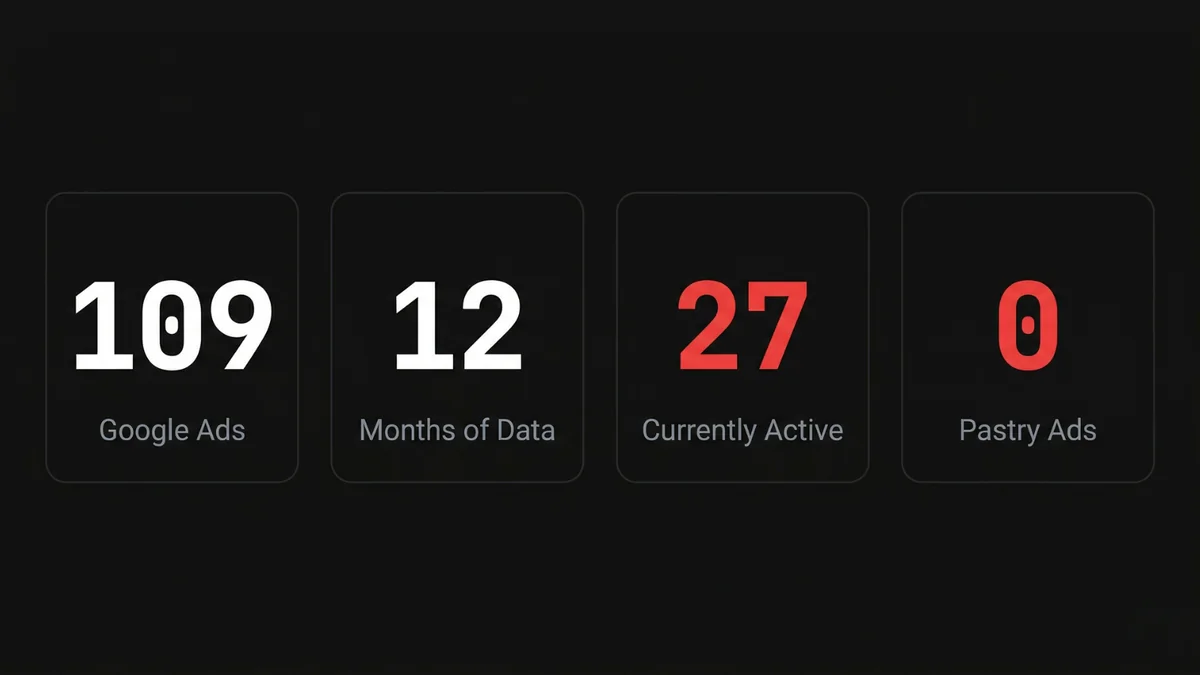
109 ads. Spanning from March 2025 to March 2026 - a full year of campaign history. But only 27 of those are currently active. The rest is an archive. And the product focus flips: on Meta, pastries dominate. On Google, pastries don’t exist. Not a single ad. The Google account is still running on cereal, granola, and treats - the product lineup that built the brand before the pastry bet.
If Part 1 showed you a brand going all-in on a new product, Part 2 shows you the platform where the legacy portfolio still runs the show.
27 Ads Are Active. The Rest Is a Year of Rotating Product Pushes.
Same caveat I gave with Graza’s Google teardown. Google’s Transparency Center shows when an ad was last shown, not when it launched. An ad last shown in April 2025 probably isn’t running today. One last shown in March 2026 probably is.
27 ads were last shown in March 2026. The other 82 are historical - ranging from March 2025 to January 2026. There’s a notable gap: zero ads have a last-shown date in February 2026. Either nothing new was served that month, or the ads that ran in February kept running into March.
The active 27 break down evenly: 12 text/search, 12 video, 3 image. That’s a balanced format mix - unlike Meta, which leans 56% video.
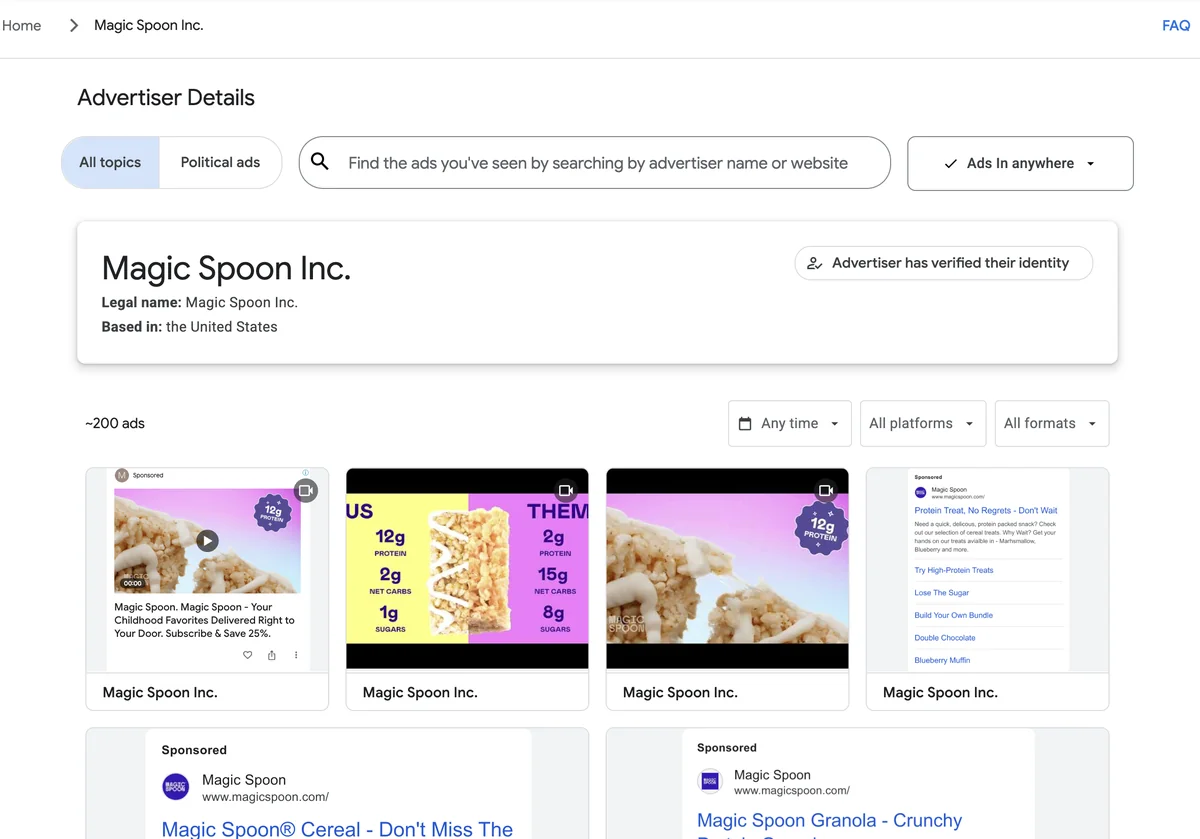
Video Dominates Overall - 60.6% of All 109 Ads. But Search Ads Tell the Product Story.
Here’s the format breakdown:
- Video: 66 ads (60.6%)
- Text/Search: 38 ads (34.9%)
- Image/Display: 5 ads (4.6%)
The video count looks massive, but most of it is brand-level. 45 of 66 video ads are categorized as general/brand content - no specific product mentioned in the headline or description. The headlines are things like “Too old for cereal? We think not,” “10+ Delicious Flavors,” “Cereal You’ll Actually Like,” and “Ever hear about Magic Spoon?” This is top-of-funnel brand awareness, not product-specific conversion.
The search and display ads are where the product story lives. And it maps by product line in a way that’s very deliberate.
Google Tells You the Product Roadmap. Here’s What Launched When.
The monthly product distribution reads like a timeline of Magic Spoon’s priorities:
March–April 2025: Granola Launch + Brand Awareness
The earliest Google ads promote Granola (launched January 2025 at retail) and general brand awareness. Search headlines like “7-8g Fiber - Magic Spoon Granola” and “No Artificial Ingredients - Magic Spoon Granola” appear here. The Granola 6-Pack is the promoted offer.
April–May 2025: Treats Push
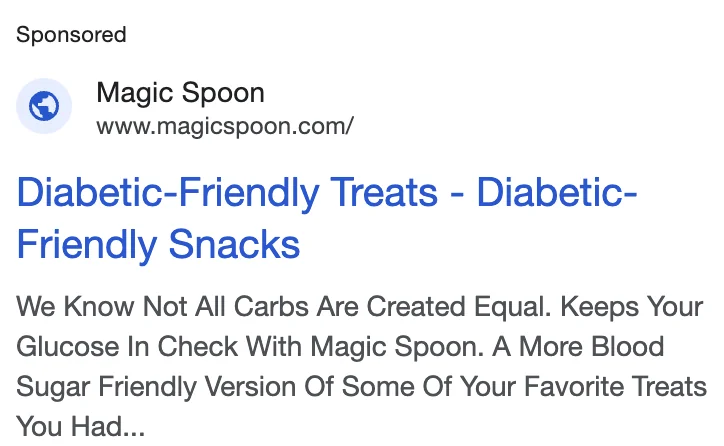
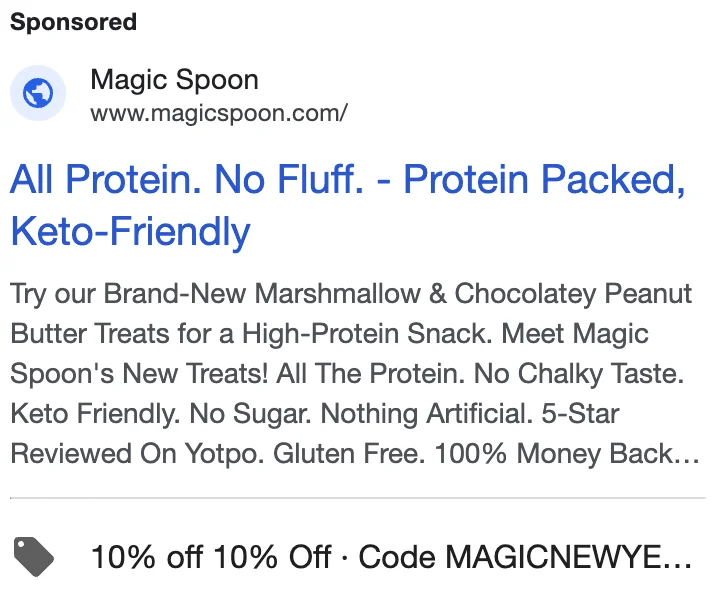
By late April, Treats dominate. 7 ads in May alone are Treats-focused: “All Protein. No Fluff.,” “Chewy. Not Chalky.,” “Diabetic-Friendly Treats.” This is where the health positioning gets aggressive - blood sugar messaging, diabetic-friendly claims, keto-friendly framing.
June–November 2025: Brand Video + Rotation
The middle of the year is mostly brand-level video ads. General messaging like “10+ Delicious Flavors,” “Nostalgically Delicious,” and the internal-name video ads (“MSP Trick Nostalgia 6s DL”) dominate. Product-specific search ads are sparse. The brand is maintaining awareness while the search budget cycles down.
December 2025–January 2026: Cereal Resurfaces + Video Refresh
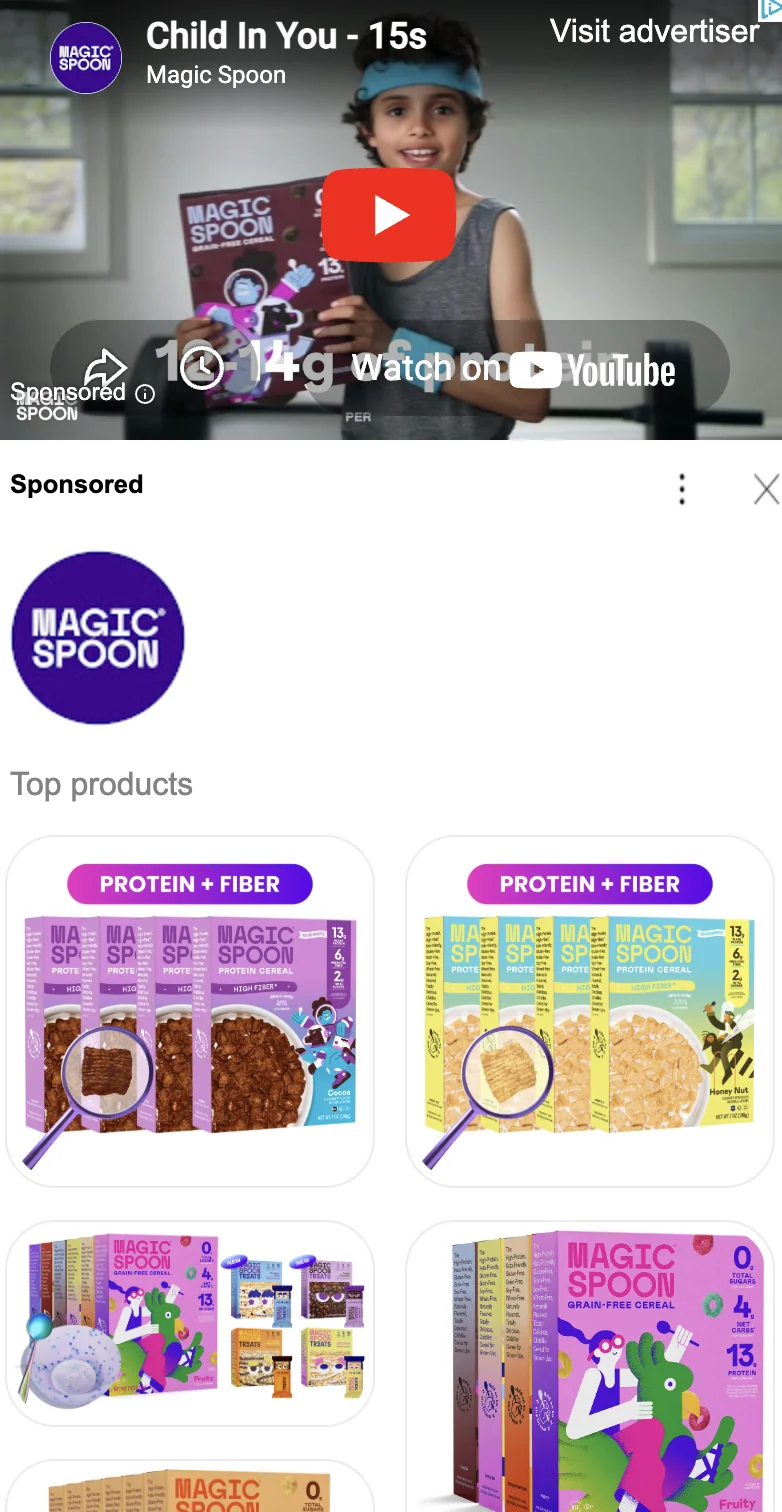
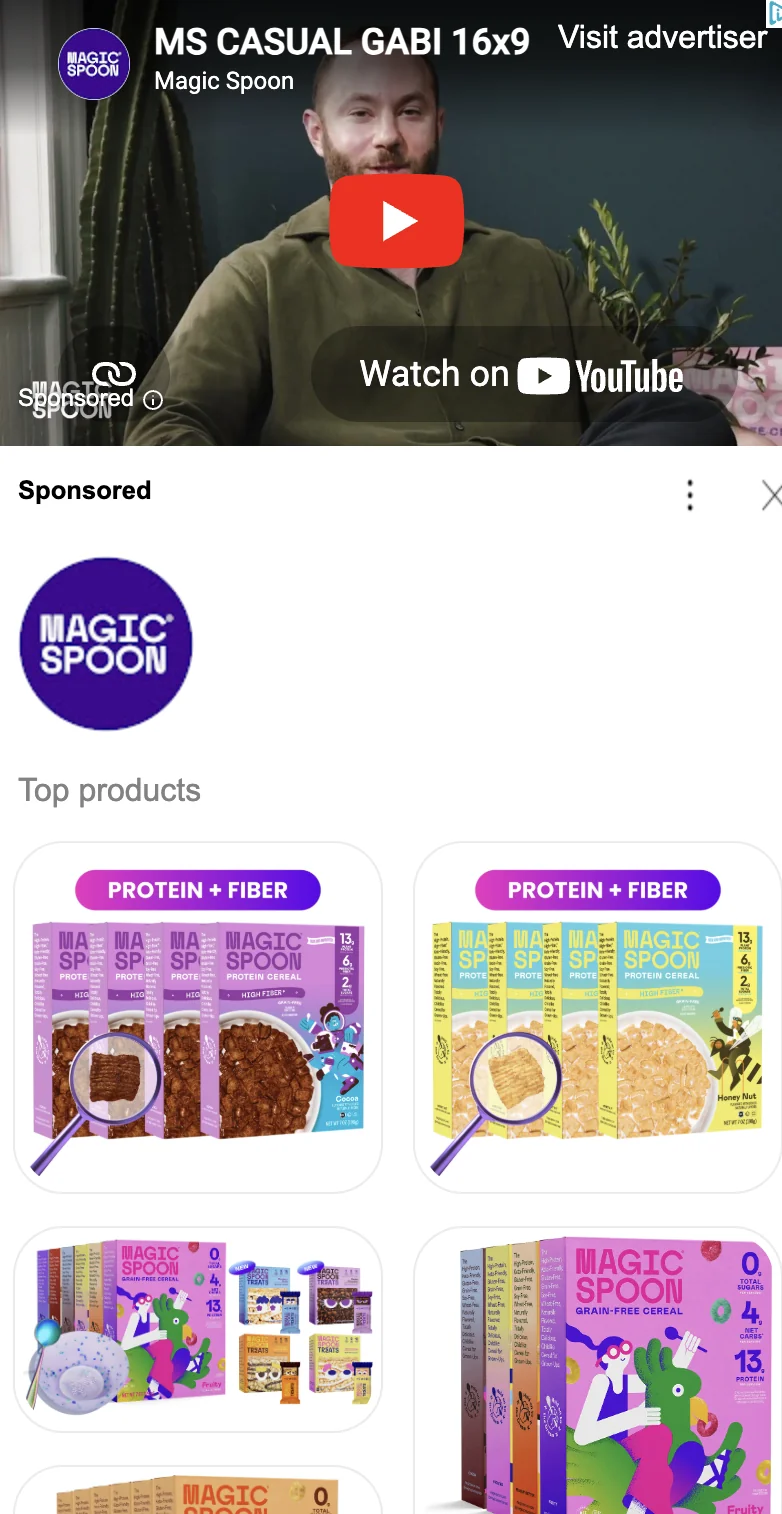
10 ads in December, 15 in January. Cereal comes back strong - 4 cereal ads in each month. A batch of new video creatives appears: “Child In You - 15s,” “Magic Spoon Cereal - Hooked,” “MS WILDCARD 16x9,” “MS CASUAL GABI 16x9.” These internal naming conventions leaked into the ad data - and they tell you the creative team organizes video by concept name and aspect ratio.
March 2026: The Active Account
27 ads active. Cereal (9), Brand/General (9), Treats (5), Granola (4). No pastries. The Google account is running the full legacy portfolio while Meta pushes the new product.
Search Ads Run the Health Positioning That Meta Doesn’t.
15 search ads. These are the most interesting ads in the Google account because they reveal positioning angles that don’t appear anywhere on Meta.
The Diabetic / Blood Sugar Angle
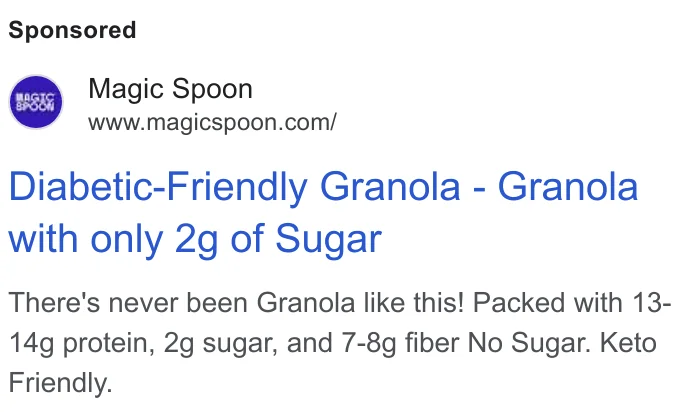
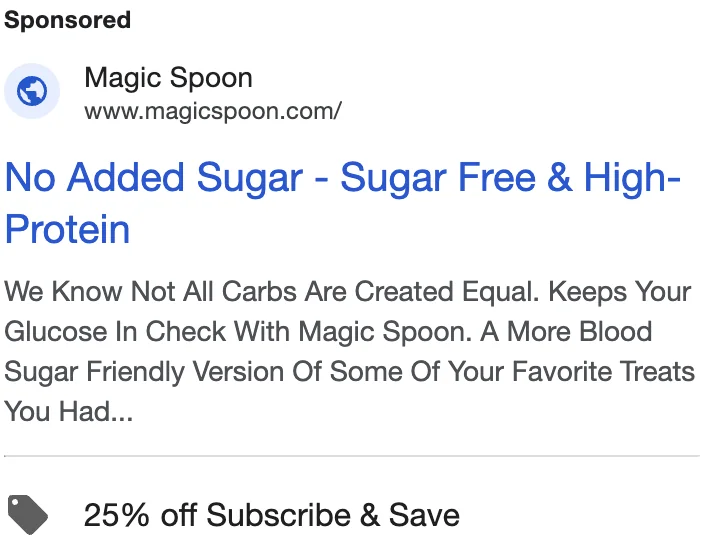
Multiple search ads target a health-conscious audience with glucose-specific messaging:
- “Keeps Your Glucose In Check With Magic Spoon”
- “A More Blood Sugar Friendly Version Of Some Of Your Favorite Treats”
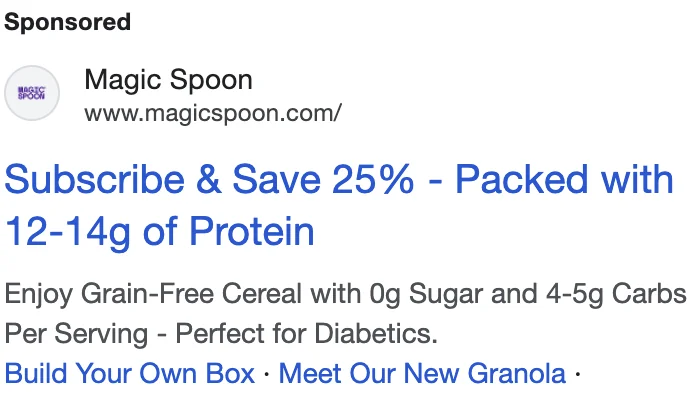
- “Perfect for Diabetics”
- “Enjoy Grain-Free Cereal with 0g Sugar and 4-5g Carbs Per Serving - Perfect for Diabetics”
This is a niche positioning play that doesn’t exist on Meta. Not in any of the 64 Meta ads. On Google, someone searching “diabetic-friendly cereal” or “low sugar snacks for diabetes” might land on a Magic Spoon ad. That’s a search intent you can capture on Google that doesn’t translate to feed-based platforms.
No other brand in this series has used diabetic-friendly messaging. It’s unique to Magic Spoon and unique to Google.
The Keto Positioning Lives Here
“Keto-Friendly” appears in multiple search headlines and descriptions. On Meta, keto messaging has faded to 17.2%. On Google, it’s still a primary positioning - because people still search for keto cereal. The brand speaks to the trend where it still lives (search intent) while de-emphasizing it where it’s fading (social feeds).
Flavor Lists as Headlines
Several active search ads list specific flavors: “Available In Cocoa, Frosted, Fruity, Blueberry Muffin, Peanut Butter, And Cinnamon Roll.” This is a Google-specific tactic - product variety reduces the risk for someone searching generically. Nobody puts a flavor list in a Meta ad body. On Google, it works because the searcher is further down the funnel and wants to know exactly what they’re getting.
Social Proof in Search Copy
“50,000+ 5-Star Reviews” appears in the cereal search description. “5-Star Reviewed On Yotpo” shows up in the shopping ads. Magic Spoon embeds review counts and platform-specific proof into search copy - converting credibility into click-through.
3 Shopping Ads. All Point to Amazon.
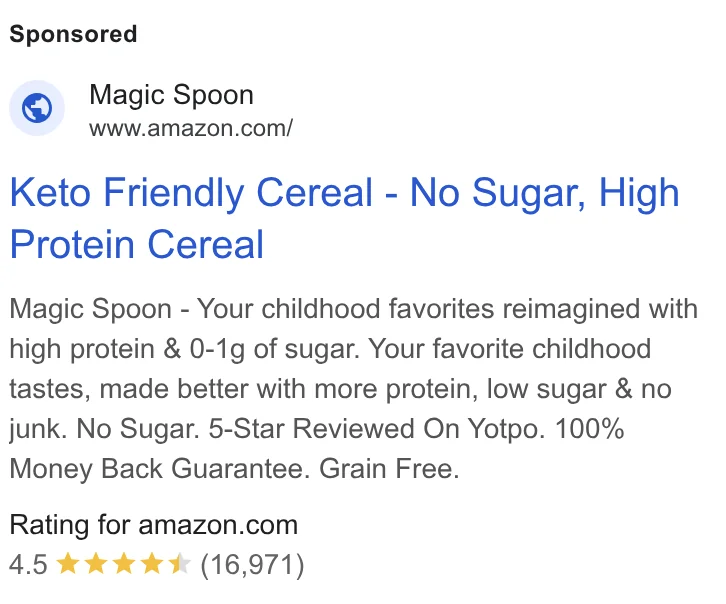
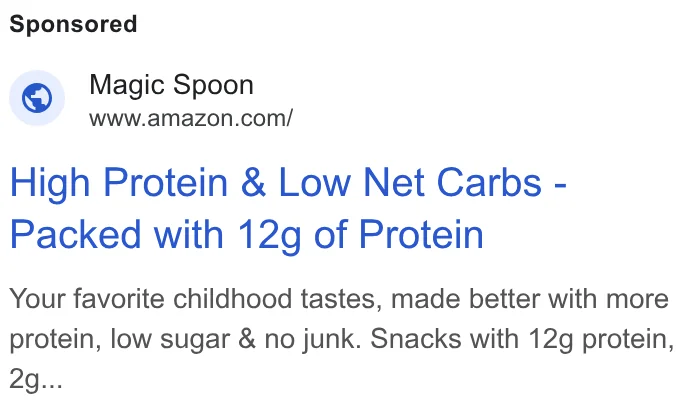
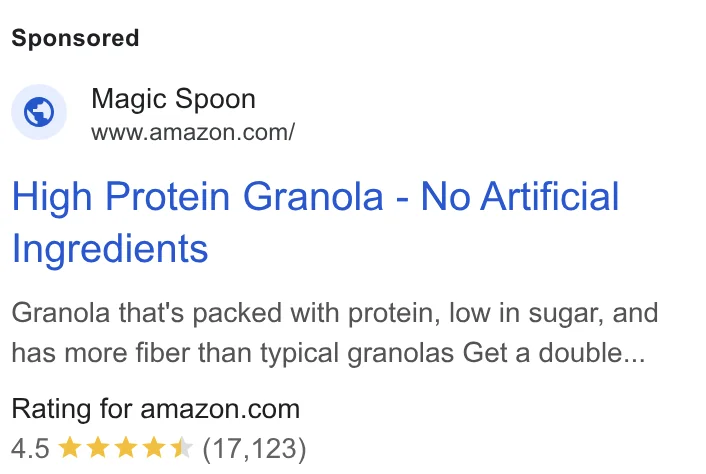
Three search/shopping ads explicitly drive to www.amazon.com:
- “Keto Friendly Cereal - No Sugar, High Protein Cereal” → Amazon
- “High Protein Granola - No Artificial Ingredients” → Amazon
- “High Protein & Low Net Carbs - Packed with 12g of Protein” → Amazon
Same dual-marketplace strategy I found with Graza. Magic Spoon runs Google ads to drive Amazon purchases - not just their own DTC site. All three Amazon ads were last shown in October 2025, so this might be a seasonal or testing play rather than an always-on channel. But the intent is clear: capture search traffic and send some of it to Amazon, where the conversion friction is lower (Prime shipping, established payment, one-click buy).
The shopping ads also carry the richest copy: “100% Money Back Guarantee,” “Grain Free,” “5-Star Reviewed On Yotpo.” These are conversion-optimized for a shopper who’s comparing options, not a social scroller.
Video Internal Names Leaked. The Creative Team’s Naming Convention Is Visible.
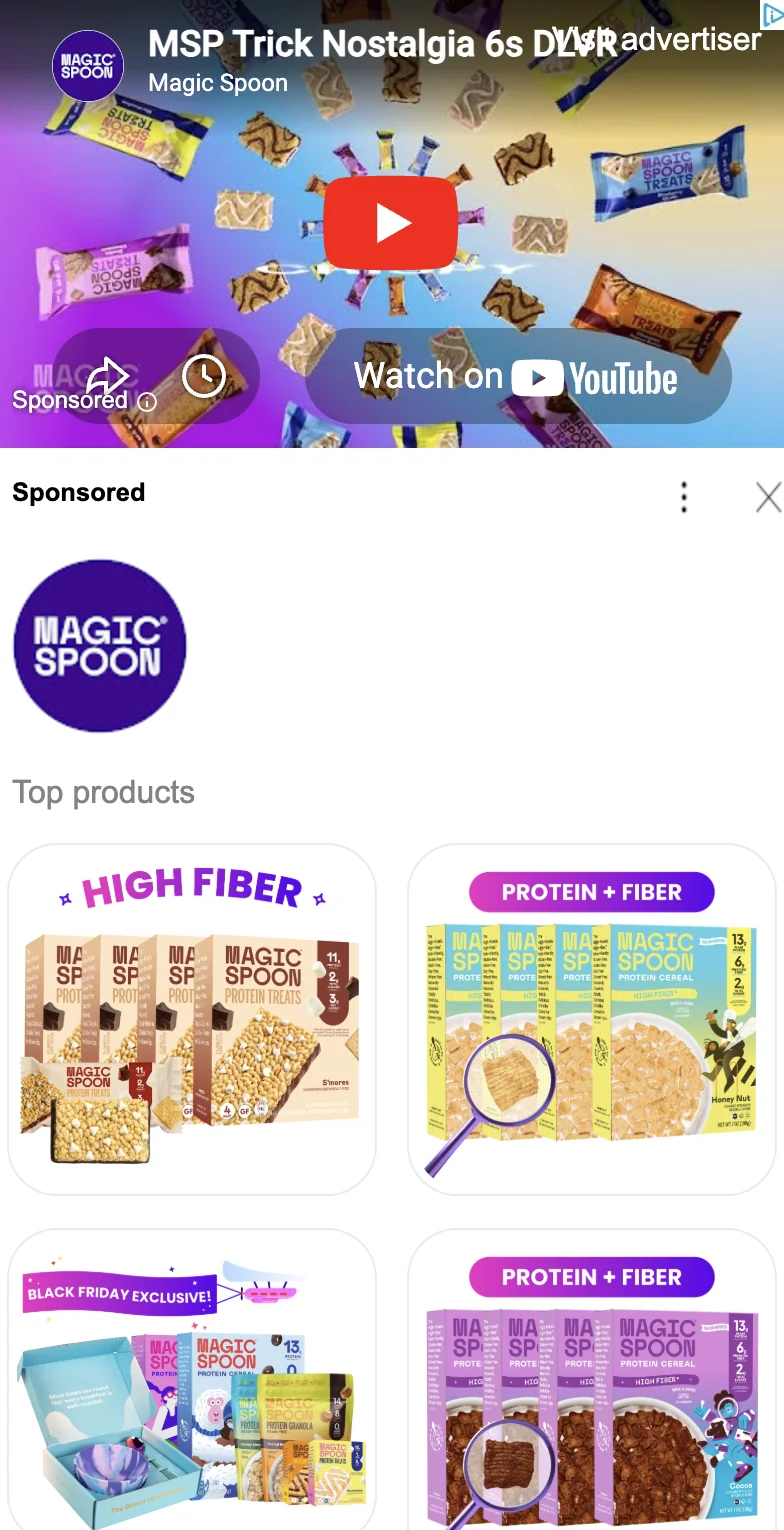
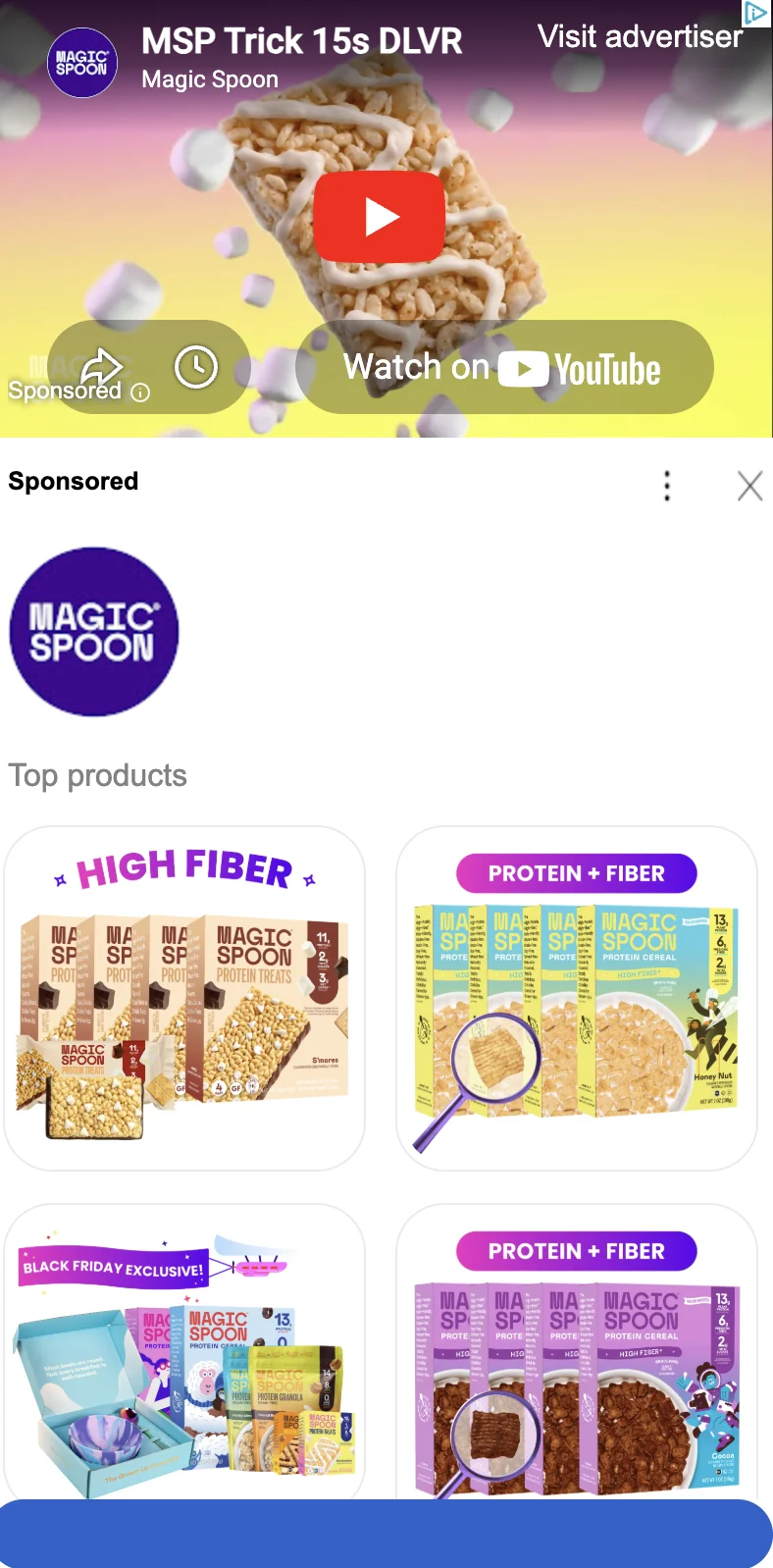
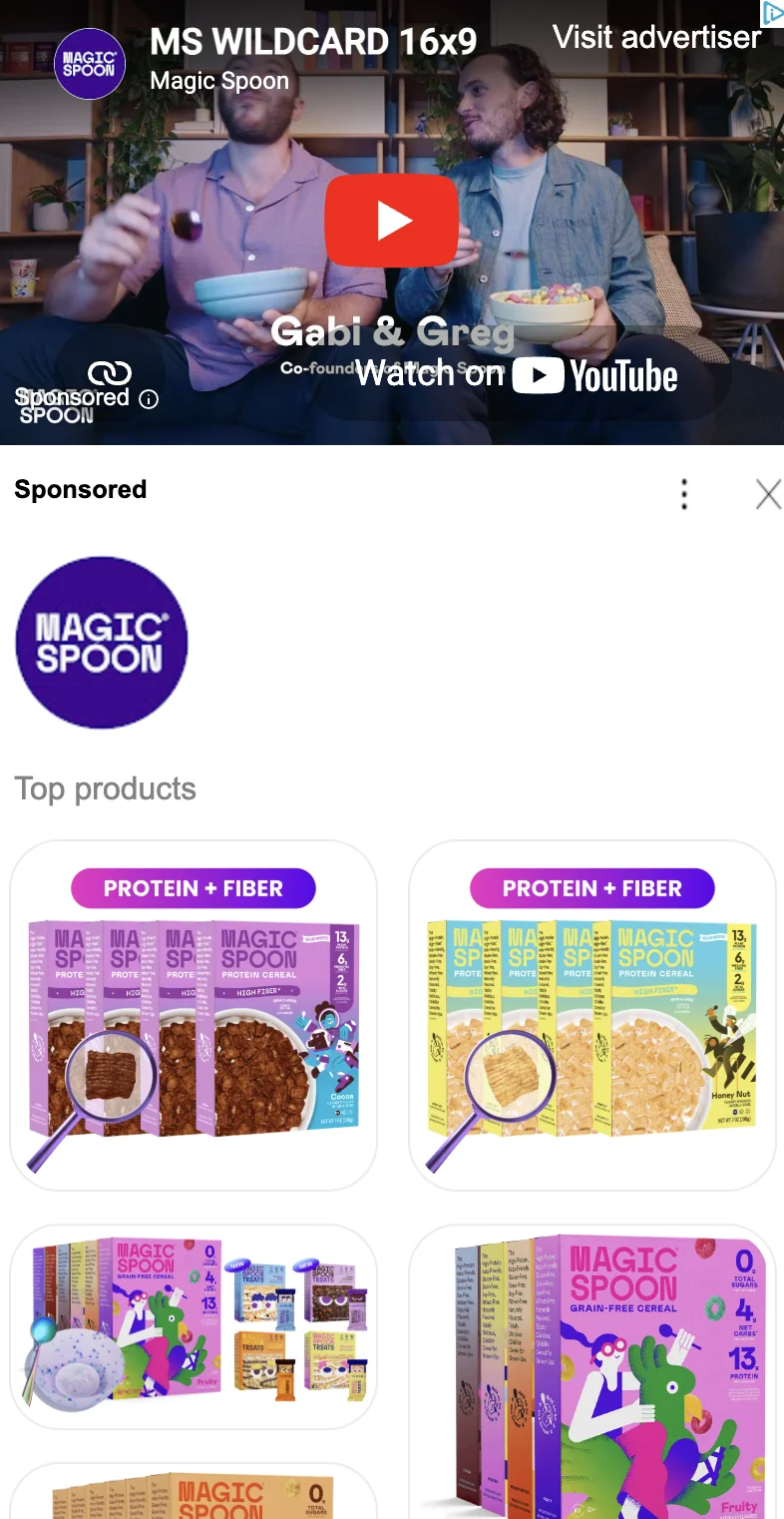
This is a small finding but a fun one. Five video ads have internal creative names visible as headlines instead of consumer-facing copy:
- “MSP Trick Nostalgia 6s DL” - September 2025
- “MSP Trick 15s DLVR” - September 2025
- “MS WILDCARD 16x9” - December 2025
- “Child In You - 15s” - December 2025
- “MS CASUAL GABI 16x9” - December 2025
The naming convention breaks down:
- MSP / MS = Magic Spoon (brand abbreviation)
- Trick / WILDCARD / CASUAL = concept or campaign name
- Nostalgia / Child In You / GABI = creative theme or talent name (GABI likely refers to co-founder Gabi Lewis)
- 6s / 15s = video duration
- DL / DLVR = likely “download” or “deliverable” - asset type
- 16x9 = aspect ratio
These names were never supposed to be consumer-facing. They’re the internal file names that didn’t get replaced with proper headlines before the ads went live. It happens - Ridge had clean naming throughout, but this is a bigger operation with more moving parts. Not a big deal, but it tells you something about the workflow between the creative team and the media buying team.
Discounts Exist on Google. They Don’t on Meta.
The discount structure on Google:
- “Subscribe & Save 25%” - the biggest offer, tied to subscription
- “10% off - Code MAGICNEWYE…” - a New Year promo code (likely MAGICNEWYEAR or similar)
- “100% Money Back Guarantee” - risk reversal on shopping ads
- “25% off” - appears in cereal search headlines
On Meta: zero discounts. Zero promo codes. Zero percentage-off offers.
This is the same pattern I’ve seen with other brands in the series. Graza ran “20% Off Starter Kit” on Google and had zero discounts on Meta. Little Sleepies ran up to 50-65% off on Google and zero on Meta.
The logic: Meta is a discovery platform - you’re interrupting someone’s scroll with a brand impression. Discounting there trains people to wait for deals. Google is an intent platform - someone is already searching for the product. A discount removes the last friction point before purchase. The 25% Subscribe & Save is particularly smart - it converts a one-time search into recurring revenue.
Typos. A Lot of Them.
I try not to dwell on typos, but the volume here is worth noting:
- “High Protein Ceareal” - in a search ad headline. “Cereal” misspelled.
- “Magicly High-Protein Cereal” - “Magically” misspelled in a headline.
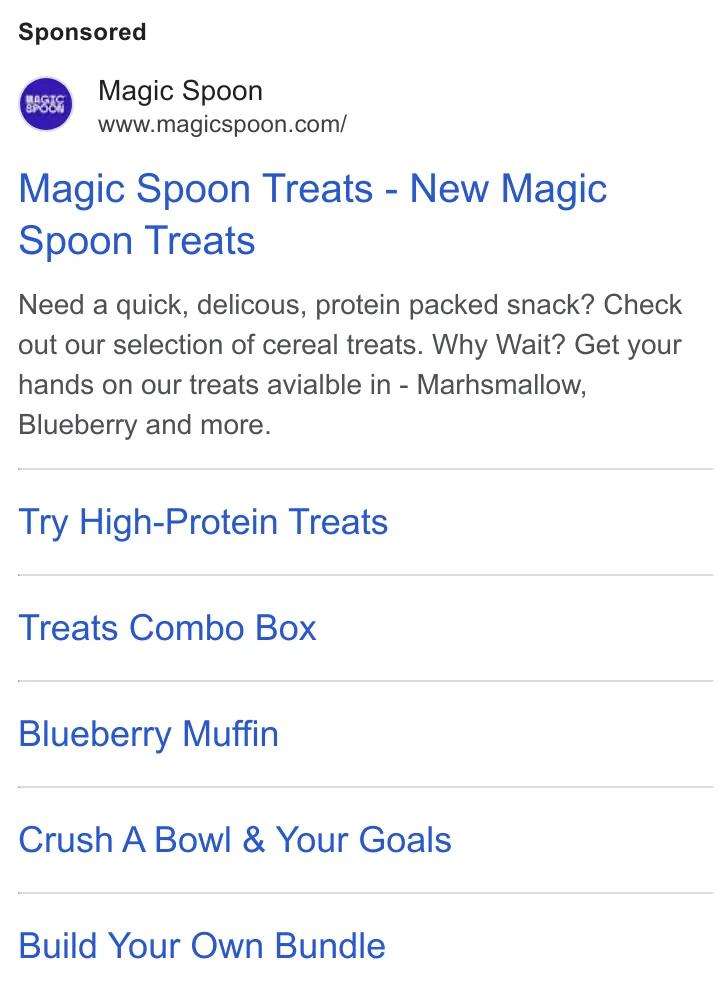
- “delicous” - appears twice in Treats search ad descriptions.
- “maglespoon.com” - appears twice as a landing URL. Likely a typo domain they own for misspelled traffic.
- “magickspoon.com” - appears 5 times as a landing URL. Another variant domain.
The variant domains (maglespoon, magickspoon) I think are intentional - brands often register common misspellings to capture mistyped traffic. But “Ceareal,” “Magicly,” and “delicous” are copy errors that made it into live ads. Combined with the internal video names leaking into headlines, it paints a picture of a media buying operation where the QA layer could be tighter.
Not a judgment - just a pattern in the data.
Almost Entirely US. A Small Canada and France Presence.
104 of 109 ads run in the United States. 9 run in Canada. 3 in France. That’s it.
Compare this to Graza’s 28 countries across the Mediterranean, or Little Sleepies’ international reach. Magic Spoon is primarily a domestic operation on Google - which makes sense given their retail distribution is US-focused (Walmart, Target, Kroger, Costco, Whole Foods are all US chains). The Canada presence aligns with proximity and likely retail availability. The 3 French ads are the outlier - maybe a small test.
Only 4 of 109 ads declare demographic, location, and contextual targeting. All 4 are active text/search ads. The remaining 105 show no declared targeting - they’re either using broad targeting or the data isn’t surfaced in the Transparency Center.
Meta vs Google: The Cross-Platform Map.
This is where the two articles come together. Same brand, same products, completely different strategies by platform.
| Meta (64 ads) | Google (109 ads) | |
|---|---|---|
| Account maturity | July 2025 – March 2026 (burst launches) | March 2025 – March 2026 (continuous) |
| Currently active | All 64 | 27 of 109 |
| Format mix | 56.3% video, 37.5% DCO, 6.3% image | 60.6% video, 34.9% text/search, 4.6% image |
| Product focus | 56% Protein Pastries | 0% Protein Pastries. Cereal, Granola, Treats |
| Pastry presence | 36 ads, entire March 2026 push | Zero |
| Keto positioning | 17.2% (fading) | Still primary in search headlines |
| Diabetic messaging | Zero | Multiple ads - “Perfect for Diabetics” |
| Nostalgia | 12.5% | Core video theme - “Too old for cereal? We think not” |
| Discounts | Zero. Full price only | 10% code, 25% Subscribe & Save, money-back guarantee |
| CTA | 95.3% “Shop Now” | Mix of “Shop Now,” “Shop now,” “Visit advertiser” |
| Amazon | None | 3 shopping ads → Amazon |
| Creator/UGC | 5 branded content videos (cereal) | Zero |
| Countries | No data (likely US) | US (104), Canada (9), France (3) |
| Subscription | Zero mention | ”Subscribe & Save 25%” - key offer |
| Clean label | 1 ad (“No Red 40”) | Not present |
| Landing pages | 7 dedicated pages, 1 dominates (79x) | magicspoon.com + magickspoon.com variants + Amazon |
| Landing page testing | Replo Edge workspace URLs | Not visible |
| AI content | Zero | N/A (not tracked on Google) |
What the Comparison Tells You
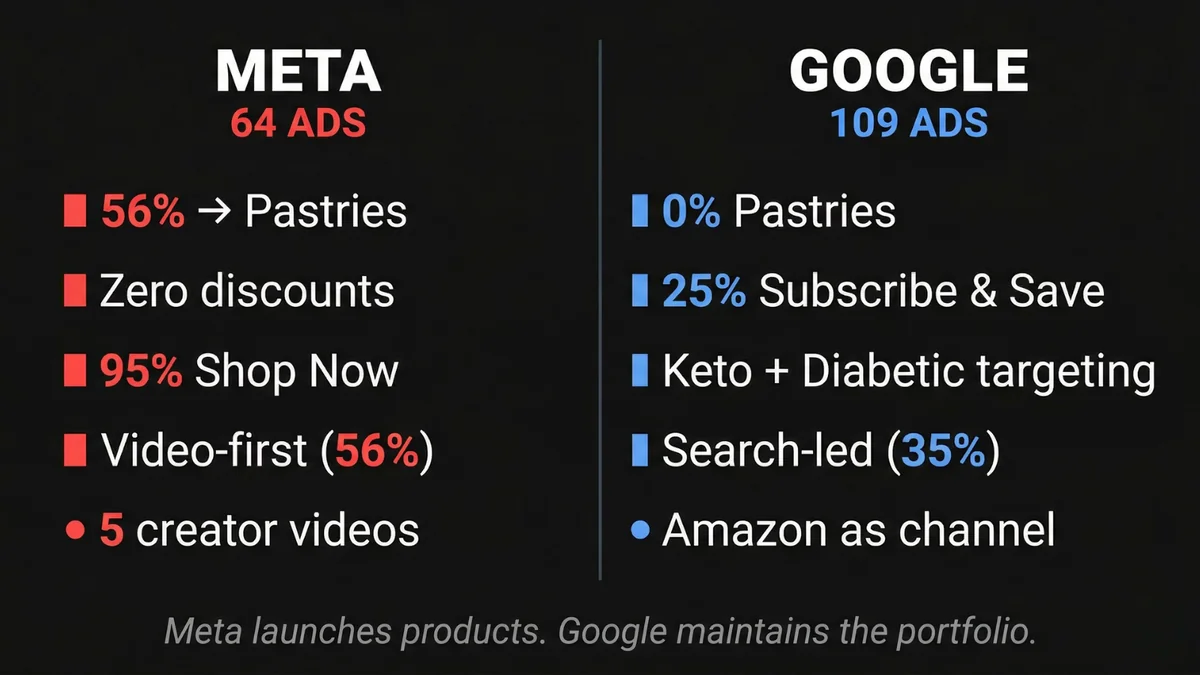
Meta launches products. Google maintains the portfolio. The Meta account is a launch vehicle - 56% of it appeared in the last three weeks to push a brand-new product. The Google account is the steady-state machine that keeps cereal, granola, and treats in front of people who are already searching for those categories.
The health positioning splits by platform. On Meta, it’s protein + fiber + zero sugar. On Google, it’s protein + keto + diabetic-friendly + blood sugar. Google captures specific health search intents that Meta’s feed-based delivery can’t target. The audience on Google is searching “low sugar cereal for diabetics.” The audience on Meta is scrolling past a protein pastry video.
Discounts live on Google, full price lives on Meta. Meta builds brand perception at full price. Google converts intent with discount offers. This is consistent across the series - Graza, Little Sleepies, and now Magic Spoon all follow this pattern. I think it has to do with the psychology of each platform: you don’t want to train scroll-discovery audiences to expect deals, but you absolutely want to remove friction for someone who’s already typed in a search query.
Pastries are a Meta-only bet - for now. Zero pastry presence on Google is the most interesting finding across both platforms. The product launched January 2026. Meta ads started March 3. Google has had nothing. I think Google pastry ads are coming - the search intent for “protein pastries” and “high protein toaster pastries” probably isn’t mature enough yet. Meta builds the category awareness. Google captures the search demand once it exists. But that’s interpretation, not data.
The Pattern.
- Magic Spoon runs 109 Google ads spanning a full year - but only 27 are currently active
- Video dominates at 60.6%, but most video is brand-level awareness. Search/text ads carry the product-specific positioning
- Zero Protein Pastry ads on Google - the entire March 2026 pastry blitz is Meta-only
- The Google account rotates product focus monthly: Granola (Spring 2025) → Treats (Apr–May 2025) → Brand video (Summer–Fall) → Cereal refresh (Winter)
- Search ads reveal health positioning that doesn’t exist on Meta: diabetic-friendly messaging, blood sugar language, keto-forward headlines
- 3 shopping ads drive to Amazon - same dual-marketplace strategy as Graza
- Subscribe & Save 25% is the primary discount lever. Meta has zero discounts
- 5 video ads leaked internal creative names: “MSP Trick Nostalgia 6s DL,” “MS CASUAL GABI 16x9” - naming conventions that weren’t replaced before going live
- Multiple typos in live ads: “Ceareal,” “Magicly,” “delicous” - plus variant domains (magickspoon, maglespoon)
- Almost entirely US-focused: 104 of 109 ads. Small Canada (9) and France (3) presence
- Nostalgia is the emotional thread throughout Google video: “Too old for cereal? We think not” appears across multiple months
The cross-platform story: Meta launches new products at full price with video and creator content. Google maintains the legacy portfolio with search ads, health-specific positioning, and subscription discounts. The two platforms serve completely different functions in the growth engine - and right now, Protein Pastries only exist on one of them.
What’s next: I’m tearing down a D2C brand every week. If there’s a brand you want me to break down, DM me on X.
Share this teardown
Read Next
Magic Spoon and their Entire Meta Ad Account Is 64 Ads.
A breakdown of Magic Spoon's 64 Meta ads, focusing on their lean but incredibly focused approach to user acquisition.
543 Google Ads. 166 Went Dark on the Same Day. Here's What Survived.
A breakdown of Fresh Clean Threads' Google Ads strategy. Why 166 ads went dark in 3 days, why 78% of active ads are Shopping, and how their Google strategy diverges from Meta.
Fresh Clean Threads Runs 150 Meta Ads. Only 17 Pieces of Copy Power All of Them.
150 active ads, 87% algorithm-driven, 17 unique copy blocks, and three simultaneous promo codes. Inside a $60M basics brand that trusts Meta's machine more than its own creative team.