Magic Spoon and their Entire Meta Ad Account Is 64 Ads.
Contents
Every brand in this series has had an ad account that matched its ambition.
Ridge Wallet had 273 Meta ads with 82% hand-crafted creative. RYZE Superfoods had 400 ads and copy survivors dating back 9 months. Little Sleepies had 350 ads running 37 collections through a single template. Even Graza, a brand that just entered Meta paid, launched 76 ads in 11 days.
Magic Spoon has 64.
Some context. Magic Spoon has raised $209M across 5 funding rounds. Celebrity investors include Shakira, Nas, Amy Schumer, Russell Westbrook, and The Chainsmokers. The brand is in over 30,000 stores nationwide - Walmart, Target, Costco, Whole Foods, Kroger. Founded in 2019 by Gabi Lewis and Greg Sewitz, it started as a DTC cereal brand that pitched itself as “childhood favorites, reimagined.” Fun fact: Andrew Benin, who founded Graza (the olive oil brand I covered in the previous teardown), worked at Magic Spoon before starting his own company. The D2C world is a small world.
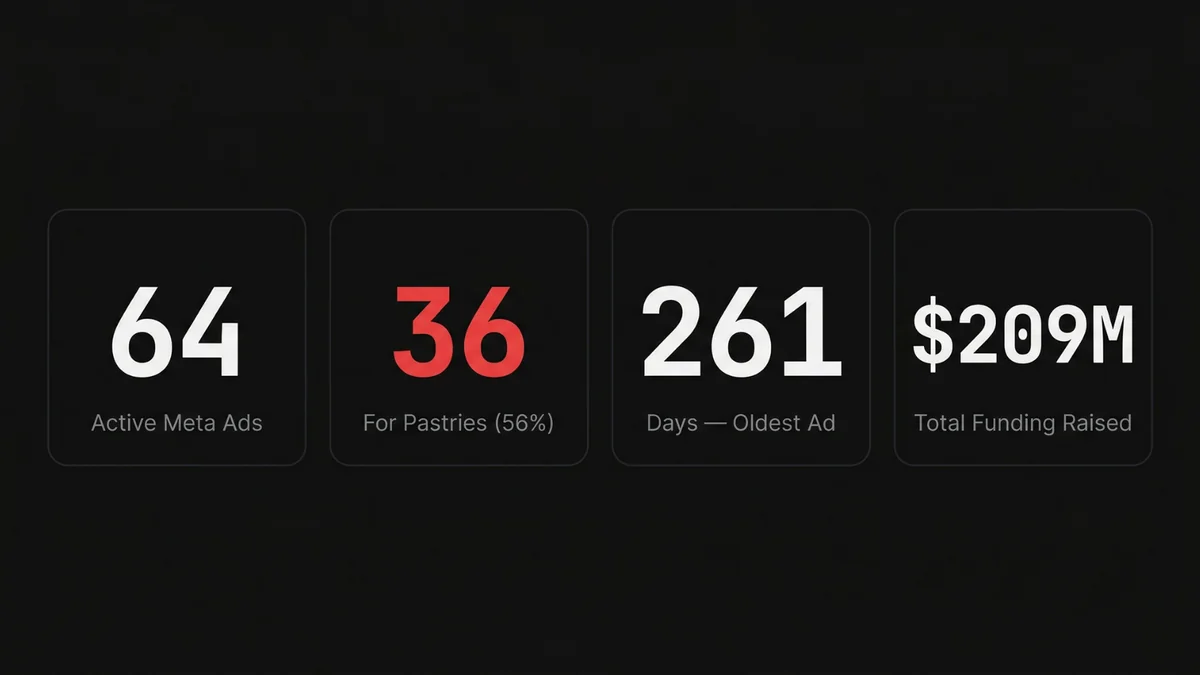
For a brand with that funding, that retail presence, and that celebrity backing - 64 Meta ads is remarkably lean. But when I dug into the data, the reason became clear. This isn’t a brand running Meta for broad awareness. 36 of those 64 ads - 56% of the entire account - are pushing a single product that launched two months ago.
Magic Spoon is betting the Meta account on Protein Pastries.
The Account Has Layers. The Oldest Ad Is 261 Days Old.
This isn’t an account that appeared overnight. It has history - just not a lot of it, and it’s concentrated in bursts.
July–August 2025: The Earliest Survivors
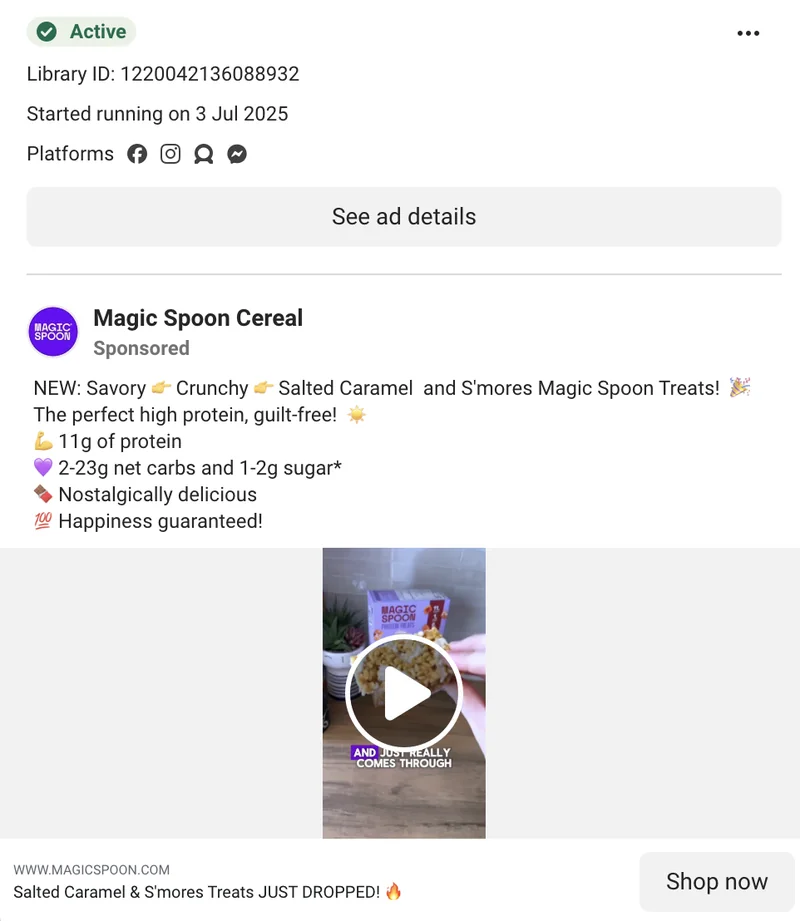
The oldest ad in the account launched on July 3, 2025 - 261 days ago. It’s a Treats video promoting Salted Caramel and S’mores Magic Spoon Treats. The URL points to a Replo Edge workspace test page. That’s significant: this ad was either a test or an early iteration that never got cleaned up. There’s one more from August 6, 2025 (227 days old) - another Treats video, same workspace setup.
Two ads from summer 2025. Both Treats. Both on test landing pages. Both still running.
November 2025: The Foundation
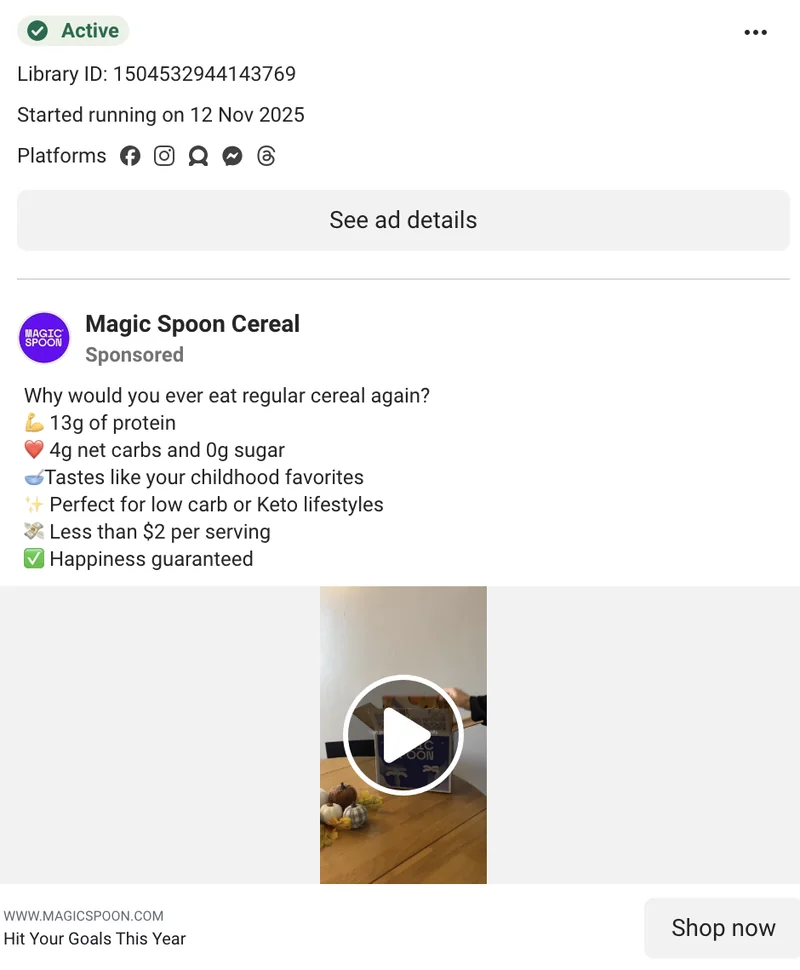
10 ads launched on November 12, 2025 - the real foundation of this account.
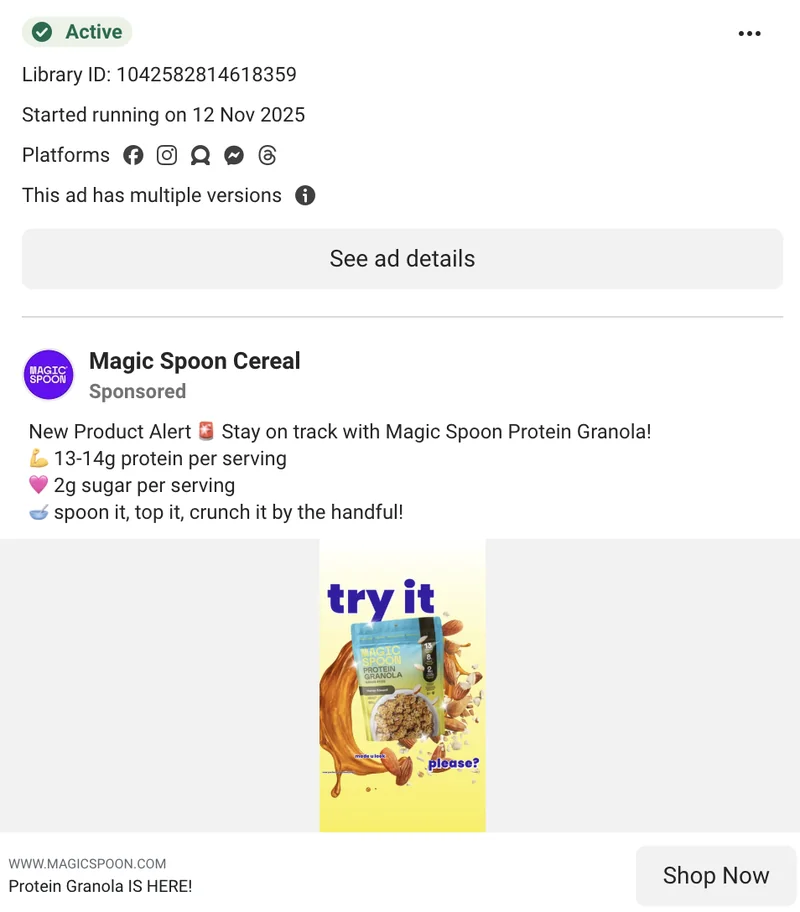
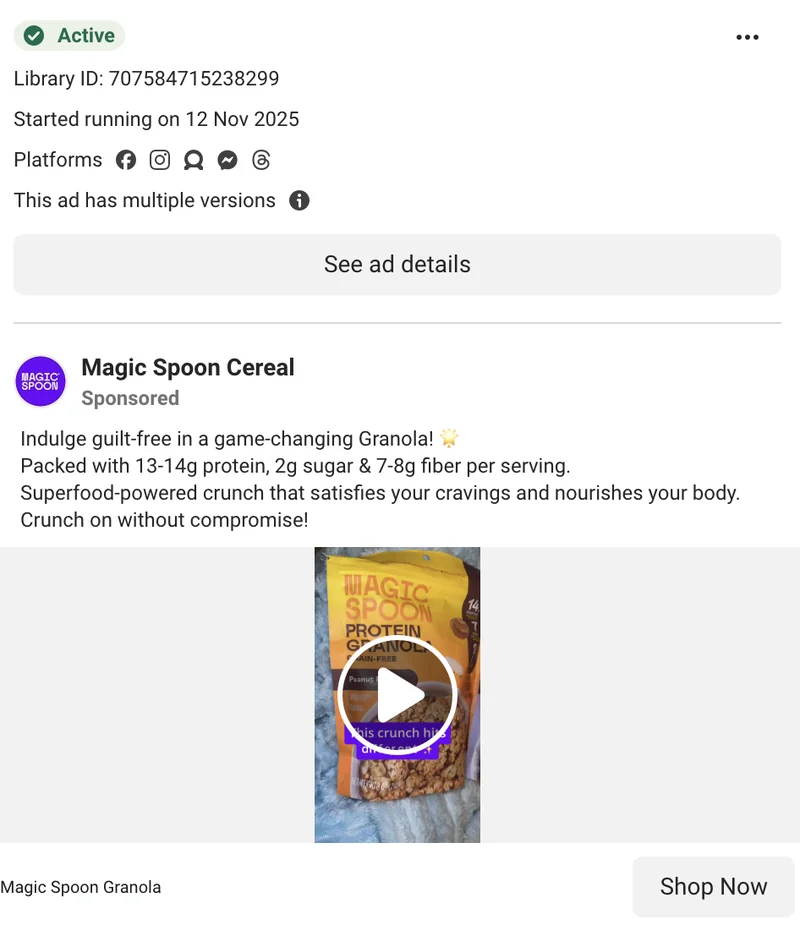
- 6 DCO ads for Protein Granola, pointing to
/pages/protein-granola-2025(plus one to a Replo Edge test URL) - 4 video ads for Cereal, pointing to
/pages/miss-cereal-25-v2
The Granola had launched in January 2025 at retail. It took 10 months for it to get a dedicated Meta push. The cereal videos use the “Why would you ever eat regular cereal again?” copy - which runs across 6 total video ads and is the longest-running cereal copy in the account.
February 2026: Marshmallow Cereal + More Cereal
8 ads. Two image ads launch the Marshmallow Cereal to /pages/marshmallow-cereal. One DCO pushes protein-fiber cereal. The rest are cereal videos and New Year’s messaging (“Remember those New Year Goals?🫡”).
March 2026: The Pastry Blitz
43 ads in a single month. 67% of the entire account launched in March 2026.
The breakdown by week:
- March 3–6: 13 ads (5 DCO + 8 video)
- March 11–12: 11 ads (2 DCO + 8 video + 1 image)
- March 17–20: 19 ads (10 DCO + 9 video)
All 36 pastry ads fall within this window. The remaining 7 are creator videos and cereal ads that coincidentally launched the same month.
The account reads like a product launch calendar: Treats → Granola → Cereal refresh → Marshmallow Cereal → Pastries. Each layer is still running. Nothing gets turned off.
36 of 64 Ads Push Protein Pastries. Every Single One Points to the Same Landing Page.
Protein Pastries were announced on January 21, 2026. Three flavors: Frosted Strawberry, Cinnamon Brown Sugar, and S’mores. 11g protein, 6g fiber, 3g total sugar per serving.
The first Meta ads appeared on March 3, 2026 - about six weeks after the PR announcement and retail launch at Target. Once they started, they didn’t stop.
All 36 pastry ads point to /pages/5-reasons-why-page. Every one. That URL has 79 total appearances in the data when you count card-level links too. It’s a dedicated landing page that frames the purchase decision as “here are 5 reasons to try this.” It’s not a product page. It’s not a collection page. It’s a persuasion page.
The Copy Structure
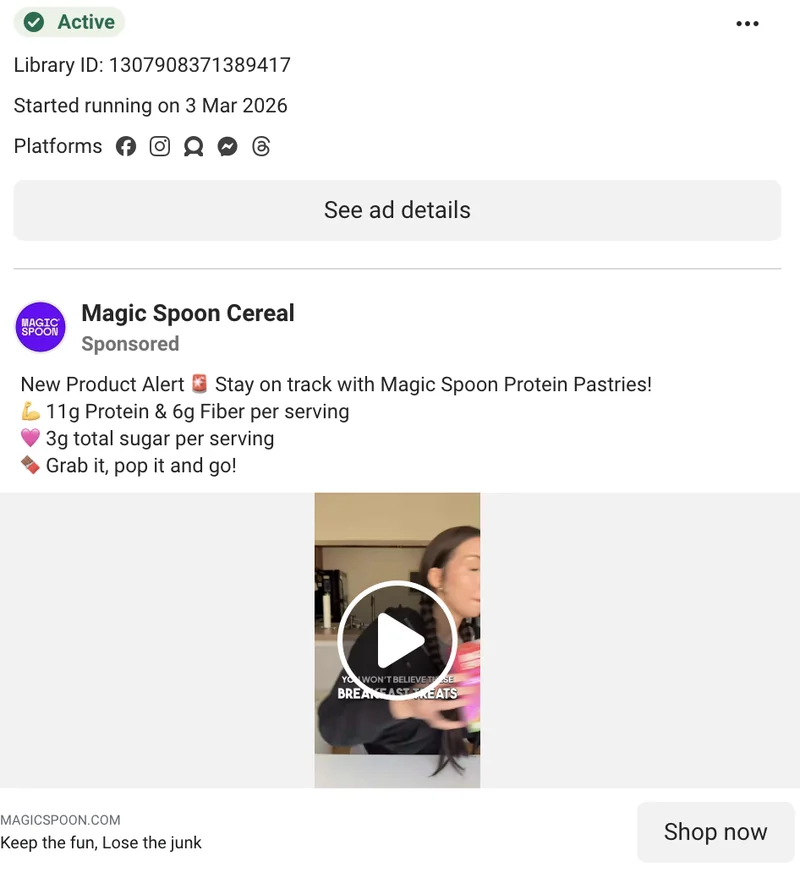
One body copy dominates the pastry push - running across 16 video ads:
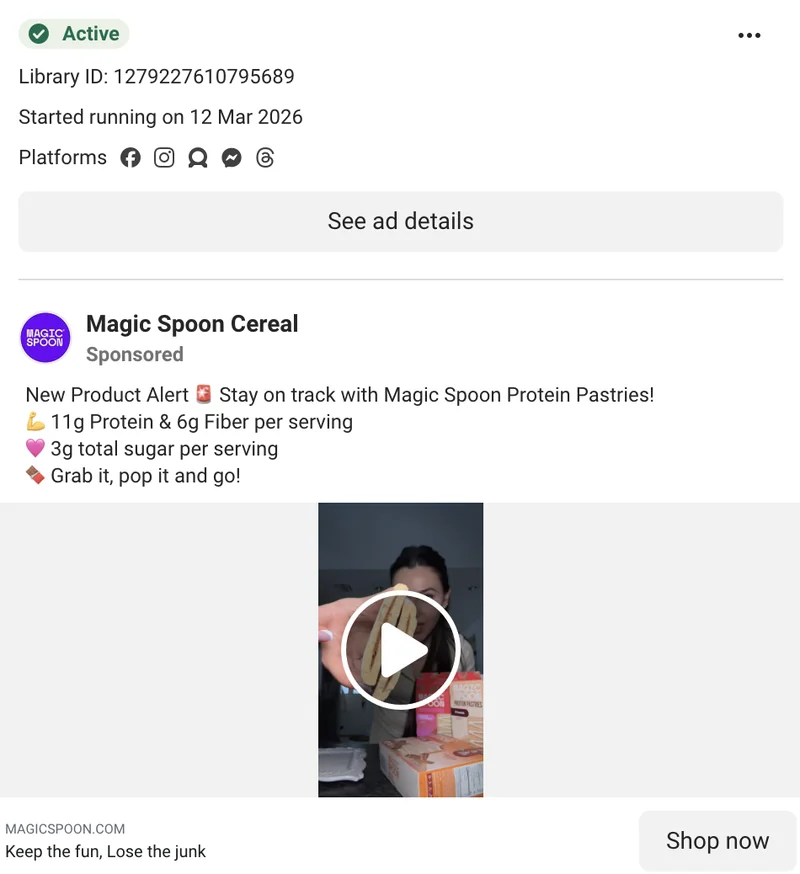
New Product Alert 🚨 Stay on track with Magic Spoon Protein Pastries! 💪 11g Protein & 6g Fiber per serving 🩷 3g total sugar per serving 🍫 Grab it, pop it and go!
Another take uses news framing: “BREAKING NEWS! 🚨 Introducing Magic Spoon Protein Pastries!” - treating a food product launch like a media event.
And then there’s a lifestyle angle running on 2 video ads: “Sometimes the slopes require a boost, which is why you should always travel with a Magic Spoon Protein Pastry!” - situational, active-lifestyle positioning.
The format split for pastry ads: 18 video, 17 DCO, 1 image. The brand leans into video for new product education, then backs it up with DCO for the algorithm to optimize.
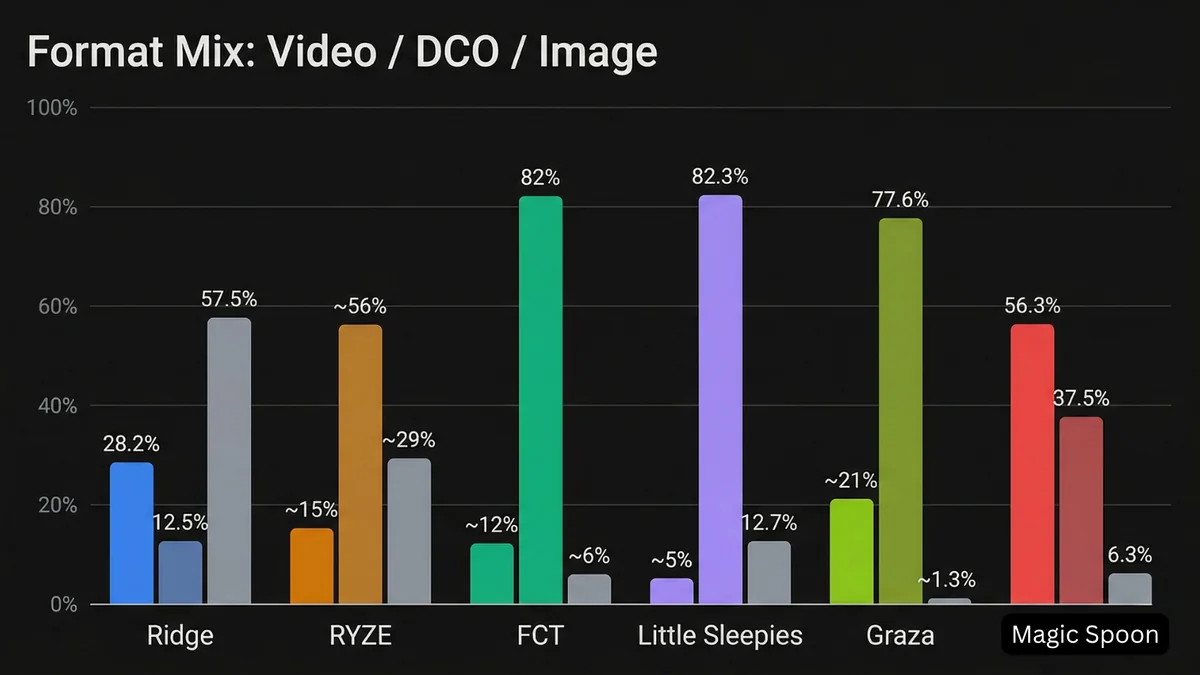
56.3% Video. The Most Video-Heavy Account in This Series.
36 video ads. 24 DCO. 4 image.
Every brand in this series has leaned on a different format mix. Ridge was image-heavy at 57.5%. Fresh Clean Threads was 82% DCO. Little Sleepies was 82.3% DCO. RYZE was DCO-dominant. Graza was 77.6% DCO.
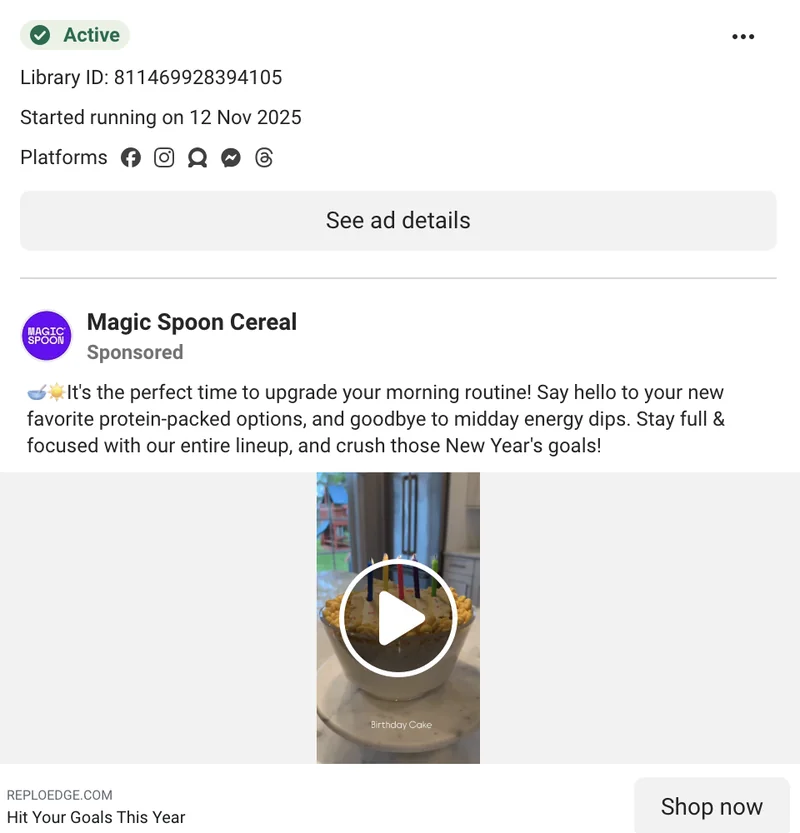
Magic Spoon breaks the pattern. Video runs 56.3% of the account - the highest ratio I’ve seen in any brand I’ve covered.
The video content splits into two categories:
Brand-Produced Product Ads (31 videos)
Pastries, cereal, treats - produced by the brand or agency, with structured copy in the body text. Professional product showcases. These run across all platforms.
UGC/Creator Content (5 videos)
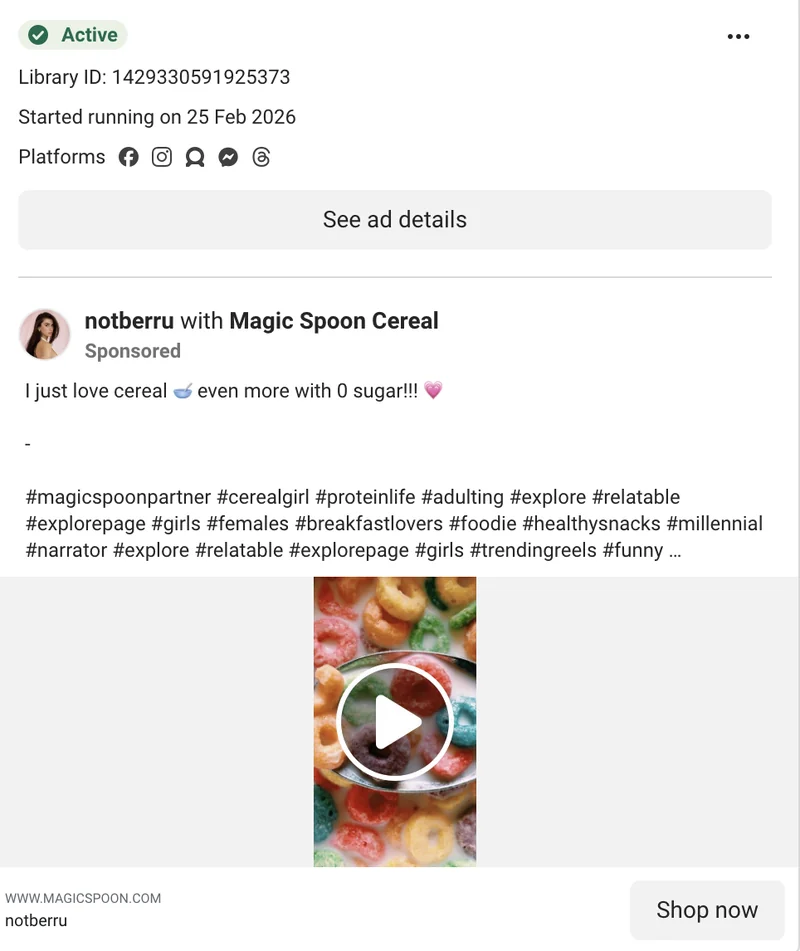
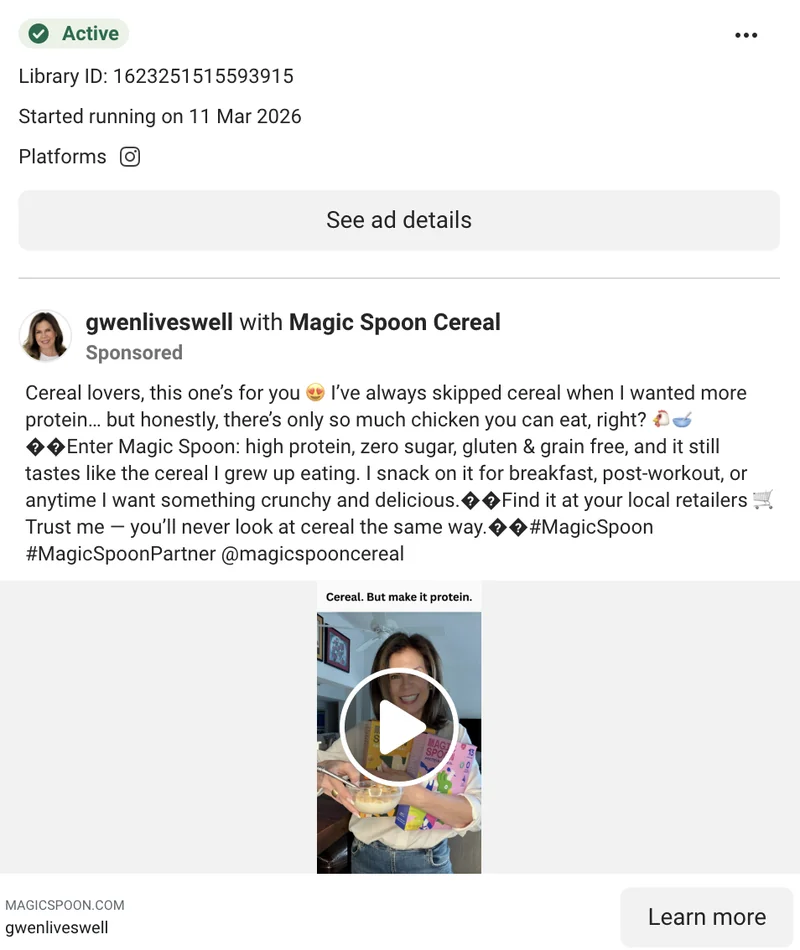
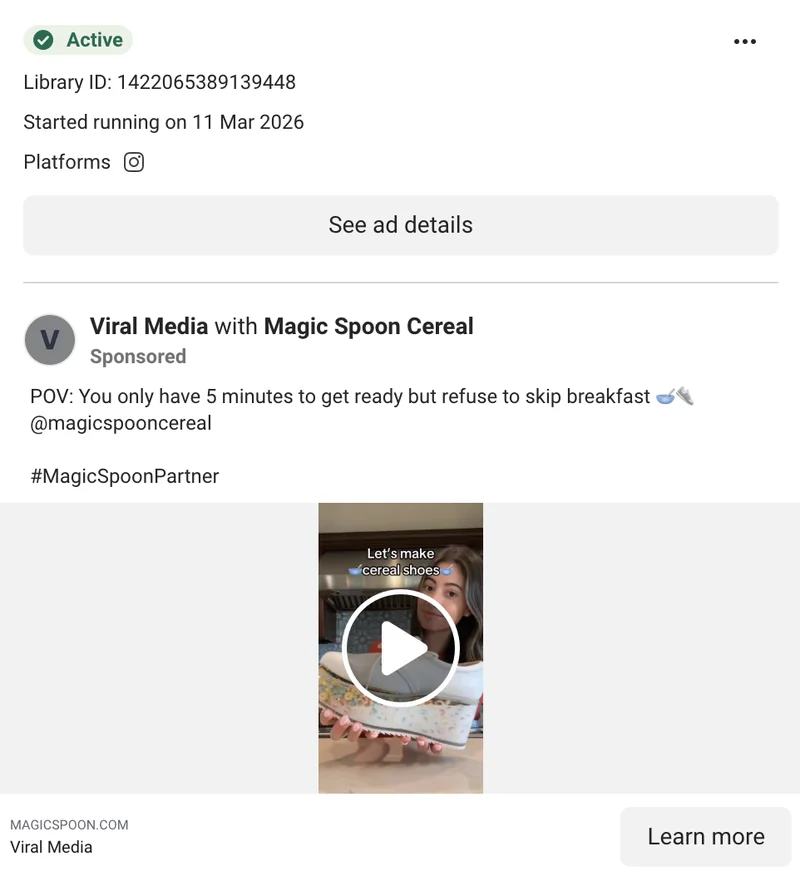
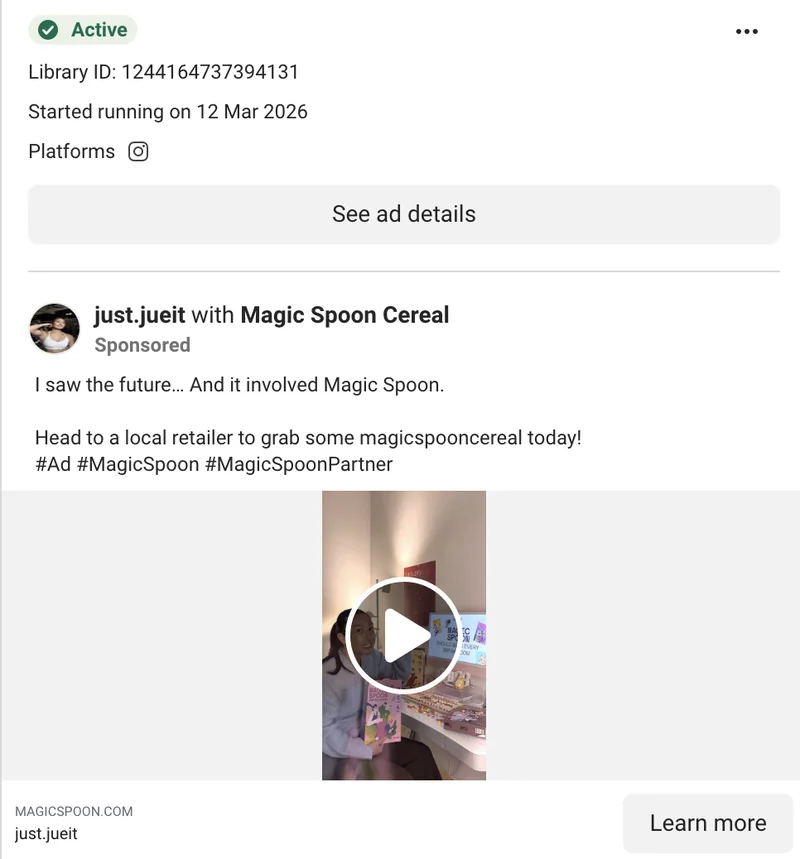
This is where it gets interesting. Five ads carry #MagicSpoonPartner or #Ad markers. Three of them run on Instagram only - the only Instagram-exclusive ads in the entire account. All five are branded content (Meta’s official partnership flag is turned on).
And every single one of them promotes cereal. Not pastries.
The paid dollars go to pastries. The creator dollars go to cereal. Two parallel strategies. I think the creator content keeps the cereal brand alive in feed while the paid budget pushes the new product hard. But the data doesn’t confirm that - it’s just the pattern I see.
24 DCO Ads. 58 Cards. 8 Unique Messages. The Tightest Copy Footprint in the Series.
The DCO setup follows the same `{{product.brand}}` template as every brand I’ve covered. But the scale here is minimal.
Little Sleepies: 288 DCO ads, 927 cards, 37 collections, 1 template. Graza: 59 DCO ads, 127 cards, 19 unique card bodies. Magic Spoon: 24 DCO ads, 58 cards, 8 unique card bodies.
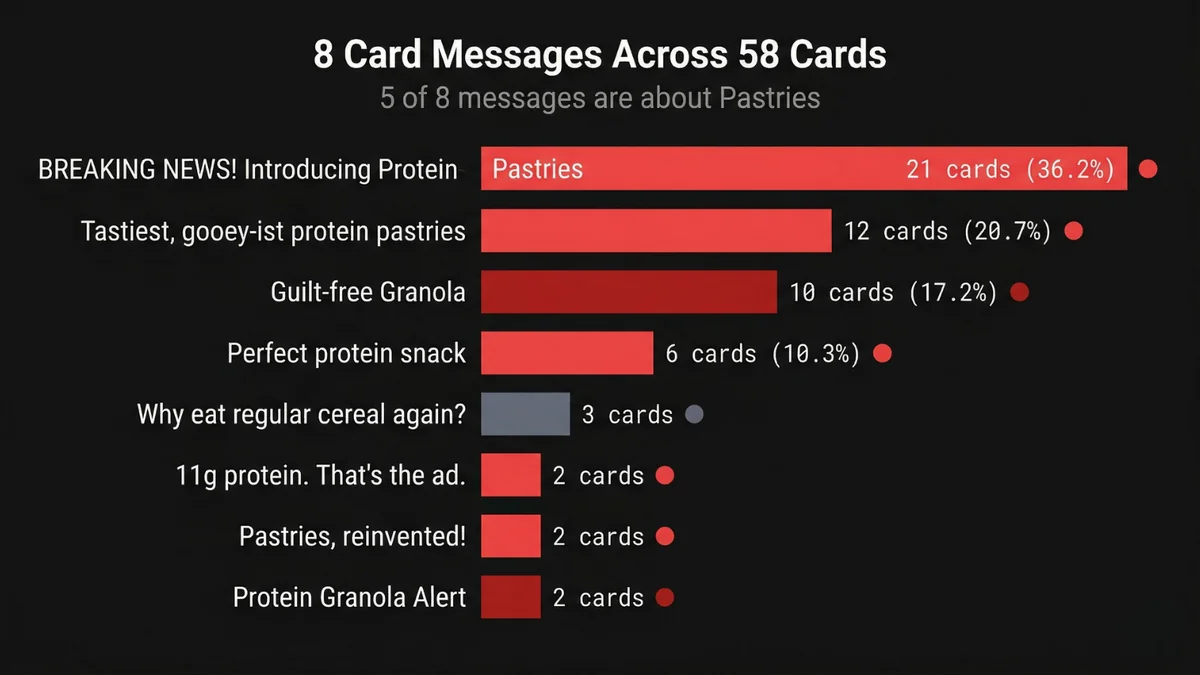
Eight messages. That’s it. Here’s how they distribute:
- “BREAKING NEWS! 🚨 Introducing Magic Spoon Protein Pastries!” - 21 cards (36.2%). The dominant message.
- “We’ve whipped up the tastiest, gooey-ist, most delicious protein pastries” - 12 cards (20.7%)
- “Indulge guilt-free in a game-changing Granola!” - 10 cards (17.2%)
- “Congrats! 🎉 You just found the perfect protein snack” - 6 cards (10.3%)
- “Why would you ever eat regular cereal again?” - 3 cards
- “11g protein. 3g sugar. 6g fiber. No artificial anything. It’s a protein pastry. That’s it. That’s the ad.” - 2 cards
- “Magic Spoon Protein Pastries are pastries, reinvented!” - 2 cards
- “New Product Alert 🚨 Stay on track with Magic Spoon Protein Granola!” - 2 cards
5 of 8 card messages are about pastries. 2 are about granola. 1 is about cereal. The DCO machine is a pastry machine.
Card uniformity: 100%. Every DCO ad sends all its cards to the same product URL. No mixed-product carousels. Same as Little Sleepies, Graza, FCT, and every brand in this series.
The most common card title: “New Product Alert 🚨” - appearing on 41 of 58 cards (70.7%). That’s not a headline. That’s an alarm bell, used 41 times.
7 Landing Pages. One Gets 79 Appearances.
Every product has its own dedicated landing page. No ads send to a general store page. No ads send to a collection page. Here’s the map:
/pages/5-reasons-why-page- 79 appearances (Pastries)/pages/protein-granola-2025- 15 appearances (Granola)/pages/miss-cereal-25-v2- 9 appearances (Cereal)/pages/classic-favorites-2025-v2- 5 appearances (Classic Cereal lineup)/pages/protein-fiber-cereal- 4 appearances (Fiber Cereal)/pages/marshmallow-cereal- 2 appearances (Marshmallow launch)- Homepage (
magicspoon.com/) - 3 appearances (Creator videos only)
The naming convention tells you something. The cereal page is versioned: “miss-cereal-25-v2” and “classic-favorites-2025-v2”. These have been iterated on. The pastry page isn’t versioned - maybe it’s still v1, or maybe it’s named differently because it’s structured as a “reasons why” educational format rather than a product page.
The Replo Edge Test URLs
Three ads point to reploedge.com/magic-spoon-workspace/ paths - one for Classic Favorites, one for Cereal, one for Granola. All have “test” in the URL. Replo Edge is a landing page builder. Magic Spoon is actively A/B testing landing page variants for different products through a dedicated tool.
Another thing I noticed: magicspoon-launch.com appears in 3 ad captions. A separate domain for launches, distinct from the main magicspoon.com. The brand runs multiple domains for different funnel stages.
Protein Appears in 90.6% of Ads. But the Real Story Is What’s Rising and What’s Fading.
Here’s how the messaging themes map across all 64 ads:
- Protein - 90.6% (58/64). The universal constant. Every product leads with protein.
- Sugar (low/zero) - 75% (48/64). The second pillar.
- Fiber - 51.6% (33/64). This is the newcomer.
- Low carb/keto - 17.2% (11/64). This used to be the primary positioning.
- Nostalgia/childhood - 12.5% (8/64). The emotional hook.
- Guilt-free - 9.4% (6/64). Treat/granola language.
- Goals/New Year - 7.8% (5/64). Seasonal, expiring.
- Clean label - 3.1% (2/64). Small but sharp.
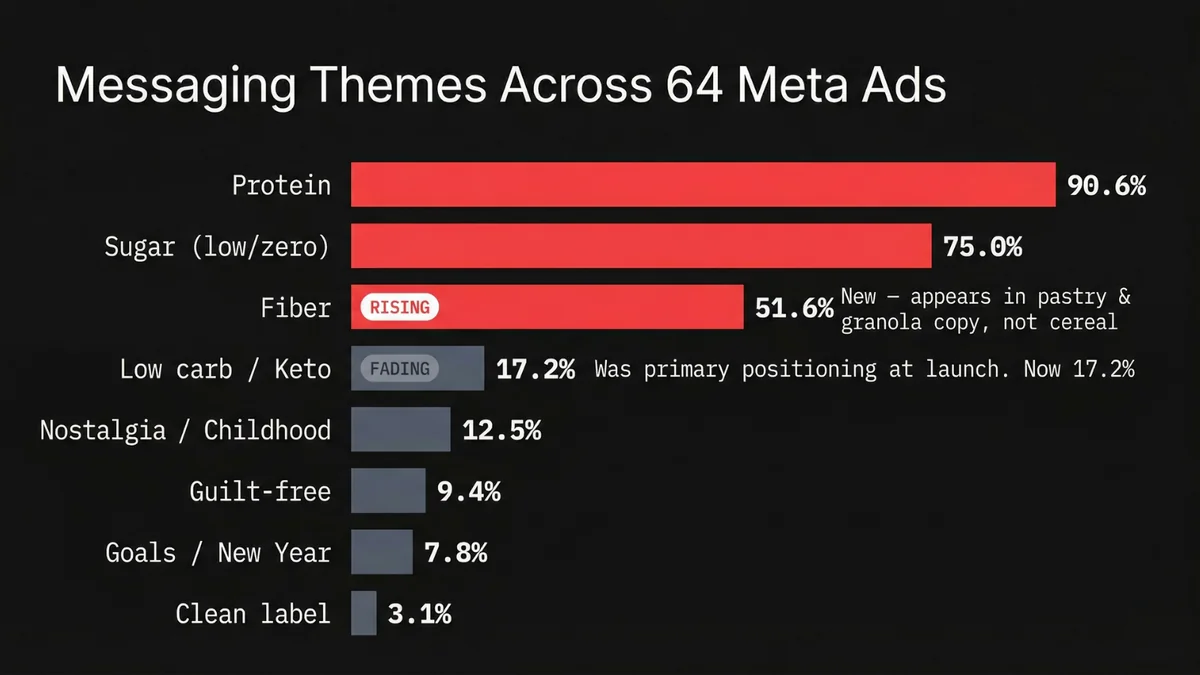
The fiber story is interesting. It appears almost exclusively in pastry and granola copy - not cereal. Cereal leads with protein and zero sugar. Pastries lead with protein AND fiber. Granola leads with protein and fiber too. As Magic Spoon extends beyond cereal into baked goods and granola, fiber becomes the new functional claim that separates those products from the original cereal.
The keto positioning at 17.2% is a fraction of what the brand was known for at launch. When Magic Spoon first sold cereal in 2019, “keto-friendly” was the headline. Now it’s buried in bullet points, if it appears at all. The Google ads still use it more aggressively - I’ll cover that in Part 2.
The Clean Label Ad
One ad stands out from everything else in the account:
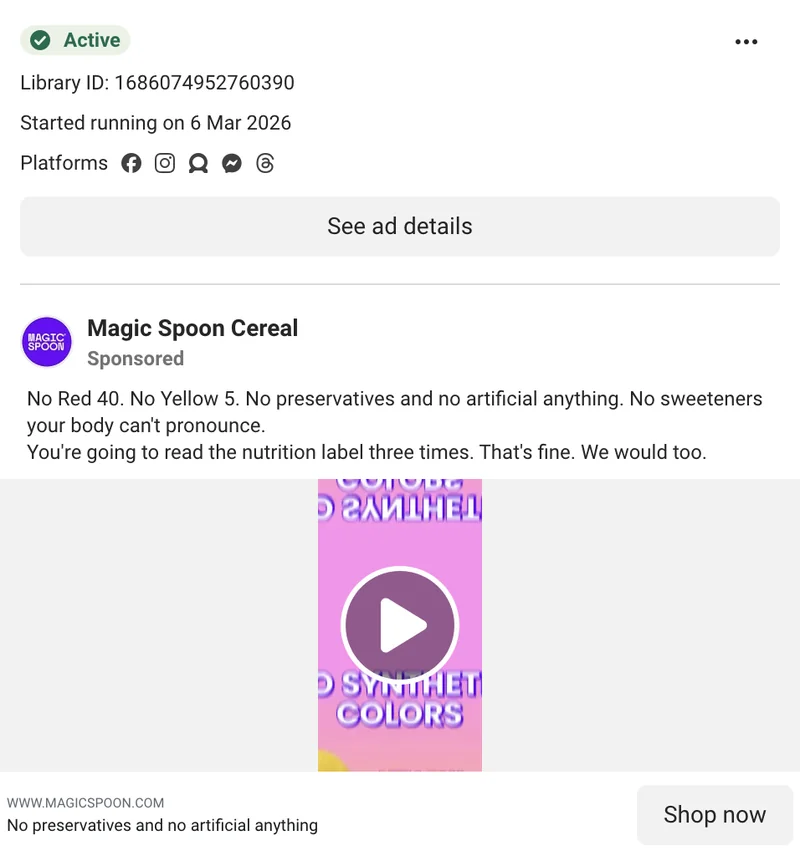
No Red 40. No Yellow 5. No preservatives and no artificial anything. No sweeteners your body can’t pronounce. You’re going to read the nutrition label three times. That’s fine. We would too.
This is the only ad in the account that leads with what the product doesn’t contain rather than what it does. It’s a negation-led pitch - “no, no, no, no” - that reads like a response to consumer anxiety about synthetic dyes and clean labels. In a category where Red 40 discourse has gone mainstream, this copy hits differently. It runs as a video ad pointing to the cereal page, not the pastry page.
The Testimonial in the Link Description
Four pastry DCO ads carry a customer testimonial in the link description field: “My wife has gluten sensitivity issues, and losing baked goods, pastries, bread, etc. has really been demoralizing to her. So happy that Magic Spoon found a way to make GF cereal with great flavors!” Social proof embedded in metadata. Most brands leave this field empty or use it for generic copy. Magic Spoon uses it to tell a real person’s story.
What I Didn’t Find.
No discounts. Zero promo codes, zero percentage-off offers, zero free shipping mentions on Meta. The Google account has 10% codes and 25% subscription discounts. Meta is running at full price.
95.3% “Shop Now.” 61 of 64 ads. Only 3 use “Learn More.” Graza was 52.6% “Learn More” - still educating. Magic Spoon is in conversion mode. They’ve moved past the “let me explain this product” phase.
Full platform distribution. 100% Instagram, 95.3% Facebook/Audience Network/Messenger, 92.2% Threads. Keeps Audience Network on - no brand safety concerns for a cereal brand, same as Graza, opposite of Little Sleepies.
Zero AI-flagged content. Same as every brand in the series.
No country targeting data. All 64 ads show empty on country delivery. Can’t tell if this is US-only or broader.
113,938 page likes. For a brand with $209M in funding and 30,000+ retail locations, that’s moderate. Little Sleepies has 371K. Ridge has 366K. Magic Spoon grew through retail expansion, PR (Forbes called it “the future of cereal,” TIME named it a Top 100 Invention of 2019), and influencer seeding - not Facebook organic.
No TikTok or LinkedIn ad library presence found.
The Pattern.
- Magic Spoon runs 64 Meta ads - the leanest account in this series for the best-funded brand
- 56% of those ads push Protein Pastries, a product that launched January 2026. The first Meta ads appeared March 3, six weeks after retail launch
- Every pastry ad points to a single “5 reasons why” landing page (79 total appearances). One URL, one conversion funnel
- Video dominates at 56.3% - the most video-heavy account in the series. 5 UGC/creator videos exist, but they promote cereal, not pastries
- 24 DCO ads use just 8 unique card bodies across 58 cards. 100% card uniformity. The tightest copy footprint yet
- Messaging is shifting: protein remains universal (90.6%), but fiber is the rising claim (51.6%) tied to pastries and granola, while keto is fading (17.2%)
- The account has layered launches from July 2025 to March 2026: Treats → Granola → Cereal → Marshmallow → Pastries. Nothing gets turned off
- Active landing page testing via Replo Edge workspace URLs. Versioned landing pages for cereal (v2). A separate launch domain (magicspoon-launch.com)
- Zero discounts on Meta. 95.3% “Shop Now.” Full conversion mode at full price
- One clean label ad (“No Red 40. No Yellow 5.”) - a positioning statement for a category increasingly defined by what it removes
What’s next: The Google account tells a different story. 109 ads spanning a full year, Amazon as a channel, a diabetic-friendly positioning that doesn’t exist on Meta, and video internal names that leaked the creative team’s naming conventions into the ad data. That’s Part 2.
I’m tearing down a D2C brand every week. If there’s a brand you want me to break down, DM me on X.
Share this teardown
Read Next
Magic Spoon Has 109 Google Ads Spanning a Full Year. Protein Pastries Don't Exist on This Platform Yet.
A deep dive into Magic Spoon's Google Ads account, exploring their legacy product rotation, Amazon strategy, and unique health priority.
543 Google Ads. 166 Went Dark on the Same Day. Here's What Survived.
A breakdown of Fresh Clean Threads' Google Ads strategy. Why 166 ads went dark in 3 days, why 78% of active ads are Shopping, and how their Google strategy diverges from Meta.
Fresh Clean Threads Runs 150 Meta Ads. Only 17 Pieces of Copy Power All of Them.
150 active ads, 87% algorithm-driven, 17 unique copy blocks, and three simultaneous promo codes. Inside a $60M basics brand that trusts Meta's machine more than its own creative team.