Summer Fridays Won't Discount on Meta. On Google They Run a 20%-Off Sale.
Contents
In the last teardown I wrote that Summer Fridays runs zero discounts on Meta - no sales, no promo codes, just a 15% subscription offer. That holds for Meta. So when I scraped their Google account, the first thing the data put in front of me was a creative that read "Take 20% Off Everything - Use Code: BDAY - Our Biggest Sale Of The Year."
Same brand, same window, and the discount discipline was gone.
I went through 399 Summer Fridays creatives in the Google Ads Transparency Center, the same brand over the same period as the Meta scrape. Almost everything that defined the Meta account - the lip-first focus, the no-discount posture, the brand-new launch dates, the US targeting - either flips or disappears here. What follows is everything the Google data showed me, set against the Meta picture wherever the two line up. One caveat: Google's US transparency exposes no spend, and 184 of the 399 creatives returned readable text, so the copy findings rest on those 184 while the format and date counts cover all 399.
The format inverts: text on Google, visuals on Meta
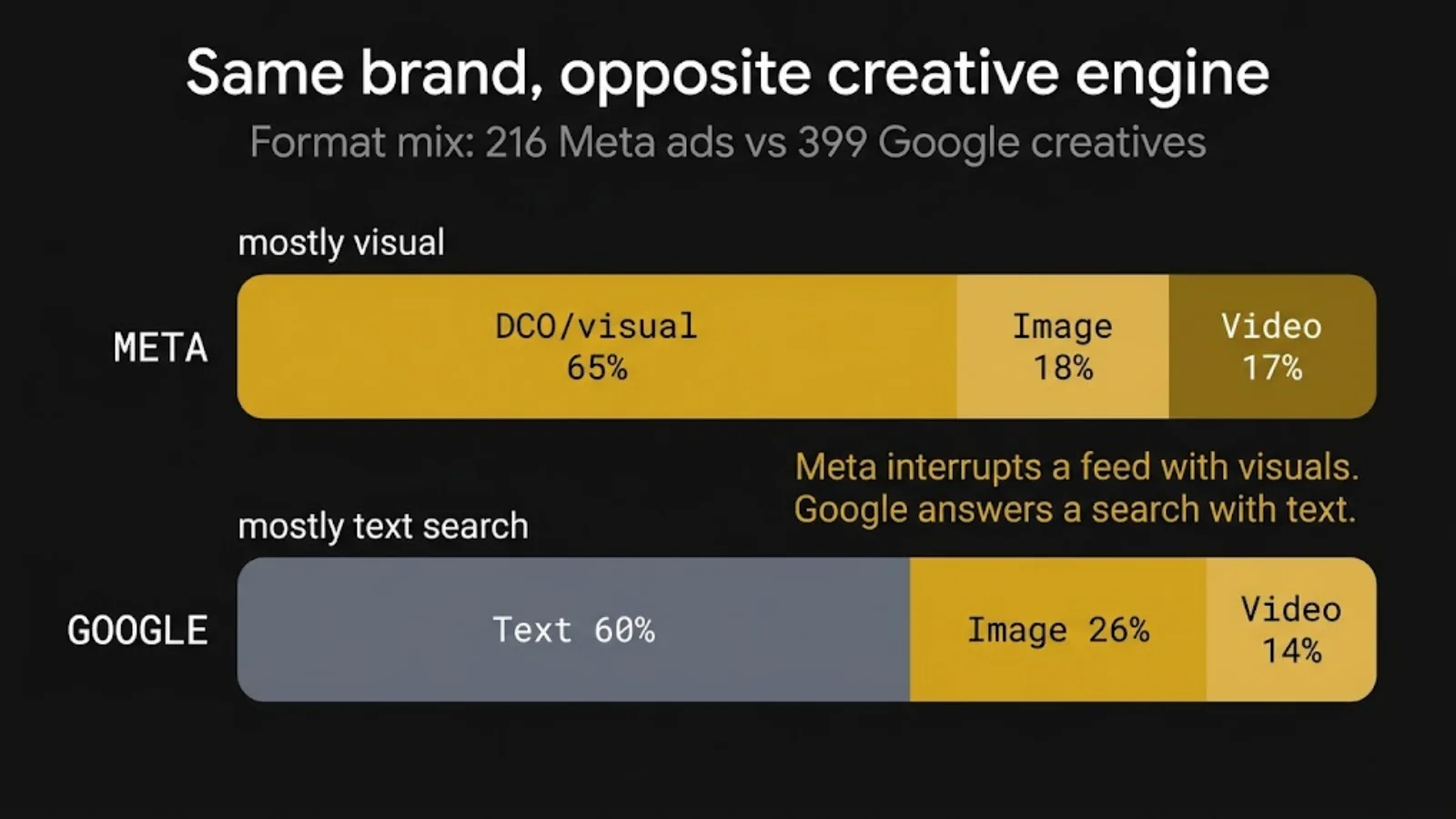
On Meta, two-thirds of the account was DCO and the rest was image and video. It was a visual account.
Google is the opposite. Of the 399 creatives, 241 are text (60%), 103 are image (26%), and 55 are video (14%). The same brand that leads with dynamic catalog visuals on Meta leads with search text on Google. My read is the obvious one - meet attention where it lives, interrupt a feed with imagery, answer a search with words.
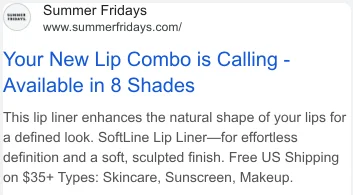
The Jet Lag Mask that's missing from Meta is the Google backbone
This is the reversal that surprised me most.
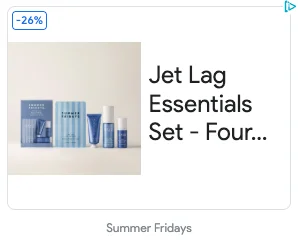
On Meta, the Jet Lag franchise that built the brand was down to 14 ads. On Google, it's the oldest, most durable thing they run. The single oldest readable creative is a Jet Lag Mask text ad first shown May 15, 2023 - 1,077 days before my scrape. Jet Lag and eye-care keywords dominate the readable Google copy. Where the firstShown dates exist, the median Google creative is 292 days old.
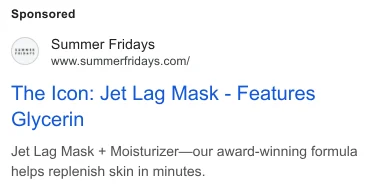
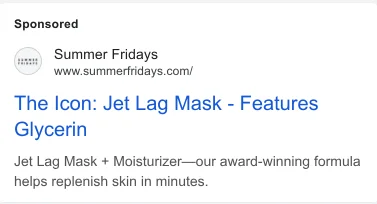
So the two accounts split the catalog by job. Meta chases new-flavor demand with fresh creative. Google harvests years of accumulated brand and category search intent for the hero skincare line. The product that's nearly absent on one platform is the foundation of the other. (Google's library also retains older creatives, so age here partly reflects retention - but a 2023 first-shown date on an ad still surfacing is a genuinely long run.)
The discounts that didn't exist on Meta
The cleanest contradiction between the two accounts is price.
Meta ran no sales and no codes across 216 ads. Google is full of them:
- "Take 20% Off Everything* - Use Code: BDAY - Our Biggest Sale Of The Year"
- "20% Off Sitewide - 20% Off Until 3.10"
- "Free Shipping On Orders $35+"
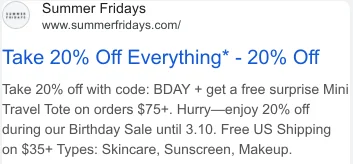
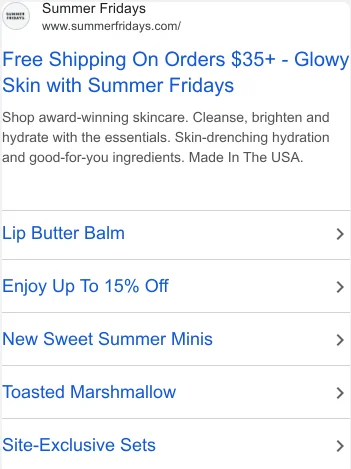
So inside a single window, the same brand protected full price on Meta and ran a sitewide 20%-off Birthday Sale with a promo code on Google. My hunch is that Meta carries the brand-building, drop-driven, premium face where a visible discount would cheapen the scarcity story, while Google search catches people already shopping, where a code closes them. The numbers only prove the split exists - the reasoning is mine, and you may read it differently. I've seen the same platform split on GORUCK (0% off on Meta, up to 53% off on Google) and RYZE (25% on Meta, 40% on Google), so it's starting to look like a broader D2C habit.
Google answers problems Meta never raises
On Meta, Summer Fridays sold flavor and mood. On Google, a cluster of search ads sells solutions to skin problems.
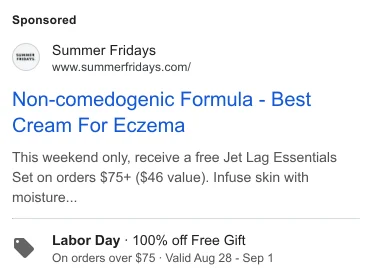
The headlines read like answers to typed queries: "Skin Soothing Formulas - Sensitive Skincare," "Non-comedogenic Formula - Best Cream For Eczema," and "Formulated for Tired Eyes. Brighten, de-puff & firm." None of this language appears anywhere in the Meta account. Same products, but Google positions them against eczema, sensitive skin, and tired eyes - the words people actually search when something's wrong.
The fragrance launch runs on both platforms, in opposite registers
Sunlit Vanilla is the one product getting full-funnel treatment everywhere.
On Meta it ran as creator video - lowercase, hashtags, "available march 17th." On Google it runs as search and as a waitlist play: "Your New Signature Scent - Sunlit Vanilla Eau de Parfum" and "Sign Up to Be the First to Try." Same launch, two completely different mechanics - borrowed creator credibility on Meta, captured intent and an email signup on Google.
They left their internal creative names in the ads
This is the kind of thing you only catch reading the creatives closely.
The OCR pulled internal file names straight off the Google video thumbnails, because they were baked into the asset. One reads "SF HERO 15S VERT4K LOGO" - which parses as Summer Fridays, hero cut, 15 seconds, vertical 4K, logo end-card. It's a peek at the naming convention behind the production pipeline, the same kind of leak I found in BYLT's creator-named video files and the MUD\WTR account.
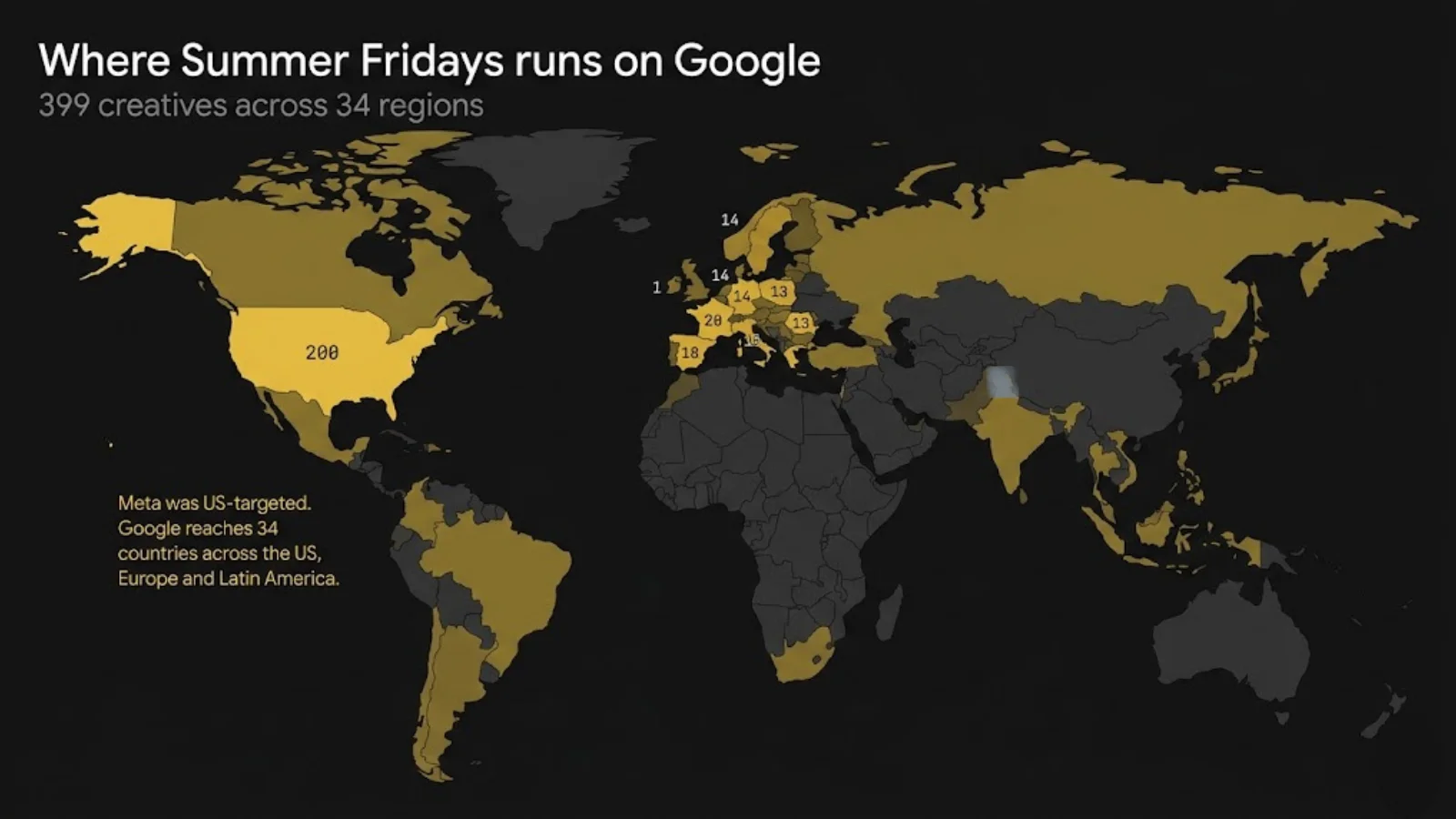
The map widens from the US to 34 countries
Meta was effectively a US-targeted account. Google is not.
Across the region-tracked creatives, Summer Fridays ads appear in 34 distinct regions. The US is the clear anchor (200), then a European and Latin American tail: France (20), Spain (18), Italy (15), Germany (14), Romania (13), Greece, Poland, Sweden, Norway, Ireland, Mexico, and Brazil among them. Google is the surface where the brand reaches outside the US at all.
The April refresh is mirrored - the relaunch was cross-platform
The Meta account was 80% rebuilt in April 2026. Google shows the same wave.
167 of 399 creatives have a last-shown date in April 2026, and 159 (40%) were last shown within two weeks of my scrape - 101 text, 40 image, 18 video make up the currently-live set, with the rest historical creatives Google retains. So the April surge wasn't a Meta-only event. Both accounts were refreshed at once, which reads as one coordinated spring push across platforms rather than two separate decisions.
Meta vs Google, side by side
| Dimension | Meta (216 active ads) | Google (399 creatives) |
|---|---|---|
| Dominant format | 65% DCO / visual | 60% text search |
| Hero product | Lip Butter Balm (flavor drops) | Jet Lag Mask / eye-care |
| Oldest ad | 180 days | 1,077 days (since May 2023) |
| Posture | New-launch hype + scarcity | Evergreen intent harvesting |
| Discounts | None - only Subscribe + Save 15% | 20% off "BDAY" code, sitewide sale, free shipping $35+ |
| Skincare angle | Flavor & mood | Eczema / sensitive skin / tired eyes |
| Fragrance launch | Creator/UGC video → Sephora | Search + "be first to try" waitlist |
| Geography | US-targeted | 34 regions (US + EU + LatAm) |
| CTA | 100% "Shop now" | Search-native, no single CTA |
What the data showed
- 399 Google creatives: 60% text, 26% image, 14% video - the inverse of Meta's visual mix.
- The Jet Lag Mask is the oldest, most evergreen ad on Google (first shown May 2023, 1,077 days), the same product that's nearly absent on Meta. Median Google creative age is 292 days.
- Meta ran zero discounts. Google runs a 20%-off "BDAY" Birthday Sale, a sitewide sale, and free shipping on $35+. Same brand, same window.
- Google sells skin problems Meta never names - "Best Cream For Eczema," "Sensitive Skincare," "Formulated for Tired Eyes."
- The Sunlit Vanilla fragrance launch runs on both platforms in opposite registers: creator video on Meta, search + a "be the first to try" waitlist on Google.
- Internal creative file names leaked into the Google video OCR ("SF HERO 15S VERT4K LOGO").
- Google reaches 34 regions (US anchor, then a EU and LatAm tail); Meta was US-targeted.
- The April 2026 refresh is mirrored - 167 creatives last shown in April, 159 live within two weeks of scrape - so the relaunch was a coordinated cross-platform push.
- Caveats: no spend or impression data on either platform, and the Google copy analysis rests on the 184 of 399 creatives with readable OCR.
Put the two teardowns next to each other and one picture forms. Summer Fridays isn't running one strategy across two platforms. It's running two. Meta is the new, drop-driven, no-discount, lip-and-fragrance face built to interrupt a feed. Google is the mature, evergreen, discount-ready, skincare-and-search face built to answer intent. Neither account is the whole brand. You only see Summer Fridays once you read both.
I'm tearing down a D2C brand every week. If there's a brand you want me to break down, DM me on X.
Share this teardown
Read Next
I Scraped 216 Summer Fridays Ads. It's a Lip Company Now.
216 Summer Fridays Meta ads, 80% younger than a month. The Jet Lag Mask is in 14 of them. Lip Butter Balm runs 84. Zero discounts, 14 creator videos for the new perfume.
Cozy Earth Hides the Word "Bamboo" on Meta and Shouts It on Google
418 Google creatives: luxury in 61% of copy, bamboo in 35%, Oprah in 6 search ads, a 10-year warranty Meta never mentioned, and Black Friday discounts up to 40%.
I Scraped 369 Cozy Earth Ads. The Whole Account Points at One Sunday in May.
369 Cozy Earth Meta ads, every one of them from 2026. 58% built by the algorithm, a third pointing at Mother's Day, zero Oprah mentions, and a $5,000 sweepstakes running quietly underneath.