I Scraped 216 Summer Fridays Ads. It's a Lip Company Now.
Contents
Summer Fridays built its name on one product: the Jet Lag Mask. A face mask that went so viral it became the thing the brand is known for, the hero that turned two beauty influencers into a real company.
So when I scraped their 216 active Meta ads, I expected skincare. What I kept running into was lips.
Of the 216 ads, the Jet Lag franchise that built the brand shows up in just 14. The rest of the account is Lip Butter Balm, Lip Stain, a lip liner, a lip set, and a brand-new perfume. By ad-level destination, Lip Butter Balm leads with 84 ads and Flushed Lip Stain follows with 42. Count it at the card level and the skew gets harder still: Lip Butter Balm sends to 234 card destinations and Flushed Lip Stain 157, against 53 for Jet Lag. The product that made Summer Fridays famous is now a minor line in the account. Lips are the engine.
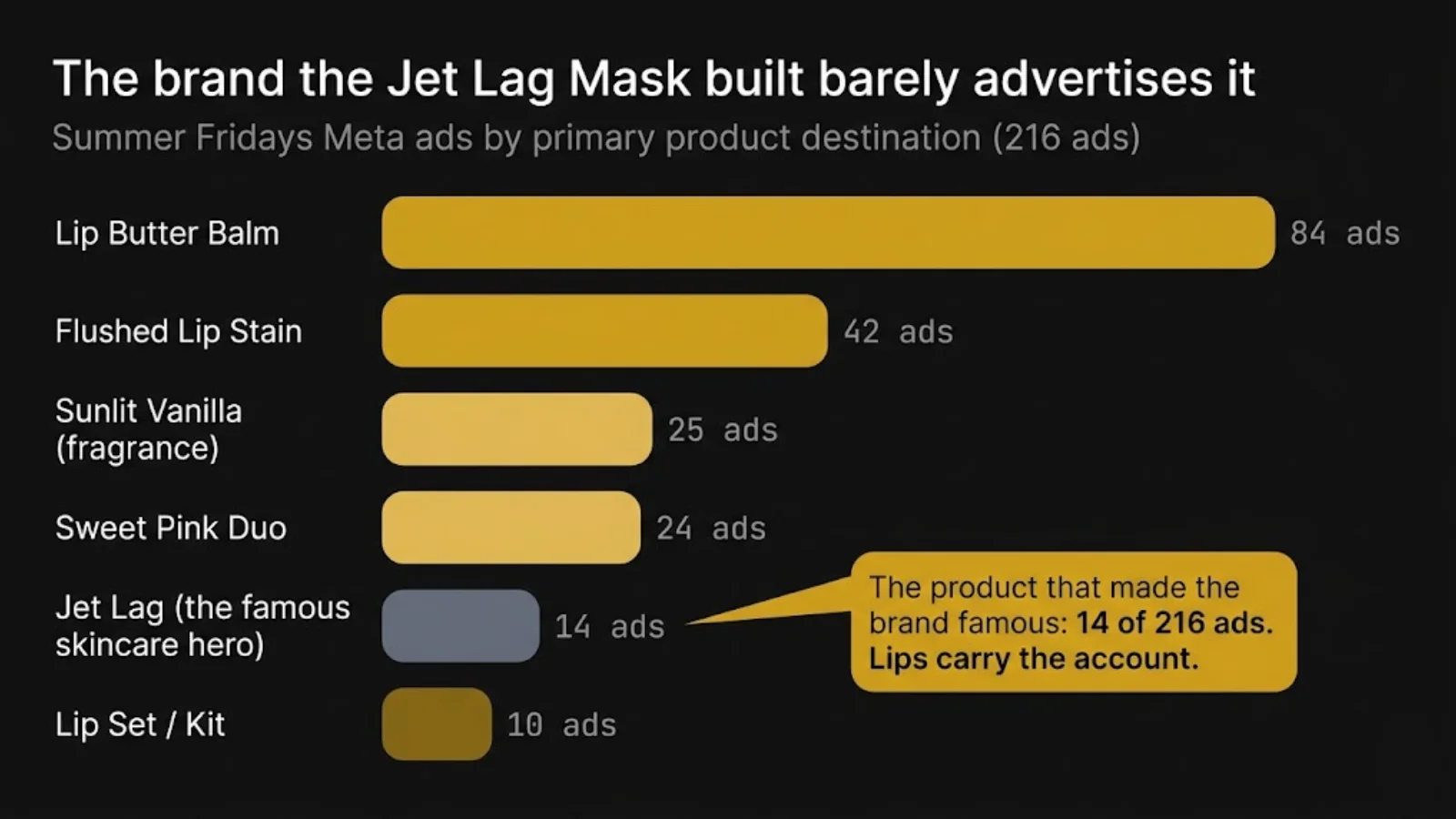
80% of the account launched in a single month
The first thing the dates showed me was how new all of this is.
173 of the 216 ads - 80% - started running in April 2026, the same month I scraped. Broken down by week: 69 launched in one week, 57 in another, 41 in a third. The median ad in the account is 15 days old. The single oldest survivor dates to October 2025 - the only ad older than six months.
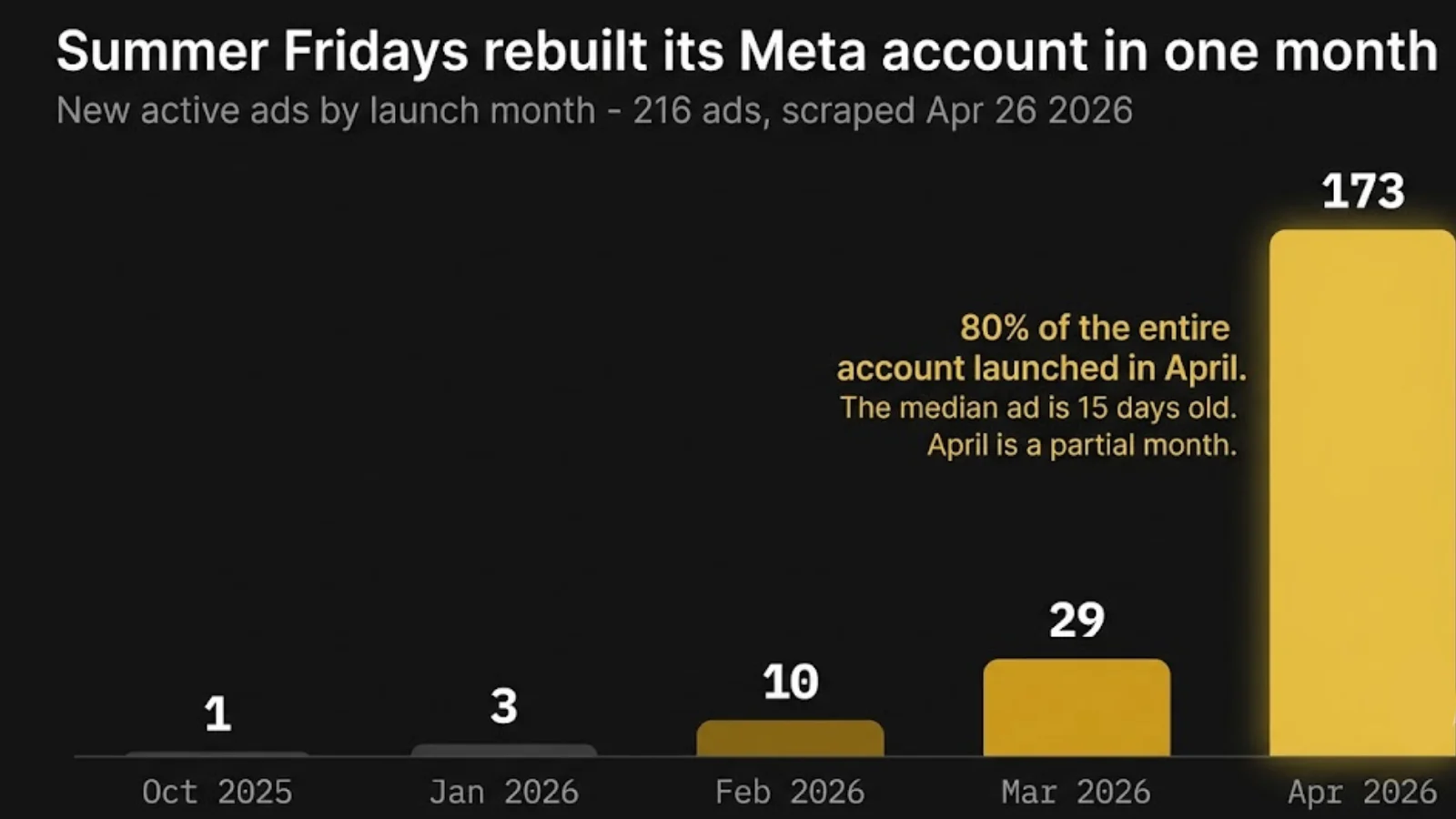
This isn't an evergreen account that's been compounding for years. It's a deck that was cleared and rebuilt at scale, right now. My hunch is a Q2 creative reset built around the spring drops and the new fragrance, not steady-state spend - but the timestamps only prove the surge, not the reason behind it.
Two-thirds of the account was built by the catalog, not a designer
When I broke the 216 ads down by format, the split was 140 DCO (65%), 39 image, 36 video, and 1 DPA.
DCO is Dynamic Creative Optimization. You hand Meta a product feed and a set of assets, and the algorithm assembles the ad at delivery. I can show you the proof inside the data: 140 of the ads have a body text that literally reads {{product.brand}} and a title that reads {{product.name}}. Those aren't errors in my scrape - they're template variables that get filled from the catalog at the moment someone sees the ad.
So for two-thirds of the account, Summer Fridays isn't writing the ad copy. The feed is.
Most of these are tight four-card units: 102 of the 141 carded ads run exactly four cards.
They lock the words and test the merchandising
What surprised me more than the DCO share was how few distinct messages sit underneath it.
Across all 216 ads, there are only 25 unique body texts, and most of those are the {{product.brand}} template. The real variation lives in the card titles, and every one of them is framed as a launch or a restock:
- "NEW! Toasted Marshmallow" - 177 cards
- "Lip Stains are Back" - 106
- "NEW! Sweet Pink Duo" - 66
- "Back in Stock" - 57
- "Sunlit Vanilla Fragrance" - 45
- "NEW! Jumbo Pack: 15 Pairs" - 43
- "Subscribe + Save" - 20
- "NEW! SoftLine Lip Liner" - 16
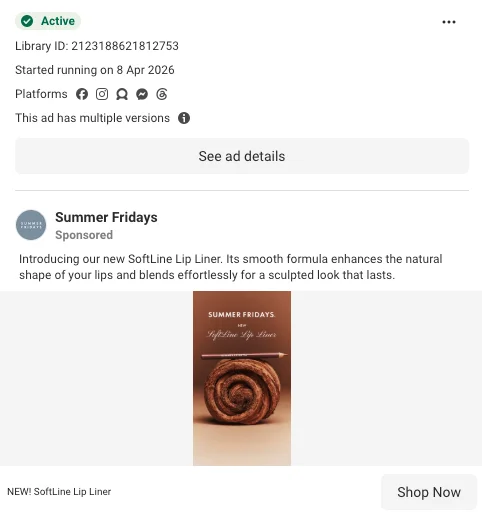
This is the same move I've watched RYZE, Our Place, and Little Sleepies make. Settle on the messaging, stop rewriting it, and push the testing into which product and which framing the catalog serves. The words are fixed. The merchandising is the variable.
The whole account runs on limited-edition drops
If there's one word that defines the copy, it's "limited."
It appears 285 times across the account's text. "New" appears 459 times, and "back" 351. The single most-pushed product is Lip Butter Balm Toasted Marshmallow - sent to 76 ad destinations and 177 card titles - and it's framed every time as a limited-edition flavor that's "back - for now."
This is Summer Fridays doing in paid what they're known for in organic: manufacturing scarcity on flavors rather than cutting price. Hot Cocoa gets the same treatment - "back - for now."
Flushed Lip Stain gets it too, except there the scarcity is about inventory rather than a new SKU. "Lip Stains are Back" runs on 106 card titles, "Back in Stock" on 57. They're treating a restock like a launch.
The only discount in the account is a subscription
I went looking for the wall of percentages I expected from a beauty brand running 216 ads. It isn't there.
"Sale" appears zero times. "Code" appears zero times. Every "% off" and "save" in the account traces back to one mechanic: "enjoy 15% off" through Subscribe + Save, the auto-delivery program (20 cards point at the subscription page).
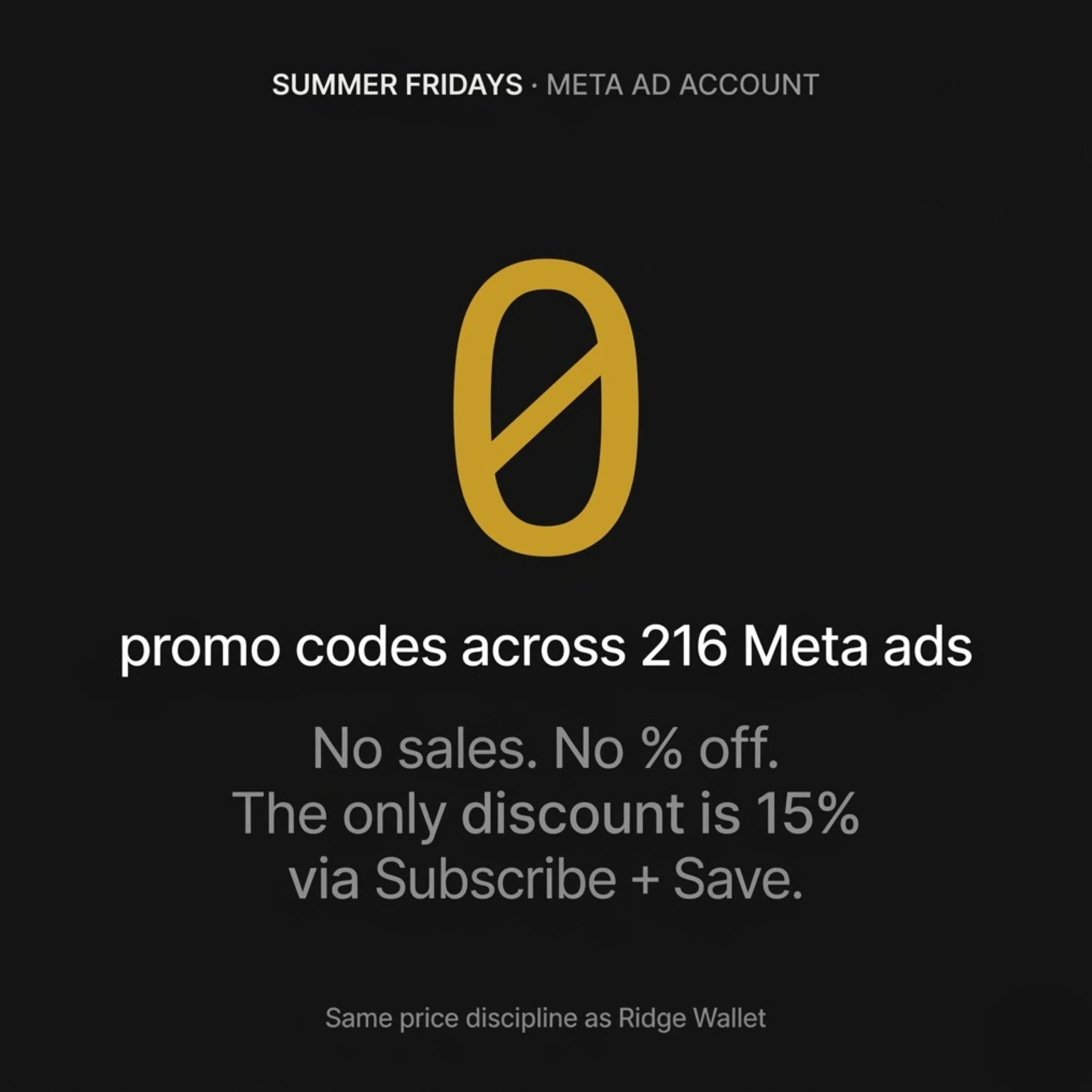
So a sub-$40 lip brand is running a subscription engine and treating it as the only place a discount lives. This is close to the Ridge Wallet posture - sell on product and scarcity, protect the price, never train the customer to wait for a sale. Hold onto it, because it doesn't survive the move to Google. More on that in the next article.
Creator video is walled off for the new fragrance
Most of the account is polished brand copy. But 14 ads are flagged as branded content - real creator partnerships - and they behave completely differently from everything else.
All 14 are video. All of them are TikTok-native: lowercase, emoji, hashtags like #perfumetiktok and #vanillaperfume, each ending in the "ad" disclosure. And they're pointed almost entirely at one thing - 10 of the 14 push Sunlit Vanilla, the new perfume, and the other 4 push a lip set.
The format-by-product breakdown backs it up. Sunlit Vanilla runs 10 video ads out of 25. Flushed Lip Stain runs 1 video out of 42. Jet Lag runs 2 out of 14.
The read is obvious, but I'll mark it as mine: the established products get the brand's own polished voice, and the unproven new category - fragrance - gets borrowed creator credibility instead. The thing they're least sure of is the thing they hand to creators.
The ads point people to Sephora, not just their own site
One detail in those creator videos stopped me. They don't all send you to summerfridays.com.
The copy repeatedly says "Available @sephora" alongside "Available at SummerFridays.com." The brand handle @summerfridays is tagged 14 times; @sephora shows up 6 times. So Summer Fridays is comfortable spending Meta budget to drive sell-through at a retail partner, not only at its own checkout.
For a brand that started as pure DTC, that's a real signal of where the business actually sits now.
Sunlit Vanilla is a dated, coordinated category bet
Pulling the creator copy together, the fragrance launch even self-dates: "available march 17th."
Fragrance is a brand-new vertical for a skincare-and-lip company. And it's the single product getting the full treatment - creator video, hashtags, and Sephora co-marketing all at once. Everything about how it's being advertised says this is the account's new bet, not a side release.
Price only shows up to justify a bundle
Summer Fridays leads with product, not price.
Dollar figures barely appear, and when they do, they're almost always attached to a set. $38 and $48 show up as single-product anchors (74 mentions each). The larger numbers are bundle math: the Neapolitan Lip Trio is sold as "three sweet shades... for $60 ($72 value)," and another set anchors at $50. They only reach for a number when there's a bundle to make look like a deal.
One button, every ad
Worth one line on its own: all 216 ads use the exact same call to action - "Shop now." No "Learn More," no "Sign Up," no exceptions. The same monolithic CTA I found across all 273 of Ridge's ads and the whole Our Place account. They treat the button as a solved variable.
Placement is just as uniform - 215 of 216 ads run the full Audience Network + Facebook + Instagram + Messenger + Threads combo, with no segmentation. They let Meta optimize across everything.
What the data showed
- 216 active Meta ads, and 80% of them launched in April 2026. The account was rebuilt in one month. Median ad age: 15 days.
- The Jet Lag Mask that made the brand famous appears in only 14 ads. Lip Butter Balm (84) and Flushed Lip Stain (42) carry the account. It's a lip account now.
- 65% of the account is DCO, with the product feed writing the copy (
{{product.brand}}) and four-card units doing the work. - Only 25 unique body texts across 216 ads. The words are locked; the merchandising is what's tested.
- The account runs on limited-edition drops - "limited" appears 285 times. Toasted Marshmallow is the single most-pushed product, framed as "back - for now."
- Zero promo codes. Zero sales. The only discount is 15% off via Subscribe + Save - the same price discipline Ridge Wallet runs.
- All 14 creator/UGC video ads push the new fragrance (10) or a lip set (4). The new category gets borrowed creator credibility; the hero products get brand copy.
- The ads drive traffic to Sephora as well as DTC - an omnichannel tell stated right in the creative.
- Sunlit Vanilla (perfume) is the coordinated new bet, dated to a March 17 launch.
- Price appears only to justify bundles (Neapolitan Trio "$60 ($72 value)").
- 100% "Shop now" across all 216 ads, full-placement blanketing, no segmentation.
Summer Fridays' Meta account holds together as one story: a brand-new, drop-driven, no-discount account that has quietly turned a skincare company into a lip-and-fragrance launch machine.
Then I scraped the Google ads, and the picture flips. The Jet Lag skincare that's nearly absent here becomes the oldest, most evergreen thing they run. The discounts they refuse on Meta reappear as a 20%-off sitewide sale with a promo code. And the brand starts answering search queries about eczema and tired eyes. Same brand, same month, advertising like a different company.
That's the next teardown.
I'm tearing down a D2C brand every week. If there's a brand you want me to break down, DM me on X.
Share this teardown
Read Next
Summer Fridays Won't Discount on Meta. On Google They Run a 20%-Off Sale.
399 Summer Fridays Google creatives: 20% off 'BDAY' code after zero discounts on Meta, the Jet Lag Mask running since 2023, and 34 countries after US-only.
Cozy Earth Hides the Word "Bamboo" on Meta and Shouts It on Google
418 Google creatives: luxury in 61% of copy, bamboo in 35%, Oprah in 6 search ads, a 10-year warranty Meta never mentioned, and Black Friday discounts up to 40%.
I Scraped 369 Cozy Earth Ads. The Whole Account Points at One Sunday in May.
369 Cozy Earth Meta ads, every one of them from 2026. 58% built by the algorithm, a third pointing at Mother's Day, zero Oprah mentions, and a $5,000 sweepstakes running quietly underneath.